PART 2: My brother tried to seize our father’s timberland with a forced deed, unaware the document he made me record held a devastating trap.
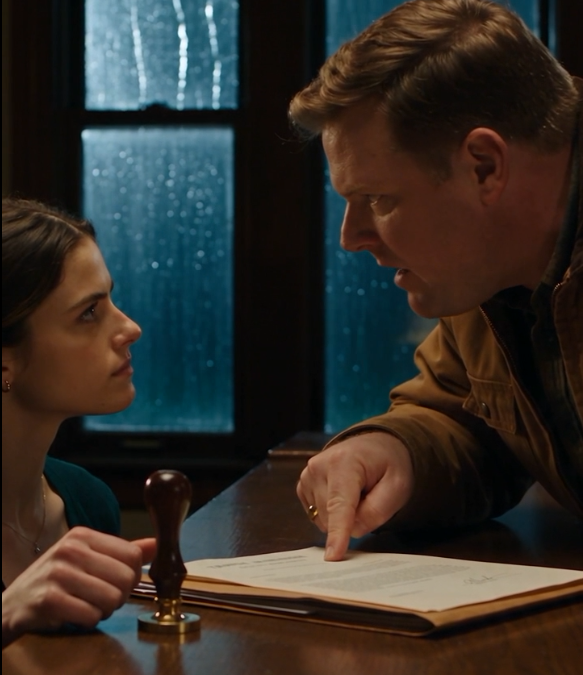
My brother tried to seize our father’s timberland with a forced deed, unaware the document he made me record held a devastating trap.
Chapter 2 — The Walhonding Covenant
I stood over the yellowed parchment of Deed Book 412, listening to the muffled drone of Bradley’s boots pacing outside the vault.
The ink on Page 88 was faded walnut sepia, preserved beneath fifty-pound rag paper that crackled like dry leaves under my fingertips.
Forty years ago, our father had stood before County Recorder Arthur Vance and entered a formal severance into the permanent land records of the state.
He had separated the eighty-four-acre ancestral tract into two distinct legal parcels, each carrying its own independent chain of title.
Parcel A encompassed eighty-one and a half acres of ancient upland hardwood, the spring-fed riverbank, and the three-story timber-frame water mill.
Parcel B consisted of precisely two and a half acres of scrub gravel, located in the swampy drainage ditch where the old railroad siding met County Road 41.
The handwritten description stapled to Bradley’s quitclaim deed copied Dad’s surveyor notes word for word, beginning at an iron pin found in the limestone culvert.
Those calls did not cross the river, and they never climbed the ridge into the timber.
Bradley had seized fee simple title to the roadside drainage ditch, leaving every single oak tree on the mountain untouched.
I closed the heavy ledger with a dull thud that echoed against the steel roller shelves.
When I stepped back through the swinging oak security gate, Bradley was checking his heavy gold wristwatch with an irritated scowl.
“Time is up, Clara,” attorney Cooper declared, pointing a blunt finger at the wall clock above the grantor indexes.
“Four o’clock has arrived, and you have completed your inspection.”
“Stamp the instrument or we will walk directly into Judge Hallowell’s chambers for an emergency citation.”
“Are you certain this is the exact conveyance you wish recorded on the permanent record?” I asked Bradley, holding his gaze across the marble countertop.
“You are not talking your way out of this,” Bradley laughed, leaning in close enough that I could smell peppermint chewing gum and stale diesel fuel.
“Every foot of land Dad owned belongs to me now.”
“You had thirty years to build a real career, but you chose to hide out in Dad’s woods making wooden spoons.”
“Now the woods are mine, the mill is getting scraped, and you are moving out.”
I did not answer him.
I picked up the heavy Bates numbering machine, checked the purple ink ribbon across its steel numbering wheels, and positioned the paper on the felt strike pad.
I pressed down hard with the heel of my right hand.
The machine let out a sharp, metallic snap that resonated through the quiet office.
Across the top margin of Bradley’s quitclaim deed, the purple die pressed six crisp digits into the cotton fiber: Instrument Number 2024-004819.
“Sixty-eight dollars accepted,” I said evenly, sliding his four twenties into the cash register and counting out twelve dollars in change.
“Here is your certified recording receipt, Document Number 2024-004819, filed at four-o-two in the afternoon.”
Bradley snatched the receipt off the counter and stuffed it into his leather jacket pocket.
Then he reached into his breast pocket, pulled out a folded white legal document, and slapped it down where the money had been.
“Thirty-day notice to quit and vacate,” Bradley said, his grin stretching across his sunburned cheeks.
“I have a timber harvesting crew pulling skidders onto the property at seven o’clock Monday morning.”
“If your personal truck and your woodworking chisels are not off that parcel by dawn, the loggers will bulldoze the shed with everything inside it.”
“Have a wonderful weekend, Clara,” Dale Cooper added with a mock tip of his head.
The two men pushed through the double glass doors of the recorder’s office, their boots clicking down the marble staircase of the rotunda.
Martha Higgins walked over to my station and laid her hand gently on my wrist.
“Clara, honey,” Martha whispered, her forehead furrowed with genuine worry.
“Why did you stamp it?”
“We could have found an indexing irregularity to hold it until Monday morning so you could talk to legal aid.”
“Look at the parcel identification code on the auditor’s stamp, Martha,” I said, turning the deed toward her.
Martha adjusted her wire-rimmed glasses and squinted at the red transfer ink on the back flap.
“Parcel zero-one-four, dash, zero-zero-eight-two,” Martha read aloud, her eyebrows knitting together.
“Wait a second.”
“The home tract and the water mill are parcel zero-one-four, dash, zero-zero-eight-one.”
“Zero-zero-eight-two is the old gravel turnaround where the county road trucks used to dump asphalt tailings.”
“Bradley did not record a deed to the timber ridge,” I said, pointing down through the glass floor into the records vault.
“He just recorded a deed to the ditch.”
Martha let out a sharp breath, her hand flying to her mouth.
“Does he know what is buried in that ditch, Clara?”
“I am going to spend the next two hours finding out,” I told her.
When the courthouse doors locked at four-thirty, the great stone building emptied out, leaving only the hum of the air handlers and the sweep of the janitor’s broom in the hall.
I carried my flashlight down the spiral iron stairs into the lowest basement level of the deed repository, where the county kept the miscellaneous records and environmental liens.
In Ohio county government, the recorder preserves land conveyances, but the auditor and the county commissioners preserve the debts and special assessments that run with the land.
I pulled open the metal drawer marked Commissioners’ Journal, 1991.
Inside was a heavy red folder stamped with the seal of the Ohio Environmental Protection Agency.
I sat on a wooden step-stool beneath a bare fluorescent bulb and turned the brittle yellow pages.
Thirty-three years ago, in the autumn of 1991, my brother Bradley was nineteen years old and running an unlicensed industrial waste hauling business with an old dump truck.
To save disposal fees at the certified landfill in Zanesville, Bradley had hauled sixty drums of toxic trichloroethylene degreaser and spent industrial solvents from an electroplating shop in Akron.
He had dumped all sixty drums into the gravel pit along County Road 41, right on the boundary of our family’s property.
When the Ohio Department of Natural Resources discovered the leaking drums contaminating the runoff into the Walhonding River, the state prepared criminal indictments for hazardous waste dumping.
Our father had stepped in to protect his reckless son from a ten-year prison term.
Dad had agreed to an administrative consent decree with the Coshocton County Commissioners and the Ohio EPA.
Under the terms of the 1991 settlement, the criminal charges were dropped, but a permanent environmental remediation judgment of five hundred and twelve thousand dollars was assessed against the land.
Dad had deeded the gravel pit into a separate tax parcel—Parcel B—so the contamination lien would not touch the family farm or the mill.
Because Dad remained the owner of record and monitored the test wells on the perimeter every spring, the county commissioners had agreed to stay collection of the judgment during his lifetime.
Then my eyes caught the acceleration clause on page fourteen of the consent order.
“Upon any voluntary sale, transfer, or quitclaim conveyance of fee simple title in Parcel B to any third party or heir, the stayed assessment shall immediately accelerate.”
“The entire sum of five hundred and twelve thousand dollars, together with statutory interest, shall become immediately due and payable by the grantee of record.”
Dad had known that Bradley would never stop trying to steal the timber ridge.
Dad had known Bradley would bully an old man in a nursing home, draft a cheap deed, and try to grab the land without ever paying a title company to examine the chain of ownership.
Dad had handed Bradley the exact legal description of the toxic gravel pit, disguised under the vague title of the old homestead survey.
By rushing to the counter and forcing me to stamp that deed into the public record before probate opened, Bradley had legally assumed sole personal liability for the half-million-dollar EPA cleanup.
A cold draft swept through the basement vault, rattling the security grates.
My heart pounded with fierce relief, but a deeper dread settled over me as I climbed the stairs into the empty lobby.
Bradley was an aggressive contractor with four excavators, six dump trucks, and a crew of men who did whatever he told them.
He did not know he owned the ditch; he believed he owned the mountain.
And at seven o’clock on Monday morning, the chainsaws would be running on the Walhonding ridge before anyone could show him a court order.
Friday night brought an early frost that turned the pumpkin fields silver across the valley.
I spent Saturday morning in the miller’s cottage, packing Dad’s hand-turned wooden bowls and our mother’s quilt collection into cardboard boxes.
My sixteen-year-old daughter, Lily, knelt by the stone fireplace, wrapping antique brass cabinet latches in old newsprint.
“Mom, are we really going to lose the mill?” Lily asked, her voice cracking as she held up a hand-carved maple bowl Dad had turned for her tenth birthday.
“We have lived here since I was in sixth grade.”
“We are not going to lose it, baby,” I said, kneeling beside her and pulling her into my arms.
“Your grandfather was the smartest surveyor in this county, and he built a fence around this place that no bulldozer can break.”
Just before noon, a loud diesel engine rumbled down the dirt lane, shaking the glass panes in the kitchen window.
A yellow Caterpillar backhoe with Bradley’s company logo emblazoned on the arm swung off the road and dropped its steel front bucket into our gravel driveway.
The operator, a burly man named Wayne who had worked for Bradley for ten years, began digging a deep trench directly across our only exit.
I ran out onto the porch in my work boots and flannel shirt, the cold autumn wind whipping my hair across my face.
“Wayne, stop that machine right now!” I yelled over the roar of the diesel engine.
Wayne throttled the motor down to an idle and leaned his arm out of the cab window.
“Sorry, Clara,” Wayne called out, chewing on an unlit cigar.
“Bradley called me an hour ago and told me to cut the private water line from the mill spring.”
“He said you were trespassing on commercial timber land and had twenty-four hours to abandon the structure.”
Behind the backhoe, Bradley’s silver Ford F-350 pulled up on the grass, crushing the wild aster beds Dad had planted along the fence.
Bradley stepped down from the running board, wearing a heavy canvas coat and a bright orange hunting cap.
“I told you Monday, Clara, but I decided I did not want you snooping around my timber all weekend,” Bradley shouted, walking toward the trench with a satisfied smirk.
“The water is shut off, the lane is blocked, and the logging flatbeds are staging at the crossroads right now.”
“You are digging up an easement that does not belong to you, Bradley,” I said, standing on the edge of the stone porch.
“This cottage is located on Parcel A, and you do not own a single square inch of it.”
Bradley threw his head back and laughed, a loud, barking sound that echoed against the wooden siding of the mill.
“Keep dreaming, little sister,” he sneered.
“Dale Cooper pulled the auditor’s duplicate on his phone this morning.”
“The Vance homestead is transferred to Bradley Vance on the county computer system.”
“You stamped the paper yourself with your little purple clock.”
“If you are not off this dirt by tomorrow night, I will have the sheriff escort you to the county line in handcuffs.”
He climbed back into his pickup, slammed the door, and sprayed gravel against the porch railing as he peeled away toward town.
Inside the cottage, the kitchen faucet sputtered and went dry with a hollow sucking sound.
Lily stood by the dry sink, tears cutting pale tracks through the dust on her cheeks.
“Mom, please,” she whispered.
“What are we going to do?”
“We are going to visit the county auditor,” I said.
At eight o’clock on Monday morning, forty-five minutes before the courthouse opened to the general public, I stood inside the private office of Frank Sterling.
Frank was sixty-one years old, a retired civil engineer who had served as Coshocton County Auditor for sixteen years.
His office was lined with aerial topography maps, parcel cadastral surveys, and shelves of blue tax duplicate ledgers.
On his mahogany conference table, I laid out four certified documents from the county archives.
The first was Deed Book 412, Page 88, showing the 1982 parcel severance.
The second was Deed Book 704, Page 312, recorded in May of 2019, which conveyed Parcel A into the Thomas Vance Heritage Trust, naming me as sole trustee.
The third was the 1991 Environmental Protection Agency consent decree from the Commissioners’ Journal.
The fourth was Bradley’s recorded quitclaim deed, bearing my Bates stamp from Friday afternoon, alongside the conveyance fee declaration signed by Bradley under penalty of perjury.
Frank put on his reading glasses and traced the metes-and-bounds calls on Exhibit A with a mechanical pencil.
He compared the bearings to the digital parcel map on his dual-screen monitor.
“Well, I’ll be damned,” Frank muttered under his breath, leaning back in his swivel chair until the springs groaned.
“Bradley thought he was pulling a fast one on the probate court.”
“He used the parcel number from the old ditch tax bill because that was the only tax notice that still went to your dad’s physical mailbox,” Frank said, tapping the screen with his pencil.
“The tax statements for Parcel A have been billed directly to the Trust at your post office box for five years.”
“Bradley never bothered to run a title search or hire an abstractor,” I explained.
“He told his lawyer that Dad owned the whole farm outright, so they simply copied the description off the only tax paper Bradley found in Dad’s desk.”
Frank picked up the 1991 EPA consent order and read the acceleration clause on page fourteen.
A slow, grim smile spread across the auditor’s weathered face.
“Clara, the county commissioners have been trying to figure out how to fund the remediation of that toxic rail siding for twenty years,” Frank said.
“The federal EPA has been threatening to cut off our regional water infrastructure grants if that site isn’t cleaned up by next summer.”
“Your father’s stay of execution was strictly personal to him.”
“The moment Bradley signed this conveyance fee statement swearing he had acquired fee simple title to Parcel B, that stay dissolved.”
“He owes the county treasury five hundred and twelve thousand dollars, plus statutory interest, effective Friday at four-o-two in the afternoon.”
“Can you enforce it right now, Frank?” I asked.
“The timber skidders are already at the gate.”
Frank picked up his desk telephone and dialed a three-digit extension.
“Get Sheriff Cole in here immediately,” Frank told the receiver.
“And tell him to bring two cruisers and a commercial vehicle inspection officer.”
At eight-forty-five, the low autumn sun broke through the gray clouds, casting long golden shadows across the Walhonding River valley.
At the main entrance to the Vance Mill, three massive tractor-trailers carrying John Deere timber feller-bunchers sat idling along the shoulder of County Road 41.
Their air brakes hissed in the cold morning air, their diesel exhaust hanging thick over the frosted weeds.
Gene Kowalski, the owner of Buckeye Timber Products, stood by the heavy iron gate with a pair of three-foot bolt cutters in his gloved hands.
Bradley stood beside him, drinking coffee from a travel mug, pointing up the wooded ridge with an arrogant grin.
Dale Cooper was leaning against the fender of his sedan, reviewing a clipboard of legal contracts.
“Cut the chain, Gene,” Bradley ordered, waving his coffee mug toward the padlock.
“I have the recorded deed right here in my briefcase.”
“If anybody tries to interfere, my lawyer will have them cited for obstructing commercial commerce.”
“Hold on a minute, Bradley,” Kowalski said, pausing with the jaws of the bolt cutters resting against the steel chain.
“Somebody is coming up the lane fast.”
Two Coshocton County Sheriff cruisers rounded the bend with their amber and blue lightbars flashing, followed closely by Frank Sterling’s county auditor sedan.
The gravel crunched violently as the cruisers pulled across the driveway, blocking the logging trucks from the gate.
Sheriff Cole stepped out of the first vehicle, wearing his brown uniform jacket and adjusting his utility belt.
Frank Sterling and I stepped out of the auditor’s car.
Bradley’s face darkened from cocky amusement to furious irritation.
“What is this, Clara?” Bradley demanded, marching toward the police cruiser with his arms spread wide.
“You called the sheriff because you cannot accept that you lost?”
“Sheriff, I want this woman removed from my property immediately.”
“I am the legal owner of this eighty-four-acre tract, and I have a recorded deed stamped by her own office on Friday afternoon.”
“Nobody is cutting this gate yet, Bradley,” Sheriff Cole said in a calm, authoritative voice.
“Auditor Sterling has requested an emergency boundary and title verification on this parcel.”
Dale Cooper stepped forward, waving his clipboard aggressively in the sheriff’s face.
“This is outrageous government overreach!” Cooper yelled.
“The deed was recorded under Ohio Revised Code Chapter 317!”
“Under the state’s race-notice recording statutes, a recorded quitclaim instrument establishes priority of title over any unprobated estate claims!”
“Miss Vance herself executed the recording stamp!”
“You cannot invalidate an official public record with a roadside traffic stop!”
Frank Sterling stepped forward, opening a thick blue leatherette portfolio.
“Nobody is invalidating your deed, Mr. Cooper,” Frank said, his voice flat and professional.
“The deed is completely valid, legal, and permanently recorded.”
“The problem is that neither you nor your client ever bothered to read the surveyor’s description you filed.”
Bradley let out a harsh laugh.
“What are you talking about?” Bradley snapped.
“The deed says right on the heading: ‘All lands and timber rights of the Vance Homestead Parcel’!”
“Headings carry zero legal authority in the State of Ohio, Mr. Vance,” Frank replied, holding up the certified plat map.
“In real estate conveyancing, the specific metes-and-bounds survey governs all transfers.”
“Your deed begins at the limestone culvert on County Road 41 and runs south along the old rail spur for six hundred feet.”
“It describes Parcel 014-0082.”
“That is the two-and-a-half-acre gravel drainage ditch where you are currently standing with your coffee mug.”
Bradley froze, his coffee cup tilting slightly until black coffee dribbled over his knuckles.
“What?” Bradley stammered, his face turning an ash-gray color beneath his hunting cap.
“No, that’s impossible.”
“Dad owned the whole eighty-four acres!”
“He did,” I spoke up, looking my brother directly in the eyes.
“And five years ago, Dad deeded Parcel A—the entire timber ridge, the river frontage, the mill, and my cottage—into the Thomas Vance Heritage Trust.”
“That warranty deed was recorded in Book 704, Page 312.”
“I am the sole trustee, and the timber rights are legally protected under a permanent agricultural conservancy covenant.”
“You don’t own the trees, Bradley.”
“You own the ditch.”
Gene Kowalski dropped the bolt cutters onto the asphalt with a loud clang.
“Wait a damn minute,” Kowalski said, rounding on Bradley with his face flushed red.
“You took a fifty-thousand-dollar cash advance from my timber company on Friday afternoon!”
“You signed an affidavit of timber ownership swearing you held merchantable title to the white oaks on this ridge!”
“I have three logging crews on the clock at twelve hundred dollars an hour!”
“It’s a mistake!” Bradley shouted, panic creeping into his voice as he looked wildly between his lawyer and the sheriff.
“Dale, tell them it’s a mistake!”
“If the description was wrong, the deed is null and void!”
“I reject the deed!”
“I rescind the conveyance!”
“You cannot rescind a recorded conveyance across the hood of a police car, Mr. Vance,” Frank Sterling stated, pulling a sealed white envelope from his binder.
“You signed the county conveyance declaration under penalty of perjury.”
“You paid the statutory transfer tax.”
“And by accepting fee simple title to Parcel B, you triggered the immediate acceleration clause under the 1991 Ohio Environmental Protection Agency consent decree.”
Frank handed the heavy white envelope to Bradley.
Bradley’s hands shook so badly that the envelope fell against his work boots before he could catch it.
“What is this?” Bradley whispered, his voice cracking.
“That is a formal demand from the Coshocton County Treasurer and the Board of County Commissioners,” Frank said.
“Under the 1991 consent order for the toxic trichloroethylene dumping on Parcel B, the stayed judgment of five hundred and twelve thousand dollars is now fully accelerated against the current owner of record.”
“You have thirty calendar days to tender full payment to the county treasurer.”
“If payment is not received by November twenty-eighth, the county prosecutor will file an immediate tax foreclosure and attach liens to your personal contracting business, your equipment fleet, and your commercial bank accounts.”
Bradley stared at the paper in horror, his breath coming in shallow, ragged gasps.
“Five hundred thousand dollars?” he croaked.
“Dad settled that thirty years ago!”
“Dad protected you thirty years ago, Bradley,” I said, stepping close enough to see the sheer terror in his eyes.
“He took the blame so you wouldn’t go to prison when you were nineteen.”
“He carried that debt on his shoulders for forty years so you could build your excavation business.”
“And when he was dying in the nursing home, you repaid him by shoving a quitclaim deed in his face while he was too weak to push your hand away.”
“Dad knew who you were, Bradley.”
“He knew you were too cheap to pay for a title search, and he knew you would never read the survey.”
“He gave you exactly what you deserved.”
Gene Kowalski was already pulling his cell phone from his pocket, barking orders at his lowboy drivers.
“Turn the rigs around!” Kowalski shouted into the phone.
“Cancel the harvest!”
“We’re hauling the equipment back to Canton right now!”
Kowalski turned back to Bradley, poking a thick finger into Bradley’s chest.
“I want my fifty-thousand-dollar deposit wired back to my corporate account by five o’clock today, Bradley,” Kowalski growled.
“If that wire doesn’t clear, my corporate counsel will file a criminal fraud complaint with the state attorney general before breakfast tomorrow.”
Dale Cooper took two steps back toward his car, quietly gathering his briefcase and closing his clipboard.
“Dale!” Bradley yelled, spinning around toward his lawyer.
“Where are you going?”
“Do something!”
“I am withdrawing as your counsel of record, Bradley,” Cooper said, his voice flat and devoid of any courtroom swagger.
“You provided false property representations to my office, and you induced me to threaten public officials with a frivolous mandamus action.”
“I am not losing my license to practice law over your family feud.”
Cooper climbed into his sedan, started the engine, and backed out onto the highway without waiting for another word.
Within ten minutes, the logging flatbeds had rumbled away into the distance, their diesel roars fading behind the timber ridge.
Bradley was left standing alone in the churned gravel of the drainage ditch, clutching the county demand letter against his chest.
Sheriff Cole stepped up to Bradley’s side and pointed down the lane toward the highway.
“Mr. Vance, your equipment operator dug a trench through an unsevered county right-of-way on Saturday,” Sheriff Cole said.
“You have until five o’clock this afternoon to bring your backhoe down here, fill that trench, and restore Miss Vance’s water line.”
“If that trench is not repaired by sunset, I will personally cite you for criminal mischief and county road obstruction.”
Bradley did not argue.
He did not look at me.
He climbed into his truck, his head slumped down against the steering wheel, and slowly backed away down the road.
By Tuesday morning, the October weather had cleared, leaving the sky over Coshocton County a sharp, brilliant blue.
The trench in our driveway was filled and leveled, and clean spring water flowed once more through the copper pipes of the miller’s cottage.
At eight-thirty, I walked through the double doors of the Coshocton County Courthouse, hung my wool coat on the brass coat rack, and took my seat behind the recording counter.
Martha Higgins smiled at me from her desk, sliding a warm ceramic mug of black coffee onto my blotter.
“Morning, Deputy Clerk Vance,” Martha said softly.
“Good morning, Martha,” I replied.
On the polished oak counter before me sat our heavy cast-iron Bates numbering machine, its nickel plating catching the morning sun through the arched limestone windows.
I ran my thumb across the smooth steel frame, listening to the quiet rhythm of the courthouse waking up for another day of public business.
Across the valley, three miles away on the Walhonding River, the massive wooden wheel of our great-grandfather’s mill turned steadily in the cold current, anchored deep in the earth our father had protected with his life.