A Newborn’s Wristmark Shook the Maid—Then the Wealthy Father Asked the Question She Feared Most
Chapter 1: The Baby in the Marble Hall
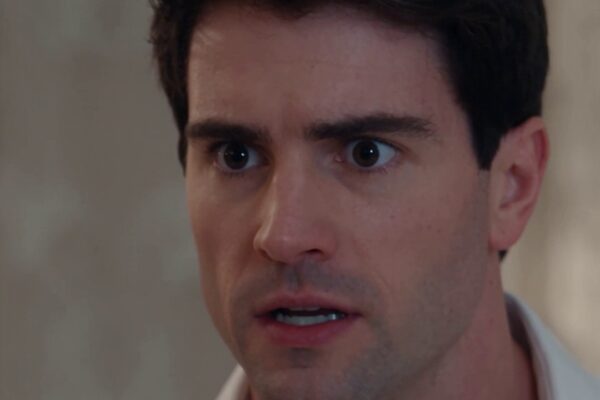
Lucas Vale was crying hard enough to echo beneath the chandelier. Adrian held him awkwardly against his white shirt as Emma Reed approached in her burgundy dress, its white collar and sleeve trim bright against the dark fabric. Daylight poured through the tall windows, glancing off cream marble and the white-and-gold furniture.
“He won’t stop,” Adrian said. The open collar of his shirt was rumpled, and his free hand hovered helplessly near the baby’s blanket. “I’ve tried everything.”
“Let me try.”
At twenty-eight, Emma had soothed children through fevers, nightmares, and tantrums. She had never seen Adrian look so lost. He shifted the weeks-old infant toward her, and Emma took him carefully, supporting his head against her shoulder.
The grand staircase curved behind them beneath the high ceiling. Lucas kept crying, his tiny face pinched, his bare arms moving restlessly. Emma swayed gently and murmured to him, but his cries filled the hall all the same.
“Hey, sweetheart,” she whispered. “I’ve got you.”
She tried a slow, steady rhythm, holding him close against her chest. When his arm slipped awkwardly beneath the edge of the blanket, she adjusted it so he would be more comfortable.
Then she saw the mark.
A round brown birthmark sat on the inside of his wrist, distinct as a coin.
Emma stopped breathing.
For one suspended second, the bright marble hall seemed to tilt. Her fingers went still against Lucas’s sleeve. The baby’s cry carried on beside her ear, but she barely heard it. Tears gathered in her eyes before she could stop them.
Adrian noticed. “What?”
Emma turned the baby’s wrist a little, looking again. The mark was unmistakable. Lucas cried on against her chest, unaware of the shock passing through her.
“Emma,” Adrian said, quieter now. “What’s wrong?”
She couldn’t answer. Not yet. Her mother had carried that same unusual mark. So had Anna, Emma’s older sister. Emma had a smaller one herself, tucked near her shoulder. The memory rose with painful clarity: Anna’s wrist beside hers, the familiar circle whenever her sister pushed up her sleeves.
“Why are you looking at him like that?” Adrian asked.
Emma blinked hard and tried to steady her voice. “Where was he born?”
“St. Anne’s. He’s my son.” Adrian’s brow tightened. “You know that.”
“I know.”
“Then what are you asking?”
She held Lucas closer. His crying softened to hiccups, then rose again. Emma looked down at his wrist, at the mark that had belonged to the women she loved.
“What do you need to know?” Adrian asked.
She raised her eyes to his. “Who’s his mother?”
“Claire.”
The name drained the warmth from Emma’s face. She looked back at the mark, then at Adrian.
“Emma. What do you know?”
“My sister had that exact mark,” she whispered.
A beat.
“And she disappeared eight months ago.”
Chapter 2: The Message That Never Arrived
Adrian stared at her.
“What do you mean, disappeared?”
Lucas fussed against Emma’s shoulder. She kept one hand beneath his head and looked at Adrian across the marble hall.
“Anna stopped answering,” she said. “About eight months ago. She left her apartment, and nobody in our family heard from her again.”
“Was she missing? Did you report her?”
“We tried. The police said she was an adult and there was no evidence of a crime. Her lease was ending. Her phone went dead.” Emma swallowed. “She’d been frightened before she left. Secretive. I thought she was in trouble, but she wouldn’t tell me what kind.”
“Frightened of whom?”
“I don’t know.”
“Did she say anything about a baby?”
Emma’s arms tightened around Lucas. “I knew she was pregnant. I suspected it, anyway. She never said the words. She wore loose clothes, canceled plans, and once asked if I’d ever wanted to start over somewhere nobody knew your name.”
Adrian looked toward the staircase. “I never knew her.”
“You expect me to believe that?”
“I’m telling you what I know.”
“You work with half the city. Anna worked at one of your properties.”
“Not for me. She worked a temporary outreach job through Harbor House. The charity used a storefront we owned. I attended one fundraiser. I don’t remember meeting her.”
Emma studied his face. He looked angry, but not in the way guilty people often did. He looked frightened.
“You said Lucas was born at St. Anne’s,” she said.
“He was.”
“And Claire gave birth to him?”
“That’s what the hospital records say. That’s what Claire told me. I was there.”
Emma looked down at Lucas. “Then why does he have my sister’s mark?”
“A birthmark isn’t proof of anything.”
“I know that.”
“Do you?”
She met his eyes. “My mother had one. Anna had one. I have a smaller one. I’m not saying that makes him Anna’s baby. I’m saying it’s enough to ask.”
Lucas gave a thin cry. Emma shifted him gently, keeping his cheek clear of her collar.
Adrian reached out, then stopped. “Can I take him?”
She hesitated. This was his home. Lucas was his son, by every account she had heard before that morning. Anna was a name he claimed not to know.
Emma handed the baby over carefully. Adrian held Lucas against his chest, one palm supporting his back. The child quieted a little.
“Claire is at her sister’s,” Adrian said. “She’ll be back this afternoon.”
“Don’t tell her what I said.”
“Why?”
“I want to hear what she says without giving her time to prepare.”
His jaw set. “You’re accusing my wife of stealing a baby.”
“I’m asking why the baby has my sister’s birthmark.”
“I know what you’re asking.”
“No. You know what you think I’m asking.”
For a moment they watched Lucas. His eyelids fluttered, his cry dwindling to a restless sound.
“If your sister is alive, we find her,” Adrian said.
“And if she isn’t?”
“I’m not deciding that from a birthmark.”
“Good.”
“I’ll call the hospital and ask what I can legally access. Claire’s records are private. I won’t be able to hand them over.”
“I’m not asking you to.”
“What are you asking?”
“Don’t erase the question because the answer is inconvenient.”
He nodded once. Emma took out her phone.
“I’m calling my aunt,” she said. “She’s the last person who saw Anna before she left.”
Ruth answered on the fourth ring.
“Emma? Is everything all right?”
“Did Anna tell you where she was going?”
Silence.
“Aunt Ruth?”
“I told you what I knew.”
“You told me she’d gone to stay with a friend. You never told me she was pregnant.”
“I didn’t know that.”
“Did she ask you to keep something from me?”
A long breath. “She asked me not to look for her.”
“When?”
“Two days before she left.”
“Why?”
“She said she needed to think. She said you two had been fighting.”
Emma glanced at Adrian. He had turned slightly away, giving her privacy while keeping Lucas close.
“We were,” Emma said. “That doesn’t mean she wanted me gone forever.”
“I thought she’d call when she was ready.”
“So did I.”
The admission hurt. Emma had turned the silence into an explanation: Anna wanted distance. Anna was angry. Anna would come back when she was done punishing everyone.
“Did she tell you where she was going?”
“No. Just that she had a place to stay.”
“Did she mention a baby?”
“No.”
“Did you keep anything of hers?”
“Her old phone is in my desk drawer. It was empty when she handed it to me.”
“Can you bring it here?”
“Why?”
“Because I need to understand what happened.”
“Are you in trouble?”
“I don’t know yet.”
Ruth’s voice softened. “I’ll bring the phone.”
When Emma hung up, Adrian watched her.
“She had an old phone,” Emma said. “My aunt has it.”
“What are you hoping to find?”
“I don’t know.”
“Messages?”
“Maybe.”
He nodded. “I’ll ask the hospital what records exist and what I’m allowed to request. I’ll also have the house cameras preserved. If Anna came here, there may be something.”
“She might never have come here.”
“Then we’ll know that too.”
“You said you never met her.”
“I said I don’t remember meeting her.”
“That’s a careful distinction.”
“It’s an honest one.”
Emma had no answer. Adrian lowered his eyes to Lucas and adjusted the blanket.
“I’ll ask Claire to come home,” he said.
“You said she’ll be back this afternoon.”
“Then we wait.”
“No. You can wait. I want to talk to my aunt when she gets here.”
“Do you want me to take Lucas upstairs?”
“No. Keep him here.”
“You should sit down.”
“I’m fine.”
“You’re crying.”
“I know.”
She wiped her cheek. Lucas made a small, indignant sound.
Adrian nodded toward the sitting room. “You can make your call there.”
“Will you stay with him?”
“I’m his father.”
It was a simple answer, and something in Emma’s chest loosened despite herself.
Ruth arrived before noon with Anna’s old phone and a paper grocery bag of odds and ends: a knitted cap, a cracked hair clip, two unopened envelopes, and a snapshot of the sisters at a county fair. Emma was nineteen in the picture, Anna twenty-one. Their mother stood between them with a hand on each daughter’s shoulder.
The birthmark showed at Anna’s wrist where her sleeve had slipped back.
Emma went still.
“There,” she said.
Ruth peered over her shoulder. “What?”
“Anna’s mark.”
“Oh. I never noticed that.”
“It’s always been there.”
“Your mother had one too.”
“Exactly.”
Ruth’s face tightened. “Is that why you called?”
“There’s a baby here with the same mark. Adrian says Claire gave birth to him.”
“You think he’s Anna’s?”
“I don’t know. That’s what we’re trying to find out.”
Ruth sat slowly. “Anna told me she was going somewhere safe.”
“Did she say where?”
“No.”
“Did she say who she was afraid of?”
“No. She said she couldn’t keep doing everything alone.”
“When?”
“Just before she left.”
“Why didn’t you tell me?”
“Because she asked me not to.”
“Did you think I’d hurt her?”
“No.”
“Then why keep it from me?”
“Because you were both angry. I thought giving her the space she asked for was the kindest thing.”
Emma remembered their last argument: a kitchen table cluttered with bills, Anna accusing her of turning every favor into an obligation. Emma had snapped that Anna always made herself impossible to help. Anna had looked at her as if she’d been waiting for those words.
“Maybe I made it easy for her to leave,” Emma said.
“You were both tired,” Ruth replied.
“I was twenty-seven.”
“So was she. Old enough to be scared.”
Emma set down the photograph and examined the phone. It was an old model with a cracked corner, no SIM card, and a swollen battery. She left it on the table rather than trying to turn it on.
“Did she give it to you like this?” she asked.
“I found it in my desk after she left. Her number stopped working. I thought she’d changed it.”
Adrian appeared in the doorway. “Claire is on her way.”
Ruth stood. “You’re Adrian Vale?”
“Yes.”
“You’re the father?”
“I believe I am.”
“That sounds uncertain.”
“It’s honest.”
“And who is the mother?”
“Claire.”
“Did Anna work for you?”
“She worked at a charity using one of our properties.”
“Did you know her?”
“I’m trying to remember.”
“Try harder.”
“Ruth,” Emma said.
“I have a right to ask.”
“You do.” Emma turned to Adrian. “Did you have a relationship with Anna?”
“No.”
“Did you ever meet her alone?”
“I don’t know. I may have spoken with staff at an event. I can’t honestly say I never saw her.”
“Did you know she was pregnant?”
“No.”
“Did you have reason to think she might be?”
“No.”
Ruth folded her arms. “You expect us to take that at face value?”
“No,” Adrian said. “I expect you to verify it.”
The front door opened. Claire came into the hall without removing her coat, one hand gripping the strap of her bag.
“Adrian? You said there was a problem.”
She saw Emma and Ruth. “Why are they here?”
“I need to ask you something,” Adrian said.
“About what?”
“Lucas’s birth.”
Her gaze flicked to the baby in his arms, then to Emma. “What did you tell her?”
“Nothing about you. She recognized his birthmark.”
Claire’s face drained of color.
Emma stood. “Do you know my sister? Anna Reed?”
“I don’t know what you mean.”
“Claire,” Adrian said.
“No. I want to know what she told you.”
“Nothing,” Emma said. “I asked who Lucas’s mother was. Adrian said you.”
“I am his mother.”
“Did you give birth to him?”
Claire’s eyes moved to Lucas. “Yes.”
“Then why do you recognize my sister’s name?”
“I don’t.”
“You just went pale.”
“I’m tired.”
“That doesn’t explain it.”
Adrian’s voice hardened. “Claire, answer her.”
Claire set her bag down carefully. “Yes. I knew Anna.”
Ruth let out a sharp breath.
“How?” Adrian asked.
“Through Harbor House.”
“When?”
“Last winter.”
“And you never told me?”
“It wasn’t relevant.”
“How could Anna be irrelevant if she’s connected to Lucas?”
Claire looked at Emma. “You don’t know that she is.”
“You recognized her name.”
“I worked with many women there.”
“Did you help her?”
“Yes.”
“With what?”
“Shelter. A place to stay. Referrals. She was scared.”
“Of whom?”
“I can’t answer that.”
“Private from me, or private from Adrian?”
Claire said nothing.
“Did you know Anna was pregnant?” Adrian asked.
“I knew she was expecting.”
“You told me you didn’t know anyone connected to Harbor House who was pregnant.”
“I said I didn’t know Anna was pregnant when she came to the house.”
“That isn’t what you told me.”
“Your memory is selective.”
“Did she have Lucas?”
“I can’t prove that.”
“You can answer yes or no.”
Claire looked at Emma, and the anger faded from her face. “I believe she did.”
Emma felt her heart beat hard against her ribs. “You believe?”
“Anna gave birth at St. Anne’s.”
“And you told Adrian you did.”
“I did give birth.”
Adrian’s grip tightened around Lucas. “What?”
“I lost a baby,” Claire said.
The room went quiet.
“When?” Emma asked.
“Before Lucas.”
Adrian’s voice was barely audible. “You told me the pregnancy ended at thirty-four weeks.”
“It did.”
“Was there a baby?”
“There was a baby.”
“And you told me Lucas was that baby?”
“No.”
“Claire.”
She shook her head. “It wasn’t Lucas.”
The words entered the room like cold air.
Adrian looked down at the infant. “You let me believe he was your son.”
“I was trying to protect him.”
“From what?”
“From being taken from the only stable home he had.”
“Who was going to take him?”
“I didn’t know.”
“You don’t know that anyone would have.”
“No. I was afraid.”
Emma stepped closer. “Was Anna his mother?”
Claire shut her eyes.
“Yes.”
Ruth covered her mouth.
“How did he get here?” Adrian asked.
“Anna asked me to keep him safe.”
“When?”
“After she gave birth.”
“Were you there?”
“Yes.”
“Why?”
“Because she had no one else.”
“She had me,” Emma said.
Claire looked at her. “She didn’t think she could come to you.”
The sentence struck where Emma feared it would.
“What did you tell her about me?”
“Nothing.”
“Did she ask for me?”
Claire hesitated.
Emma’s voice broke. “Did she?”
“She asked if you were still angry.”
“And what did you say?”
“That you were hurt.”
“Did you tell her I wanted her gone?”
“No.”
“Did you tell her you’d bring Lucas to her if she needed time?”
“I said I would help.”
“That isn’t an answer.”
“I told her she could stay with me after the hospital. I said she could rest and decide what she wanted.”
“And she gave you her baby?”
“She didn’t give him to me. She asked me to keep him for a while.”
“Did she say she’d come back?”
“Yes.”
The word broke the silence.
Adrian’s jaw tightened. “And you let me believe you gave birth to him.”
“I thought it would protect him.”
“From what?”
“From becoming the center of a legal fight. From being moved between strangers. From people questioning whether Anna could care for him.”
“You don’t know that would have happened.”
“No. I was afraid.”
“Why did you do it?” Emma asked.
Claire looked at Lucas. “I had just lost a baby. I went to Harbor House because I thought helping someone else might give that loss a shape. Anna was alone and terrified. When he was born, I held him while she slept. I thought I could give them both somewhere safe.”
“You made yourself his mother.”
“I told myself it was temporary.”
“When did it stop being temporary?”
“When she didn’t come back.”
“How long did you wait?”
“Two weeks.”
“Did you call her?”
“I tried. Her number changed. I went to the apartment where she’d been staying. She was gone.”
“You didn’t call me?”
“No.”
“Why?”
“Anna said she didn’t want you involved until she could explain.”
“And you believed her?”
“I wanted to.”
“Why?”
Claire glanced at Adrian. “Because he wanted a child. Because I had lost one. Because I loved Lucas. Because every day he stayed, it felt harder to hand him back to a life I couldn’t see.”
Adrian turned away with Lucas. “What happened at the hospital?”
“Anna delivered him. Her paperwork was under her name. I was listed as her support person. Afterward, she asked if I could take him home while she recovered.”
“Did you adopt him?”
“No.”
“Did you receive guardianship?”
“No.”
“Then what right did you have to leave with him?”
“I didn’t leave with him that day. Anna did. She stayed at the shelter for a week, then came to my apartment.”
“Did she give you anything in writing?”
“No.”
“Did you call a lawyer?”
“No.”
“Did you tell the pediatrician you were his mother?”
Claire lowered her eyes.
“Did you?”
“Yes.”
“You lied to his doctor.”
“I was the person caring for him.”
“That isn’t the same,” Adrian said.
“I know.”
Emma looked at Lucas, now quieter against Adrian’s chest. “Did Anna leave him with you before or after she disappeared?”
“Before.”
“How long before?”
“About a month.”
“Then she didn’t disappear with him.”
“No.”
“Where did she go?”
“She said she needed to handle something. She said she’d be back.”
“Did you believe her?”
“I did.”
“Did you try to find her?”
“I called. Her number changed. I went to the apartment where she’d been staying. She was gone.”
“You didn’t report her missing?”
“I was afraid they’d take Lucas.”
“From you?”
“From everyone. I thought if I told the truth, they’d put him in foster care while they figured it out.”
“You don’t know that.”
“No. I was afraid.”
“And Adrian?”
“I told him I’d given birth.”
“Why?”
“Because I didn’t know how to explain that the baby I loved was someone else’s. Because I thought I could make it right later. Because I was selfish.”
Claire said it plainly. It did not absolve her. It did make Emma understand the shape of the lie.
Adrian sat on the edge of a chair, still holding Lucas. “You told me the hospital record was yours.”
“The record of my stillbirth is mine.”
“And Lucas’s record?”
“Anna’s.”
“So the record that says you delivered him—”
“Isn’t his.”
“Then how did he leave the hospital?”
“Anna took him. Under her name.”
“And then she placed him with you?”
“Informally.”
Adrian rubbed his forehead. “We need to verify this.”
“I know.”
“We need a pediatrician who knows the actual history. We need legal counsel. We need to notify the right people.”
“I know.”
“You should have told me before today.”
“I know.”
“You should have told me months ago.”
“I know.”
“I don’t know what to do with that.”
“I don’t expect you to forgive me.”
“I’m thinking about Lucas.”
The baby stirred, his fingers flexing in sleep.
“His care comes first,” Adrian said. “Whatever the adults have done, he didn’t choose it.”
Emma nodded. “He needs a doctor today.”
“He has a pediatrician,” Claire said.
“Who believes you gave birth to him?”
Claire’s lips parted, then closed.
“We can correct the history,” Adrian said. “We’ll tell the pediatrician what we know and get advice before taking any other steps.”
“And Anna?” Emma asked.
“We find her.”
“Not by assuming she abandoned him.”
“No.”
“Not by assuming she’s dead.”
“No.”
“Not by calling her irresponsible because she asked for help.”
“I won’t.”
Claire rose. “I’ll give you everything I have.”
“Everything?” Emma asked. “Every message, every note, any number she gave you?”
“Yes.”
“Even if it makes you look worse?”
Claire met her eyes. “Yes.”
“Then start now,” Emma said. “When did you first meet Anna?”
“Last December. I was volunteering at Harbor House. She came in with a friend, an older woman I never knew well.”
“How did you learn she was pregnant?”
“A few weeks later. She asked where she could get prenatal care without her family finding out.”
“Why was she afraid of her family?”
“I don’t know. She didn’t say.”
“Did you offer to contact me?”
“Yes. She said no.”
“Did she say she was afraid of me?”
“No. She said you were angry with her.”
“I was. That isn’t the same as being unsafe.”
“I know that now.”
“Did you tell her to stay away from me?”
“No.”
“Did she tell you who the father was?”
“No. She said he wasn’t part of her life.”
“Did she say he was dangerous?”
“She said she didn’t want him involved. She didn’t explain.”
“Was Adrian the father?”
“I don’t know.”
Adrian answered before Emma could. “I wasn’t.”
“How can you be sure?” Ruth asked.
“Because I didn’t have a relationship with Anna. I never slept with her. I don’t know her beyond the possibility of having seen her at a charity event.”
Claire looked at him. “You never met her at the shelter?”
“No.”
“I thought you might have spoken with the staff.”
“I toured the building once. There were dozens of people there.”
“Could you have met her?” Emma asked.
“Possibly. I don’t remember.”
“An encounter isn’t a relationship.”
“Correct,” Adrian said.
“And Anna never said you were the father?”
Claire shook her head. “No. She said the father wasn’t involved.”
“Did she make you promise to keep him away from the child?”
“She said she wanted Lucas to have a quiet start. She didn’t want the father notified.”
“Did she say why?”
“No.”
“So you knew the father might be dangerous.”
“I knew she was afraid. I didn’t know of whom.”
“Did you ever meet him?”
“No.”
“Then you don’t know whether Adrian is him.”
“I don’t.”
Adrian sat very still. “I wasn’t.”
“You say that with certainty,” Emma said.
“Because I know what I’ve done and what I haven’t.”
“That’s one source. We’ll need the timeline too.”
He looked at her. “Agreed.”
Claire continued. “Anna stayed at the shelter until April. Then the room she had became unavailable, and she asked if I could help for a couple of weeks.”
“You took her into your home?” Emma asked.
“My apartment. Adrian and I were living apart then.”
“We were not living apart,” Adrian said. “I was in London for four days.”
“You’d moved into the guest wing.”
“You said you needed space.”
“I did.”
Emma watched them. A private fracture in the marriage had given Claire somewhere to hide a much bigger truth.
“Did Anna give birth at your apartment?”
“No. At St. Anne’s. I went with her.”
“Was she alone?”
“No. I was there.”
“Did she ask you to bring Lucas home?”
“She asked me to look after him for a few days. Then she said she needed to leave town and settle something.”
“What?”
“I don’t know.”
“What did she say about coming back?”
“That she’d come for him when she could.”
“How long did you wait before telling people he was yours?”
“About three weeks.”
“Why?”
“Because it was easier.”
“Easier than calling the police?”
“Easier than admitting I’d failed her.”
“You didn’t fail her by telling the truth.”
“I know that now.”
“Why continue the lie?”
Claire looked down. “I thought she was gone. I thought she’d chosen to leave him. And I wanted him.”
“You had lost a child. You loved him. You could have loved him and still told the truth.”
“Yes.”
“You could have kept caring for him while an agency or court decided what happened.”
“Yes.”
“But you didn’t.”
“No.”
Adrian stood. “I need to make calls.”
“Do it,” Emma said.
He went into the hall, holding Lucas close. Emma heard him ask the house manager to contact the pediatrician and his attorney. His voice stayed low, but she caught “misrepresented maternity,” “infant welfare,” and “guardianship.”
Claire sat with her hands folded.
“What did Anna look like in those last weeks?” Emma asked.
“Thin. Tired. She wore a green coat and kept a bag packed.”
“Did Lucas’s mark show at birth?”
“I don’t remember it being visible right away. A nurse pointed it out at his first checkup.”
“Who was there?”
“I was. Anna wasn’t.”
“Was that when you told the doctor you were his mother?”
Claire nodded.
“Did you sign forms?”
“Yes.”
“Where are they?”
“In my apartment.”
“Bring them.”
“I will.”
“Did you keep Anna’s belongings?”
“Some clothes, her bag, a notebook.”
“Did you read it?”
“No. I looked for a phone number.”
“Why didn’t you tell anyone Anna was missing?”
“I was afraid they’d ask questions about Lucas.”
“They would have.”
“I know.”
“Did you ever ask anyone at Harbor House to look for her?”
“I called the director once. They said they couldn’t share client information.”
“Did you call me?”
“Once, about a week after Lucas was born. I asked if you were home, without saying who I was.”
“What did I say?”
“You asked who it was. I hung up.”
“That was a private number.”
“I know.”
“Why didn’t you call again?”
“I had no right to drag you in after Anna asked me not to.”
“You had no right to lie to Adrian either.”
“I know.”
Adrian returned. “The pediatrician can come at four. The attorney will meet us here in an hour. Lucas stays with me while we work out the next steps. We’ll notify the appropriate agencies and get legal advice.”
“Will they take him?” Claire asked.
“I don’t know.”
“Adrian—”
“I won’t promise an outcome I can’t control.”
The pediatrician, Dr. Patel, arrived at four. She examined Lucas while Adrian and Claire sat nearby. Emma stayed close without crowding them.
“Has anything changed today?” Dr. Patel asked.
“His maternal history may be inaccurate,” Adrian said.
Claire bowed her head. “I told you I was his mother. I’m not.”
The doctor set down her pen. “Who is his biological mother?”
“Anna Reed,” Emma said. “My sister.”
“Do you have documentation?”
“Not yet,” Adrian said. “We’re getting it.”
“Has Lucas been ill?”
“No,” Claire said. “He’s been eating and gaining weight.”
“Any medications?”
“None.”
“Any complications at birth?”
“He was early,” Claire said. “Thirty-eight weeks. I don’t know if that was Anna’s estimate.”
Dr. Patel looked up. “We should obtain the birth and discharge records. I can examine him and document that the maternal history is being corrected. I won’t make assumptions from a birthmark.”
“Could the mark run in a family?” Emma asked.
“Some skin features can. But a birthmark cannot establish a parent-child relationship. It’s one observation among many.”
“That’s all I thought.”
“Good. What matters now is reliable history and Lucas’s care.”
She checked his feeding, weight, and breathing. The examination was reassuring.
“He’s been crying more than usual,” Adrian said.
“He’s fed and changed. Babies notice tension, even if they can’t tell you what it means.” Dr. Patel gave Lucas a soft smile. “I’ll schedule a follow-up and update his chart to reflect the corrected history.”
“Will you call the authorities?” Claire asked.
“I’m required to report certain concerns. The hospital social worker and your attorney can guide next steps. My priority is Lucas’s health.”
The attorney, Ms. Alvarez, arrived later and spoke to each of them separately before outlining the immediate process. Lucas would remain in Adrian’s care while the court and child welfare professionals assessed the situation. Claire would cooperate, and the hospital would be asked to verify the delivery history through formal channels. Any biological testing would require appropriate consent or court authorization and would take time.
“What about Emma?” Ruth asked. “She’s family.”
“She may be family,” Ms. Alvarez said. “The birthmark doesn’t establish that. Even if Anna is Lucas’s mother, Emma doesn’t automatically become his guardian. The court will consider Lucas’s best interests, Anna’s wishes, and the evidence.”
“I understand,” Emma said.
“There may be limits on what you’re told. There may be a temporary placement decision. Be prepared.”
“I’m not asking for custody.”
“Good. The focus needs to stay on Lucas.”
The attorney asked for a timeline. Emma gave the dates she remembered: her last argument with Anna, their final call, the months of silence. Claire described Anna’s visits to Harbor House and the birth. Adrian gave his travel schedule. Ruth described seeing Anna just before she left.
When the dates were laid beside one another, the first theory became harder to sustain.
The winter fundraiser was in December. Adrian attended for twenty minutes, according to the event log. Anna first visited Harbor House in January. She moved into Claire’s apartment in April. Lucas was born in May, while Adrian was in Chicago for a business conference. Claire had told him she was visiting her sister.
“I wasn’t here,” Adrian said. “I was in Chicago.”
“You can’t prove that from memory,” Ms. Alvarez said.
“I have my itinerary and hotel records.”
“That helps establish where you were. It doesn’t establish paternity by itself.”
“Understood.”
“If Anna was pregnant in January and delivered in May, that fits the dates Claire gave us. We still need medical records.”
“Could Adrian still be the father?” Emma asked.
“It’s possible in the broad sense that a person can be a biological father without being present at the birth,” Ms. Alvarez said. “But we have no evidence of a relationship. We shouldn’t turn possibility into accusation.”
Adrian looked at Emma. “I told you.”
“You told me you didn’t know her. Now there’s a timeline that supports you.”
He nodded.
Claire’s dates matched Harbor House’s intake records, though they proved only part of the story. The hospital could verify Anna had delivered Lucas. None of it explained why Anna vanished or why Claire had let the lie grow.
“We need to find Anna,” Emma said.
“Yes,” Ms. Alvarez replied. “A missing-person report can be filed or updated. The police can request records through proper channels. Don’t make public accusations or attempt to access accounts you don’t own.”
“I’m not going to hack her phone.”
“I didn’t think you were. I’m explaining the boundaries.”
“Fine.”
Ruth kept Anna’s old phone. The attorney said they could ask the carrier about lawful recovery options. Claire was to bring Anna’s notebook and all other belongings to the attorney’s office the next day.
That evening, they reviewed the loose papers from Claire’s apartment. There were appointment cards, a grocery list, and a note in Anna’s handwriting: “Ask C about the room through June.”
“C could be Claire,” Emma said.
“Yes,” Ms. Alvarez replied. “It could.”
One appointment card showed St. Anne’s, dated the week before the birth. Another had a handwritten note: “Call E after I talk to Ruth.”
Emma’s face went cold. “E.”
“Could be you,” Ruth said.
“Could be anyone.”
The attorney copied it and returned it to the file.
The hospital confirmed that Anna Reed had delivered a boy at St. Anne’s. The detailed record could not be released immediately, but it supported the account that Anna had given birth there. The hospital also confirmed Claire had delivered a stillborn daughter months earlier. That was real. So was Claire’s grief. Neither fact changed the lie.
Adrian’s travel records placed him in Chicago the night Lucas was born. His company itinerary supported his account that he had been away when Anna first arrived at Harbor House. The timeline didn’t prove he had never seen her at the fundraiser, but it contradicted the theory that he had secretly arranged to take her baby.
“I believed Claire because I trusted her,” he told Emma one evening at the nursery door. “I also believed because the story gave me what I wanted.”
“Lucas?”
“A son. A family we’d tried to have. I wanted the answer to be simple.”
“Anna’s answer wasn’t simple.”
“No.”
“Claire’s either.”
“No.”
Lucas slept in his crib, his tiny wrist uncovered. The birthmark was a soft brown circle, no larger than a pea.
“Do you think it’s him?” Adrian asked.
“Who?”
“Anna’s baby.”
“I think the records say she delivered a boy. Claire says she placed him with her. The birthmark made me pay attention. I don’t know what the court will conclude.”
“What do you think?”
Emma watched Lucas breathe. “He deserves adults who tell the truth.”
“I agree.”
“Do you think you’re his father?”
“I don’t think so. But I’ll take a test if the court or Anna asks.”
“Will you resent her if he isn’t?”
“No.”
“Will you resent Claire?”
“I already do.”
“Will you resent Lucas?”
He looked startled. “No.”
“Good.”
The next day, the carrier confirmed Anna’s old account had been closed in July, nearly a month before Emma began calling it. Account records showed an incoming call attempt to Emma’s number in June, but no completed connection. The carrier couldn’t recover any message content. It could confirm that a text had been sent from Anna’s number to Emma’s on June 12, but it failed to deliver while Emma’s account was in a temporary porting status after a carrier change.
“Can they tell us what it said?” Emma asked.
“No,” the officer said. “The content wasn’t retained.”
“Could it have been anything?”
“It could have.”
“Could it have been Anna asking me to come?”
“It could have.”
The officer didn’t soften the answer. Emma appreciated that more than reassurance.
The message had not been blocked by Adrian or Claire. It had not been redirected as part of some plot. It had failed during an ordinary account transition, then Anna’s number was closed. The mechanism was mundane, which made the consequence feel crueler.
“Who closed the account?” Ruth asked.
“Anna did, according to the carrier record.”
“Could someone have done it for her?”
“We don’t know. The request was authorized through the account PIN.”
“Could Claire have had that?”
“We don’t know.”
Claire denied closing the account or knowing the PIN. She said Anna had handed her the old phone with the account already inactive. The officer couldn’t establish who had held it when the account was closed.
Emma remembered changing carriers that summer. The service had been unreliable for a week. She had told Anna she might miss calls, believing the number would transfer without interruption. She remembered sending a text: Call again if it’s important. She didn’t know whether Anna had seen it.
“I assumed she stopped trying,” Emma said to Ruth.
“You didn’t know about the failed message.”
“I knew she was pregnant. I knew she was scared. I knew she’d asked about starting over.” Emma rubbed her forehead. “I still stopped calling after the first month.”
“You called more than once.”
“Then I stopped because she wouldn’t answer. I decided what the silence meant.”
Ruth was quiet.
Claire sat across from them in the attorney’s office. “I thought she had chosen to leave.”
“Did you know about the message?” Emma asked.
“No.”
“Did you tell yourself she had abandoned Lucas?”
“Yes.”
“Even though you didn’t know?”
“Yes.”
“Why?”
“Because if she abandoned him, keeping him felt less like stealing.”
The answer was ugly and honest.
“Did you ever consider telling me the truth?”
“Many times.”
“What stopped you?”
“Fear. Shame. Then time. Every week made it harder.”
“Did Adrian ask why there were no hospital pictures?”
“He didn’t.”
“Did he ask why the records came late?”
“They didn’t.”
“Did he ask why you never wanted to talk about labor?”
“No.”
Adrian had arrived for the meeting and heard the exchange. “I did ask how you were doing.”
“You asked if I was recovering,” Claire said. “I said yes.”
“I should have asked more.”
“You shouldn’t have needed to interrogate me.”
“I needed to listen.”
Claire looked at him. “I didn’t tell you the truth.”
“No.”
Neither filled the silence.
The note in Harbor House’s file led the police to Marisol Vega, an employee who remembered Anna. She said Anna had asked for help making a call in June. The shelter’s phone log showed a call to Emma’s number that lasted less than a minute. Marisol remembered Anna pacing afterward.
“What did Anna say?” Emma asked.
“I don’t remember her exact words. She said she’d try again later.”
“Did she say she’d spoken to me?”
“I thought she said she’d left a message.”
“I never got one.”
“I’m sorry.”
“Did she say she wanted Lucas back?”
Marisol considered. “She said, ‘I have to get steady first, then I can bring him home.’”
Emma’s throat tightened.
“Did she mention Claire?”
“She said Claire had been kind. She said the baby was safe.”
“Did she say when she’d return?”
“She needed to find work and a place of her own. I think she said by the end of the month.”
The story changed again. Anna’s absence had not been a surrender. She had been trying to build a way back.
The theory that she had chosen to disappear forever was wrong. She had asked Claire for temporary help. She had tried to contact Emma. She had intended to return for Lucas.
The failed message didn’t prove what she would have done next, but it destroyed Claire’s belief that Anna had abandoned him.
“What did you do after that call?” Emma asked.
“Anna left the shelter the next day. She said she had a job lead.”
“Where?”
“A cleaning company, maybe. She had a card.”
The company had since closed, but a former manager remembered a young woman named Anna working there for a few weeks in July. She left after an argument with a customer and asked about jobs in another city.
“Which city?” the officer asked.
“Maybe Tacoma. Or Portland. I’m not sure.”
The lead was weak. It became one more place to check.
Marisol said Anna had worried the baby’s father might find her. She said he knew where Anna used to live, but Anna never named him or described him. The police had no immediate way to identify him. Anna’s shelter file said only “not participating.” Her hospital intake listed no father.
Claire’s attorney advised her not to discuss the matter publicly. She agreed and gave the attorney the documents from her apartment. The folder included Anna’s prenatal clinic card, a photograph of her holding Lucas in a hospital room, and a note addressed to Claire.
Thank you for letting me rest. I’m not giving him up. I need to get stable. Please keep him safe until I can come back. I’ll call Emma when I’m ready to explain. Don’t tell her for me. I need to do that myself.
There was no date. Ruth recognized Anna’s handwriting from years of birthday cards. A document examiner could compare it formally if needed.
Claire had kept the note, but never shown it to Adrian. She had told herself it was vague, that Anna might not return, that “until I can come back” could mean a long time.
“She said she’d call me,” Emma said.
“She did,” Claire answered.
“And you didn’t tell me.”
“I thought she would.”
“You knew she might not be able to.”
“I didn’t know about the number.”
“You knew she wanted to.”
“Yes.”
“Then you could have told me.”
“I know.”
“Why didn’t you?”
“I was afraid you’d come for him and I’d lose the only baby I had.”
“You had no legal right to him.”
“I know.”
“You could have helped her return.”
“I know.”
“Stop saying you know.”
Claire began to cry. “What else can I say?”
“The truth.”
“I wanted him to stay.”
“That’s the truth.”
“I wanted Adrian to love him as his own.”
“That’s the truth.”
“I thought if I told you, you’d take him from me. I had lost my baby, and I couldn’t bear to lose another.”
“You chose your need over Anna’s.”
“Yes.”
“You chose your fear over Lucas’s right to know his story.”
“Yes.”
“And Adrian’s right to know what happened.”
“Yes.”
No one spoke for a while.
The authorities continued to investigate Anna’s disappearance. They checked emergency rooms and shelters in neighboring counties, contacted former coworkers, and followed the weak lead about Tacoma or Portland. A transit card linked to Harbor House had been used at a station near the river on June 28, then not again. It didn’t prove Anna had gone missing there; she could have changed cards or stopped riding.
The police said they would check nearby missing-person records and hospitals. So far, no lead established where she was.
Claire was asked to give a formal statement. She did. The social worker documented her false claims and her cooperation. The court kept Lucas in Adrian’s temporary care while the search and family assessment continued.
Before Claire left the mansion, she stood at the nursery doorway and watched Lucas sleep.
“Can I hold him?” she asked.
Adrian looked to the social worker. She said it was appropriate under the temporary plan if the visit stayed calm.
He placed Lucas in Claire’s arms.
She held him carefully, her face tightening as though the weight were more than she could bear.
“I love you,” she whispered.
Lucas’s hand opened and closed.
Claire kissed his hair, then gave him back.
At the door, she turned to Emma. “If Anna comes back, I’ll step aside.”
“You should have done that without waiting for her to come back.”
“Yes.”
“Will you tell Lucas the truth when he’s old enough?”
“Yes.”
“Not the softened version. Not one that makes you a hero.”
“No.”
“Write down what happened while you remember it. Every date. Every choice. Give it to his attorney.”
“I will.”
Claire left.
Adrian stood in the entryway holding Lucas. “I don’t know if I can forgive her.”
“You don’t have to decide today.”
“What if Anna comes back and asks for him?”
“Then it won’t be your decision alone.”
“I know.”
“Do you?”
He looked at her. “I know he isn’t mine to claim because I loved him first.”
Emma said nothing.
“I’m his father in every way that matters to me,” he continued. “But I understand that isn’t enough to make it true.”
“That distinction matters.”
“I’ll accept the test.”
“If the court orders one.”
“Yes.”
“And the result could hurt.”
“Yes.”
“Can you still care for him if he isn’t biologically yours?”
Adrian looked at the baby. “I’m already caring for him.”
“That wasn’t the question.”
“I don’t know what the court will decide. But I won’t punish Lucas for the truth.”
Emma believed him.
The proper testing took several weeks to arrange. The court authorized testing for Lucas and Adrian after the hospital record confirmed Anna as the person who delivered him. The result showed Adrian was not Lucas’s biological father. It did not identify the father. It answered only the question put to it.
Emma felt no satisfaction. It removed a theory, but it didn’t find Anna.
The hospital record, delivery documentation, and other evidence established Anna as Lucas’s biological mother. That still didn’t establish where she was or whether she could care for him now. The court maintained a temporary plan with Adrian as Lucas’s caregiver while the search continued and the agency assessed the situation. Claire’s false statements were documented. Her access to Lucas would be supervised until the court reviewed the case.
Emma was interviewed as a possible family support, but nobody suggested she should receive custody simply because she was Anna’s sister. She was asked about her home, work schedule, and relationship with Anna.
“We’d fought,” she said. “I stopped calling. I don’t know what Anna wants now.”
“Would you be willing to care for Lucas if the court asked?” the social worker asked.
“Yes, if that’s what’s best for him. But I don’t want to stand between him and Anna.”
“Would you support contact between them if Anna is found?”
“Yes.”
“Even if it’s hard?”
“Yes.”
The social worker wrote that down.
Weeks passed. The search brought small things: a possible sighting at a bus station, a name that didn’t match, a former coworker who had confused Anna with someone else. Nothing established where she was.
Emma kept Anna’s photograph in her bag. Sometimes she took it out during her break and looked at the two of them, young and sunburned, their mother between them. The picture didn’t answer whether Anna was alive. It reminded Emma that her sister had once been close enough to touch.
One afternoon, Adrian called Emma to the nursery. Lucas was awake in his crib, making soft sounds as sunlight fell across the room.
“The court approved a supervised visit for you,” Adrian said. “The social worker thinks it could help to have someone familiar around.”
“You’re sure?”
“It’s part of the plan.”
Emma approached the crib. Lucas turned his face toward her voice.
“Hi, little guy.”
He waved one arm, then let it drop. His wrist was uncovered. The round brown mark sat quietly against his skin.
“Do you want to hold him?” Adrian asked.
She looked at him. “If you’re comfortable with it.”
“I am.”
He lifted Lucas and placed him in her arms, careful and practiced now. Emma sat in the rocking chair and drew the baby close. His breathing softened against her chest.
She no longer felt the room tilting. The mark didn’t feel like a revelation. It was only a familiar shape on Lucas’s small wrist.
Adrian stood near the window. “Did you really recognize it that fast?”
Emma looked down at Lucas.
“I grew up seeing it every day,” she said.
She brushed her thumb beside the mark, careful not to cover it.
“I just never thought I’d see it on him.”
Lucas sighed and settled against her. Emma held him while afternoon light moved across the floor, leaving room in the silence for Anna to come home.