PART 2: My Arrogant Boss Treated Me Like Cheap Muscle Until His Million-Dollar Showcase Threatened To Bring Down A Historic Mansion
The dull, subterranean crack did not travel through the glass panes; it rose straight out of the basalt foundation, humming through the frozen mud and vibrating the steel leaf springs of the box truck right beneath my thighs.
I stood up from the bumper.
The caterers were trotting past in their crisp black aprons, hauling three-tiered silver trays of smoked salmon canapés into the service entry, laughing against the rising chill. Above them, through the tall bay windows of the first-floor ballroom, warm halogen chandeliers washed twenty brokers and developers in amber light. They stood in clusters, lifting flutes of Veuve Clicquot, admiring the seventy-foot expanse of uninterrupted ceiling where four solid heart-pine pillars had stood for a hundred and twelve years until an unlicensed demolition crew took a reciprocating saw to them three weeks ago.
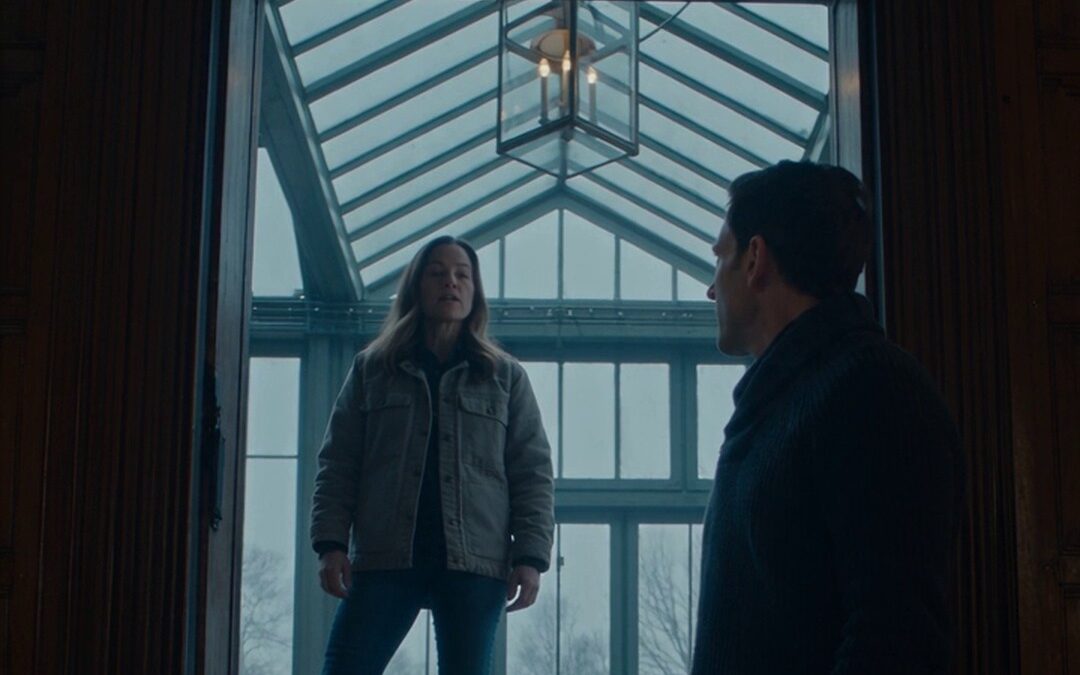
Directly above that open ballroom sat the conservatory.
Directly above that unsupported lath-and-plaster ceiling sat nine hundred and forty pounds of dense crystalline quartzite, concentrated onto four hard-rubber caster wheels no wider than silver dollars.
Four point loads. Less than two square inches of contact area per wheel, pressing down on three-quarter-inch tongue-and-groove pine that had already lost its cross-bracing.
I reached into my utility pouch, my fingers finding the cold, knurled bezel of my grandfather’s deflection gauge. Thomas Finch had spent forty years inspecting railway trestles for the Great Northern before the line was decommissioned; he had handed me that brass instrument on my twenty-first birthday with a simple warning: Wood warns you three times before it kills you, Maeve. First it sighs, then it groans, and then it snaps. If you wait for the snap, you’re already in the cellar.
The sigh had happened when the wheels cleared the threshold.
The subterranean thud was the groan.
I didn’t head for the front porch where Clara Frost stood greeting the regional president of a private equity brokerage. I walked around the east wing to the basement bulkhead, where the caterers had propped open the heavy storm doors with a case of seltzer water to haul in backup ice.
I slipped down the wet concrete stairs into the darkness beneath the house.
The basement smelled of hundred-year-old dirt, pulverized lime, and damp river stone. In the center of the mechanical bay, suspended from the rough-hewn floor joists by plumber’s tape, ran the main four-inch cast-iron sewer stack.
I clicked my headlamp on, throwing a sharp white beam against the overhead framing.
The flipper’s drywall crew had slapped two coats of flat-white paint over the ceiling of the ballroom above, but down here in the raw underbelly, the truth was laid bare in saw marks and sawdust.
To create the seamless ballroom Clara Frost had bragged about, the contractor hadn’t engineered a steel wide-flange beam to carry the transverse floor loads. They had simply sistered the original 2×10 Douglas fir joists with cheap modern SPF lumber—fastened not with through-bolts and shear washers, but with two-and-a-half-inch zinc framing nails shot from a pneumatic gun.
Under the beam of my headlamp, the zinc nails were already bending.
The heads were popping out of the wood like pimples on a cold skin, tiny cones of crushed yellow sawdust trickling down through the air like hourglass sand. The grain of the historic Douglas fir was checking along the annular rings, peeling backward in long, razor-thin curls of splintered fiber.
Ping.
A framing nail severed five feet above my head. The sheared shank shot across the basement and bounced off an iron water pipe with the sharp ring of a spent cartridge.
I pulled my phone from my canvas jacket and dialed Julian’s direct line.
It rang four times before he clicked on, the background swelling with smooth jazz and the high, tinny laughter of sixty people drinking twelve-dollar champagne.
“Maeve, I told you to stay on the curb,” Julian hissed. “If Clara sees you lingering by the catering line—”
“Julian, listen to me,” I said, my voice dropping into that flat, monotone register I had used on collapsed bridge pilings along the Spokane River. “You have less than four minutes to clear the ballroom. The sistered joists beneath the second-story bay are undergoing catastrophic shear failure. The fasteners are shearing off.”
“You are unbelievable,” Julian scoffed, his voice dripping with condescending pity. “You’re actually going to manufacture a safety crisis because your little pride was hurt over a furniture dolly? Clara is introducing the lead architect for the South Hill Historic District right now. If you disrupt this reception, I won’t just fire you—I’ll have the county sheriff trespass you off every job site in eastern Washington.”
“Julian—”
“Do not call this phone again.”
The line went dead with a digital chirp.
Above my head, the joists gave a slow, grinding shiver. It was not a crack this time; it was the wet, tearing sound of green timber ripping along the heartwood under twenty thousand foot-pounds of uncompensated dynamic torsion.
The quartzite table wasn’t just sitting still up there. Julian’s loaders had rolled it onto the center sisal rug, and now six people were leaning against its edge to inspect the hand-hammered iron base.
I didn’t take the basement bulkhead stairs back outside.
I vaulted up the narrow wooden service stairs that led from the old butler’s pantry straight into the ballroom’s rear corner.
The pantry door swung open, and I stepped out onto the polished white oak floor.
The room was packed. Women in silk cocktail dresses and men in tailored wool overcoats stood under the grand brass chandelier, their wine glasses reflecting hundreds of tiny teardrop prisms of cut crystal. At the far end of the room, standing on a raised walnut platform by the limestone fireplace, Clara Frost held a silver microphone, her face radiant under the warm spotlights.
Julian stood two feet to her left, holding a leather folio, basking in the glow of the room like a man who believed the entire world had been built solely to frame his taste.
“…and what we have achieved here,” Clara was saying into the microphone, her voice melodic and triumphant, “is the ultimate marriage of historic Spokane soul and modern open-concept luxury. We removed forty linear feet of obsolete, suffocating partition walls to let this room breathe—to create a space where the grandest gatherings can unfold without a single column obstructing your sightline.”
A polite, glittering ripple of applause rolled through the crowd.
I stepped through the crowd, my heavy leather boots leaving wet tracks of basement grit on the freshly waxed boards. People turned, their noses wrinkling as my canvas jacket, pungent with grease and sawdust, brushed their cashmere wraps.
“Excuse me,” I said, not shouting, but projecting my voice from the diaphragm the way my father had taught me on wind-whipped derrick floors. “Everyone in this room needs to step back against the outer perimeter walls. Right now.”
The applause sputtered out.
Clara froze with the microphone an inch from her glossy lips. Julian’s face flushed from pale ivory to deep beet red.
“Maeve!” Julian barked, stepping off the walnut platform, his polished oxfords clicking furiously across the floor. “What do you think you’re doing? Security! Call the front gate!”
“Julian, look at the ceiling medallion,” I told him, pointing up at the massive plaster rose from which the sixty-bulb brass chandelier hung.
A fine, powdery snow of pulverized 1912 horsehair plaster was drifting down through the warm air, settling into the hair of the city’s wealthiest property moguls like white dandruff.
Across the white expanse of the ceiling, a jagged fracture line had ripped from the south corner of the room straight to the center fixture. It wasn’t a hairline paint crack; it was three-quarters of an inch wide, and through the black gap, the jagged, split belly of a ten-inch fir joist was clearly visible, sagging downward like a broken tooth.
A woman in a silver dress screamed, dropping her glass. The crystal shattered on the floor, red wine pooling across the white oak.
“Don’t move toward the center!” I commanded, stepping in front of three terrified brokers who were trying to bolt toward the front foyer. “The load path is compromised in the middle bay! Move against the stone perimeter! Stand against the fireplace and the exterior masonry!”
Clara dropped the microphone. It hit the floorboards with an ear-splitting howl of acoustic feedback that sent the crowd surging backward toward the thick exterior walls of basalt and brick.
Above us, the conservatory floor dropped two inches with a deafening CRACK that sounded like a twelve-gauge shotgun discharging inside a tile bathroom.
The brass chandelier swung three feet to the left, its iron ceiling hook screeching as it wrenched sideways out of the framing timber.
Then, from the grand staircase, came the panicked shrieks of the two young loaders.
“Mr. Vance! It’s going! The wheels punched through the subfloor!”
Upstairs, the four caster wheels of the quartzite dolly had finally sheared through the three-quarter-inch subfloor boards. The nine-hundred-pound slab of metamorphic stone, teetering on its side, had slid off the sisal rug and was now wedged at a sixty-degree angle against the central floor joist—the exact joist that had been sistered with framing nails over the center of the ballroom.
Julian was frozen in the middle of the room, standing directly beneath the swaying sixty-bulb fixture, his eyes fixed on the ceiling in sheer, paralytic horror.
“Julian, run!” Clara screamed from the safety of the brick hearth.
He couldn’t. His knees were locked, his hands trembling at his sides, his breathing reduced to rapid, shallow gasps as plaster dust rained into his eyes.
The joist above him split with a sickening, fibrous roar.
A five-foot section of lath and lime crashed onto the mahogany buffet table six feet from where he stood, sending silver platters and crystal decanters flying in every direction.
I didn’t stop to think about his insults, his suspensions, or the twenty-two dollars an hour he paid me to carry his velvet cushions.
I sprinted across the sagging white oak floorboards, feeling the wood dip beneath my weight like a rubber bridge, and drove my shoulder straight into Julian’s ribs.
The impact lifted him off his feet.
We tumbled together across the slick hardwood, slamming into the heavy masonry base of the limestone fireplace just as the center ceiling gave way.
The nine-hundred-and-forty-pound quartzite slab tore through the lath, the plaster, and the severed joists like a guillotine.
It crashed onto the center of the ballroom floor with an impact that shattered three of the conservatory’s leaded-glass windows thirty feet above. The white oak floorboards exploded upward into kindling, the stone slicing through the subfloor until its bottom edge slammed directly into the concrete foundation wall below.
Right behind it came the grand brass chandelier.
Two hundred pounds of cast iron and crystal hit the wreckage with a thunderous roar, showering the room in a blizzard of sharp glass, twisted brass tubing, and white plaster dust that turned the air completely opaque.
Silence dropped over the ballroom.
A deep, thick, ringing silence, broken only by the hiss of a punctured radiator valve and the sound of forty people sobbing quietly against the stone walls.
I pushed myself up from the hearth, coughing the lime dust from my lungs. My canvas jacket was torn at the elbow, and my knuckles were scraped raw against the basalt, but my bones were whole.
Beneath me, Julian was curled in a fetal position against the brass andirons, shaking so violently his teeth were clattering together like dice in a cup. His cashmere scarf was ruined, gray with mortar dust, his face buried in his trembling hands.
I reached down, took him by the collar of his tailored jacket, and hauled him up until his back was braced against the brick.
“You’re alive, Julian,” I said, my voice cutting through the ringing in his ears.
He opened his eyes. Through the swirling white fog, he looked at the smoking crater eight feet away where he had been standing five seconds earlier. The quartzite slab was wedged vertically into the floor, buried three feet deep into the shattered framing, flanked by the mangled carcass of the chandelier.
He looked down at my face, then at my torn sleeve, and finally at the small brass deflection gauge that had slipped from my utility pouch and landed on the hearth between his knees.
The white dial was cracked, but the spring-loaded spindle was still resting against the stone, its needle pegged at maximum deflection: FAILURE.
“You…” Julian’s voice was nothing more than a wet, broken whisper. “You knew.”
Clara Frost came creeping out from the corner of the dining alcove, her designer coat covered in lime powder, her hair standing on end, her hands clutching her pearl necklace as if it were a life preserver.
She stared at the massive trench carved through the center of her three-million-dollar flip, then looked down at the two of us by the fireplace.
“The permits…” Clara stammered, her voice shrill with terror. “The city… they said it was safe…”
“The city never checked the point loads, Clara,” I told her, rising to my feet and wiping the white dust from my jeans. “Your flipper cut out the historic columns to save fifty thousand dollars on a steel beam, and Julian put half a ton of rock on a floor that was hanging by nail shanks.”
Outside, the first sirens began to wail up the South Hill, their flashing red and blue lights painting the high leaded-glass windows in vivid strokes of emergency color.
The crowd of brokers was already scrambling through the service door into the rain, eager to put as much distance as possible between themselves and the catastrophic fraud they had just witnessed.
I reached down to the hearth, picked up my grandfather’s brass gauge, and wiped the plaster dust from its beveled rim with my thumb. The letters stamped into the back gleamed softly in the emergency light: T.F. — 1952.
Julian looked up at me from the floor, his mouth opening, his eyes wide and hollow.
“Maeve… please,” he croaked, reaching out a trembling, dust-caked hand toward my sleeve. “Don’t… don’t tell the building inspectors what you found in the basement. If the state licensing board finds out I ordered the slab onto that floor over your objection… my career is over.”
I looked down at the senior staging director, then tossed my company box truck keys onto the hearth beside his knees.
“Your career ended the second that nail snapped in the cellar, Julian,” I said evenly. “The only difference is, you’re walking out of here on your own two feet instead of in a coroner’s basket.”
I turned my back on the wreckage and walked out through the shattered grand entrance into the cool November rain, breathing in the clean, unyielding pine air of the South Hill.