PART 2: The Condemned Wire: Part 2 — The Devil’s Bight
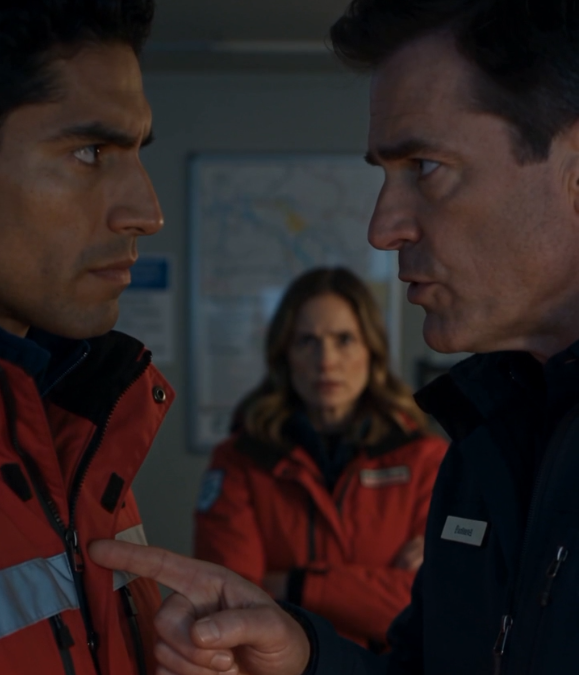
Chapter 2 — The Devil’s Bight
The yellow emergency strobe on the locker room bulkhead pulsed against Vance Holloway’s throat, turning his skin the color of curdled tallow. His hands, clean and manicured beneath the overhead fluorescents, hovered over the edge of the wax bench like two pale birds looking for a place to roost on an oil slick.
“Mateo,” Sarah whispered. Her voice did not break; it shrank to a dry, terrible wire. “Maya is fourteen. She was riding up to clear the timing wands at the mid-station gate.”
I looked down at the brass gauge stamped with my father’s initials: J.C. John Cruz had died in a federal penitentiary hospital in Oregon with soot in his lungs and three collapsed vertebrae from a dynamic sling failure on a maritime derrick. He had told me once, while scraping salt off a five-eighths galvanized thimble, that iron never forgets an insult, but it always forgives an honest man with a wrench before it forgives a thief with a checkbook.
“Vance,” I said, keeping my hands resting flat on the damp fir planks. “The keys to the upper hoist bay.”
“Cruz, you’re under suspicion of a federal felony,” Vance stammered, though his knees were already trembling inside his two-thousand-dollar Gore-Tex shell. “The sheriff—”
“The sheriff is currently spinning out on the lower switchbacks in an all-wheel-drive Tahoe with highway radials,” I told him. “And by the time his chains hit the hardpack at the base terminal, your boy Caleb and Sarah’s daughter are going to be fifty yards out in the deadfall below Tower Five. The auxiliary cable on an industrial Prinoth groomer holds ninety kilonewtons before necking. With a ten-ton cat hanging dead weight on a ninety-degree wrap around an unraveling wire rope, that steel isn’t stretching. It’s singing. You have less than twenty minutes before the crown strand I logged this morning unzips like a cheap nylon zipper.”
I leaned in until he could smell the paraffin and stale bitter coffee on my wool collar. “Give me the master ring, or start writing the press release explaining why you let your son choke on forty feet of high-tensile recoil.”
Vance’s jaw twitched. He pulled a braided steel lanyard from his parka pocket, the heavy brass cylinders clattering as his palm slicked against the ring. He didn’t drop it into my hand; he threw it onto the table between us.
“Artie,” I called out.
The old mechanic stepped out from behind the lathe, wiping his grease-blackened thumbs on a shop rag. He didn’t look at Vance. He looked at me, his eyes pale and watery beneath white, frost-burned eyebrows.
“Bring the three-quarter steel come-alongs from the tractor bay,” I commanded, my voice dropping back into the flat, rhythmic cadence of the salvage yards. “Not the aluminum utility pullers. The cast-steel Coffings from the high-voltage substation project. Grab four heavy-duty line-grips—the wedge-type Havens grips with the knurled jaws, not the spring-loaded wire clips. And Artie?”
“Yeah, Mateo?”
“Find those two Crosby five-ton snatch blocks Vance said I stole. Check the floor behind the hydraulic fluid drum in the upper vault where he tucked them this morning before calling dispatch.”
Vance’s mouth opened, but no sound came out. His throat worked silently as Sarah turned on him with the cold, predatory stillness of a mountain lion.
“Move,” I told the room.
We hit the exterior catwalk at twenty-six hundred meters. The storm was no longer a squall; it had hardened into an Arctic gale, roaring down from the Continental Divide through the gap in Deadfall Ridge. It smelled of ozone, pulverised shale, and the hot, metallic stink of groaning sheaves. Above us, the bullwheel inside the upper lift house was shuddering against its hydraulic backstop, making a hollow thump-thump-thump that rattled the iron grating beneath our boots.
The haul rope for Chair Six ran out of the bullwheel enclosure like an iron tendon disappearing into a white cataract of blowing snow. Thirty yards past the bullwheel, where the line tipped over the crest of Tower Four, the rope was violently distorted. It wasn’t hanging in a catenary curve; it was twisted into a sickening helical spiral. The thick, six-strand wire was wrenched ninety degrees sideways, flattened against the steel side-plates of the sheave assembly.
Below the tower, swallowed in the cloud, hung the silhouette of the Cat-Seven groomer.
The machine was suspended by its tail-winch like a slaughtered bull dangling from a meat hook. Its wide aluminum tracks spun uselessly in forty feet of empty mountain air. The thirty-millimeter winch wire had whipped around Chair Six’s main haul rope twice, biting deep into the wire rope’s outer armor, before sliding down into the depression above Chair Thirty-Two.
Through the blizzard, I caught the dull orange flash of an emergency blanket.
Chair Thirty-Two was pitched forward at an unnatural, forty-five-degree tilt. Caleb Holloway and Maya Chen were huddled in the metal bench under the restraining bar, their bodies pressed together for warmth. Maya’s red patrol helmet was visible against the grey ice. Above their heads, the grip that clamped the chair to the main haul rope was slipping, an inch at a time, toward the snarled mess of the groomer’s winch cable.
“They’re slipping into the bight!” Sarah screamed through the wind, her fingers digging through my parka sleeve to the bone. “If the chair slides into the winch wrap, the shear pins will blow!”
“The grip isn’t slipping on the wire, Sarah!” I yelled over the shriek of the cables. “The wire itself is rotating inside its core! The outer strands are corkscrewing!”
I laid my bare palm against the main haul rope where it entered the lift shack. The steel was so cold my skin threatened to bond instantly, but I didn’t pull away until I felt the internal pulse.
A steel rope under dynamic failure does not hum smoothly. It stutters. You can feel the micro-fractures in the heart-hemp or the independent wire core snapping like sewing threads inside a mattress. Tick. Tick-tick. Ping.
“Artie!” I roared. “Clear this deck! Nobody touches the auxiliary hydraulic pump! If anyone hits the secondary motor, the surge will peel the remaining three strands off the crown wheel!”
I stripped off my heavy outer gloves, swapping them for thin, oil-impregnated goat-skin riggers’ mitts that gave me enough tactile response to feel a burr through the leather. I clipped my harness to the static safety line anchored to the terminal’s main I-beam, took two five-ton Crosby blocks on my gear loops, and slung eighty feet of seven-sixteenths AmSteel synthetic line over my shoulders.
“Mateo!” Vance came stumbling out onto the icy catwalk, clutching his radio like a crucifix. His hood had blown back, and frost was crusting his wet eyelashes. “The sheriff says county rescue is an hour out! They have a helicopter on standby at the valley airbase!”
“A helicopter couldn’t hold a hover within five miles of this ridge without its tail rotor shearing off in the rotor-wash off Deadfall!” I spat. “Go sit in the lift shack, Vance. Keep your mouth shut, and pray the wire my father taught me to splice holds your boy’s weight.”
I didn’t wait for him to reply. I stepped off the steel platform and onto the icy ladder of Tower Four.
The ladder rungs were solid cylinders of rime-ice. Every step required driving the steel heel-spurs of my boots through the crust to hit bare rung, the metal vibrating beneath my shins with the tension of the two dying machines suspended below. By the time I reached the cross-arm forty feet above the snowline, the wind was tearing at my breath, threatening to suck the air straight out of my mouth.
From the cross-arm, the horror of the rigging became clear.
The Cat-Seven groomer weighed nearly ten tons with its heavy steel snow-blade and power tiller attached. Its auxiliary recovery winch—designed to haul the machine up seventy-degree ski runs—had suffered a catastrophic payout failure. The drum had locked halfway through an anchor cycle, the steel cable had cut across a granite outcropping, and the cat had slid backwards over the precipice, snagging the main haul rope of the chairlift like an errant fly on a leader line.
The groomer was acting as a counterweight against the lift’s main bullwheel. Every time a sixty-mile-an-hour gust hit the cat’s broad underbelly, it wrenched the lift rope three inches downward, forcing the chairlift’s cable across the blunt, unground edge of the tower’s guide flange.
Five strands were intact. The sixth strand—the crown strand I had measured at dawn—was broken.
It was splayed outward like an angry steel quill, its jagged ends whistling in the slipstream.
“Mateo!” Maya’s voice reached me from fifty feet below. It was thin, shredded by the gale, but it carried that hard, desperate sanity that only children of mountain patrollers possess. “Mateo! The grip is clicking! Every time the wind blows, Caleb’s feet are touching the cat’s tracks!”
“Don’t move, Maya!” I shouted down, leaning out over the catwalk with my cow’s-tail carabiner locked into the structural steel. “Caleb, drop your ski poles! Drop them right now!”
The boy down on the chair looked up. His face was waxen, his mouth open, his goggles pushed up onto a forehead that was already turning the dead white of stage-two frostbite. He shook his head, paralyzed.
“Drop them, you idiot!” I barked. “Every ounce of dead load is shifting the center of gravity toward the sheared strand! Drop the poles and wrap your arms through the chair-back frame! Do not touch the safety bar!”
Caleb opened his mittens. The poles fell, tumbling end-over-end through the swirling fog until they speared into the white powder a thousand feet below in the gut of Deadfall Chute.
I turned back to the cross-arm. Sarah had climbed the tower behind me, her patrol harness jingling with carabiners and hollow-core prusiks. Her face was bloodless, but her eyes were fixed on mine, steady and clear.
“What’s the play, Cruz?” she asked, her voice clipping through the howl of the storm.
“We can’t haul the cat,” I told her, unclipping the first Crosby snatch block. “If we put tension on that cat cable, the dynamic shock will sever the haul rope clean through. We have to bypass the damaged section of the lift wire. We need to rig a dead-man bridle from the tower head directly to Chair Thirty-Two, lift the chair off the haul rope by three inches to clear the grip, and then anchor the main cable tension back into the tower’s concrete base.”
Sarah looked at the churning, bucking steel cable below us. “You want to transfer thirty tons of dynamic load onto an improvised bridle using AmSteel and come-alongs?”
“It’s not improvised,” I said, setting my boots against the angle iron. “It’s how my father brought down salvage cranes off the oil platforms in the Cook Inlet when the hydraulics blew. It works, Sarah. But somebody has to ride down the haul rope on a rolling traveler to seat the line-grips on the other side of the fray.”
She didn’t hesitate. “I’ll go.”
“No,” I said. “You’re five foot four. You don’t have the leverage to seat a five-ton Haven wedge on a frozen wire rope in eighty-mile-an-hour gusts. You hold the tower station. You run the brake line on the secondary hoist. I’m going down the wire.”
She gripped the lapel of my parka, her leather mitt wet against my chest. “Mateo. If you blow the bite, there’s no bottom to that chute.”
“There never was,” I said.
I hooked two tandem steel pulleys onto the main haul rope above the fracture point. I ran an eight-millimeter dynamic safety tether through my chest harness and tied into the line-traveler with a double figure-eight on a bight. In my right hand, I held the heavy brass Haven clamp; on my back hung the snatch block and forty feet of AmSteel line, thick as a bull’s wrist and slick as eelskin.
I looked up once toward the upper hoist shack. Vance was standing at the glass window, his face pressed against the pane, watching the ex-con he had tried to send back to prison step out into the void.
I kicked off from Tower Four.
The drop hit my stomach like a bucket of ice water. The pulleys shrieked against the rime-covered steel as I slid down the forty-degree incline of the haul rope. The wind caught me instantly, swinging me out over Deadfall Chute like a pendulum. Below my boots, the sheer drop of the east face fell away into an abyss of swirling cloud and grey timber.
The rope beneath my pulleys was groaning. Through the soles of my boots, every vibration of the hanging groomer traveled straight into my marrow.
I slammed the brakes on the traveler ten feet above Chair Thirty-Two.
The jolt nearly tore the Haven clamp from my fist. The chair was swinging violently beneath me, the steel hanger arm oscillating in an elliptical arc that brought it within inches of the groomer’s suspended winch drum.
Maya looked up at me through the storm, her teeth chattering so hard I could hear the enamel clicking over the wind. “Mateo!”
“I’ve got you, kid,” I yelled down. “Caleb! Look at me!”
Vance’s boy raised his head. His lips were blue, his pupils dilated with terror. “We’re going to fall,” he whimpered. “The wire… it popped twice just now.”
“Shut up, Caleb,” I said, my voice cold and hard as iron slag. “Look at my hands. Watch what I do. You scream, you shake this wire, and I’ll drop you myself. Understand?”
The boy shrank back into the bench, nodding frantically.
I leaned back in my harness, hanging upside down over the drop with my boots hooked around the trembling haul rope. The unraveling sixth strand was right in front of my face. The wire had parted three inches from the chair grip; the five remaining strands were crushed flat against each other, their galvanized zinc coating peeling away in silvery curls under the sheer pressure of the groomer’s weight.
The core was exposed. The synthetic core of the haul rope was turning black, smoking from the internal friction of the strands sliding across one another.
I reached out with the Haven clamp.
A Haven clamp works on a simple principle: the harder you pull on the eyelet, the harder the serrated eccentric jaw bites down on the steel cable. But on an iced cable, the teeth can skate along the galvanized surface like a hockey puck on pond ice. If the jaw didn’t bite instantly, the dynamic load would strip the remaining strands like meat off a rib.
I pulled my father’s brass wire gauge from my teeth, where I had been holding it. I jammed the squared brass corner straight into the gap between the third and fourth strands, creating a mechanical notch in the steel armor.
“Sarah!” I screamed into the radio pinned to my collar. “Slack the upper winch by two inches! Give me slack on the lead line!”
“Slacking now!” her voice crackled back through the static.
The haul rope dipped violently. The groomer swung out toward the valley, its tracks clearing a jutting spur of granite by less than six inches. The sudden weight transfer sent a shockwave down the wire that threw my feet off the rope. I dangled by my harness carabiner, spinning three hundred and sixty degrees over the drop, the Haven clamp held in my teeth by the cold steel loop.
I swung back, hit the rope with my knees, and locked my legs around the steel.
With my bare right hand, I rammed the Haven clamp into the notch I had gouged. I slammed the wedge forward with the heel of my boot.
Clank.
The knurled steel teeth sank through the rime and bit into the high-tensile core.
“Bite!” I screamed. “I’ve got purchase!”
I unslung the five-ton Crosby snatch block from my back, clicked it into the Haven clamp’s forged eye, and threaded the AmSteel line through the sheave. The AmSteel led straight back up to the massive structural leg of Tower Four, where Sarah had rigged the cast-steel Coffing come-along.
“Take up the tension, Sarah!” I yelled. “Artie, crank the Coffing! Take the strain off the crown strand!”
Fifty yards up the hill, inside the howling grey storm, Artie’s lever began to work.
Click. Clack. Click.
The AmSteel line went from a sagging belly of grey braid to a bar of solid iron. It hummed a high, pure F-sharp that cut right through the roar of the wind.
Below me, the main haul rope twitched. The strain was transferring. The six-strand lift cable, which had been stretched past its yield point, began to relax by fractions of an inch. The black, smoking core cooled as the compressive force eased off its wound fibers.
“It’s holding!” Sarah’s voice crackled through the radio. “Mateo, the load is thirty percent on the tower anchor! But the groomer is shifting!”
A terrible sound came from beneath my boots.
The groomer’s winch cable—the steel line wrapped around the chairlift wire—was not meant to hold a dynamic transfer. With the haul rope shifting angle, the winch wire began to saw across the lift cable’s upper outer armor.
Bright orange sparks erupted in the blizzard, hissing as they hit the ice.
“The winch wrap is sliding!” Caleb screamed, losing his mind completely. He tried to scramble over the restraining bar, his hands clawing at the frozen vinyl of the seat. “It’s coming down on us!”
“Caleb, stay down!” Maya yelled, throwing her arm across his chest and slamming the boy back against the metal bench. “Mateo has the line! Stay down!”
The winch cable slipped two feet with a deafening SNAP that sounded like a rifle shot over the ridge.
The sudden drop yanked Chair Thirty-Two downward. The chair grip—the heavy spring-loaded iron hand that clamped the bench to the lift wire—slammed directly into the Haven wedge I had just set.
The impact sheared the primary cotter pin out of the snatch block.
The block swung sideways, hanging by a single ear of forged steel. If that ear blew, forty thousand pounds of tension would whip back through the AmSteel line, severing Sarah on Tower Four and dropping the chair into the gut of the chute.
I didn’t think. My father had spent twenty years in the iron trades, and the one thing he had hammered into my skull between his shifts at the salvage yard was that steel knows when you’re hesitating.
I dropped off the traveler line, letting myself fall six feet onto the suspension tube of Chair Thirty-Two.
My boots hit the curved steel pipe, my hands locking around the cold vertical hanger arm. The chair tilted under my arrival, swinging wildly over the empty air. Maya looked up into my face, her eyes wide, snow clinging to her dark eyelashes.
“Hold your breath,” I told her.
I reached out into the gap between the chair grip and the Haven clamp. The sheared snatch block was twisting against its remaining ear, the metal screaming as it warped.
I took my father’s notched brass gauge—the heavy, quarter-inch slab of cold-rolled alloy—and drove it straight into the gap between the block’s cheek-plate and the retaining pin hole.
I used the gauge as a temporary drift pin.
“Artie!” I roared through the radio mic against my teeth. “Crank it! Crank it now! Don’t look at the dial, Artie, break the handle if you have to!”
Above us, on the tower cross-arm, the old man threw his entire weight onto the steel handle of the Coffing come-along.
CLACK.
The AmSteel line snapped taut. The brass gauge in my hand warped instantly under the terrifying pressure, bending into a bright, golden horseshoe as the load transferred through its spine. The brass screeched against the hardened steel of the block, but it didn’t snap. Brass doesn’t fracture under shear the way untreated iron does; it mushrooms. It deformed, jammed into the hole, and locked the pin solid.
The main haul rope rose four inches.
The chair grip lifted completely off the cable, dangling free on the AmSteel bridle.
“The chair is isolated!” I screamed. “Sarah, haul the auxiliary winch! Pull the kids up to Tower Four!”
Sarah threw the engagement lever on the tower hoist. The secondary line, hooked to the back of Chair Thirty-Two’s hanger arm, began to wind onto the drum. The chair began to slide backwards, away from the snarled cat cable, rolling smoothly along the AmSteel bypass line up toward the safety of the tower platform.
“Mateo!” Maya reached out her mitten as the chair began to move away from me. “Grab the bar!”
“Can’t, kid,” I said, my boots still planted on the swaying hanger arm. “Someone has to hold the drift pin. If this brass walks out of the block, the traveler drops before you reach the tower.”
I stood on the crossbar of the chair, my bare palms clamped around the bent brass gauge, feeling the forty-thousand-pound load vibrating through my wrists, into my elbows, down through my collarbones. Every muscle in my back was locked in a brutal isometric spasm. The cold was gone; my blood was boiling with adrenaline and the sheer, animal terror of the drop beneath my heels.
Ten feet. Twenty feet. Thirty feet.
The chair ascended toward Tower Four like a bucket coming up out of a well. Caleb was weeping now, his face buried in his mittens, but Maya never took her eyes off mine.
“Almost there, Sarah!” I yelled, though my voice was nothing more than a ragged croak. “Two more yards!”
The chair reached the steel catwalk of Tower Four. Sarah lunged over the rail, her strong, patrol-hardened hands grabbing Maya by the collar of her parka and hauling her over the safety bar onto the grating. In a second movement, she reached back, seized Caleb by the scruff of his neck, and dumped him like a sack of salt beside his sister.
“They’re off!” Sarah’s voice roared through the static. “Mateo, ditch the line! Get to the ladder! The groomer is going!”
Down in the cloud below, the groomer’s winch cable finally gave up.
It didn’t snap with a bang. It tore. The three outer strands unlaid with a dry, mechanical hiss, and then the ten-ton Cat-Seven dropped like a boulder dropped down a mine shaft.
The release of weight was instantaneous and catastrophic.
The main haul rope, suddenly freed from forty thousand pounds of dynamic downward drag, recoiled upward like a bowstring. The wave of kinetic energy traveled up the mountain at five hundred feet per second, heading straight for the Haven clamp and the bent brass gauge I was holding.
I didn’t try to climb the ladder. I didn’t reach for the safety tether.
I let go of the brass gauge and kicked myself violently backward off the moving chair, out into the empty air of Deadfall Chute.
My fingers found the dynamic safety line I had anchored to the tower’s lower structural diagonal twenty minutes before.
The recoil wave hit the cross-arm.
The bent brass gauge sheared clean in two, the pieces whistling away into the storm like shrapnel. The AmSteel line parted with an explosive CRACK that shook the mountain, the synthetic fibers vaporizing into a cloud of white lint. The main haul rope whipped thirty feet into the air, clearing the sheave assembly and crashing down onto the empty steel tower head with a sound like a freight train jumping the rails.
I swung into the white void.
The dynamic rope caught me thirty feet below the catwalk. The nylon stretched, taking the brutal fall-factor load, burning through my harness straps until the leg loops pinched into my thighs like tourniquets. I slammed against the iced lattice-work of the tower leg, the wind knocked out of my lungs in a single, agonizing gasp of frozen air.
I hung there between heaven and hell, spinning slowly in the sixty-mile-an-hour wind, my arms hanging limp at my sides, my eyes looking down into the grey mist where the groomer had vanished into the rocks of Deadfall Chute.
Above me, two gloved hands reached through the snow.
Sarah’s face appeared over the steel gusset plate, followed by Artie’s grease-stained beard.
“Mateo!” she yelled, her tears freezing into pearls on her cheeks. “Grab the loop! Mateo, look at me!”
I couldn’t reach up. My right hand was locked in a frozen claw, the skin of my palm torn open where the bent brass gauge had bitten through my leather mitt.
Artie dropped a heavy webbing sling over my shoulders, clicked an oversized steel locking carabiner through my harness master ring, and hooked the line to the auxiliary hand-winch.
“I’ve got him, Sarah,” the old man grunted, his back arching as he cranked the iron handle. “He ain’t going nowhere. Lift the bastard up.”
They dragged me onto the steel catwalk like a drowned calf pulled from a freezing creek.
I rolled onto my back against the diamond-plate grating, my chest heaving, every rib screaming with bruised cartilage. Maya was there instantly, her warm mittens pressing against my frost-burned cheeks, her tears dripping onto my forehead.
“You held it,” she whispered, her voice shaking violently. “Mateo, you held the wire.”
Beside her, Caleb sat curled into a ball against the ladder stanchion, his father’s expensive mountain jacket drenched in his own sweat and terror, shivering uncontrollably.
I pushed myself up onto my elbows, spitting a mouthful of blood and mountain sleet onto the steel deck.
Through the howling whiteout, a figure came crawling along the catwalk from the upper lift house. Vance Holloway was on his hands and knees, his silver tablet gone, his hair plastered to his forehead with snow, his face hollowed out like a wax candle left too close to the stove.
He crawled straight past me. He reached his son, throwing his arms around the boy’s trembling shoulders, sobbing into the wet nylon of Caleb’s hood.
“Caleb… Caleb, oh God, you’re alive,” Vance wept, his voice small and pathetic beneath the roar of the Continental Divide. “You’re safe. You’re safe.”
He held the boy for a long time, his eyes shut tight, rocking him on the icy grating.
Then, slowly, Vance looked up.
His eyes met mine through the drifting snow. I was sitting with my back against Tower Four’s main upright, my torn hand resting on my knee, the blood dripping slowly between the steel bars to the drop below. Beside my boot lay the half of the brass wire gauge that had remained pinned in the snatch block’s jaw—twisted, flattened, and stamped with the faint, ruined initials of my father: J.C.
Vance looked at the brass. Then he looked at my red patrol parka, the zipper still half-pulled where he had ordered me to strip it off twenty minutes ago.
Sarah stood over him, her patrol radio clutched in her fist like a hammer.
“The sheriff just radioed from the lower terminal, Vance,” Sarah said, her voice dropping like an iron portcullis. “He’s got the state police with him. They want to know if they need to bring the transport van up for the man who stole the explosives and the rigging blocks.”
Vance’s throat moved. He looked down at his son, whose hands were still locked into my emergency AmSteel sling, then looked back at my face.
“No,” Vance whispered. His voice was cracked, barely audible against the storm. “Tell the sheriff… tell him it was a clerical error.”
“What was that, Vance?” Sarah stepped closer, her boot an inch from his knee. “I couldn’t hear you over the wind.”
“It was an inventory mistake,” Vance said louder, his face twisting in a spasm of humiliation and terror. “The Crosby blocks were misfiled in the upper shop. The blaster’s vault… the sensor wire wasn’t cut. It had dry-rot from the freeze. Cruz didn’t touch anything.”
Sarah looked at me, then down at the executive trembling on the diamond plate.
“Get your son down to the clinic, Vance,” she said coldly. “And when you’re done down there, clean out your desk. Because the state lift inspection board is going to see my maintenance log from this morning. And if you ever speak Mateo’s name on this mountain again, I’ll tell the district attorney whose boy was running an auxiliary chair during a red-flag wind hold.”
Vance didn’t answer. He helped Caleb to his feet, keeping his head down, and guided the staggering boy along the catwalk toward the warmth of the upper lift house, disappearing into the white fog like two ghosts.
Artie knelt beside me on the grating. He pulled a clean, dry wool bandanna from his pocket and wrapped it around my torn palm, tying it off with a neat, precise square knot.
“You’re a damn fool, Cruz,” the old man said softly, his voice gravelly with twenty years of mountain tobacco. “Your old man would have told you that was the ugliest dynamic transfer in the history of North American wire rope.”
“Did it hold?” I asked, my voice raw as a gravel road.
Artie picked up the twisted shard of the brass gauge from between my boots. He held it up to the pale light of the storm, rubbing his thumb over the crushed letters of my father’s name.
“It held,” Artie said.
I leaned my head back against the cold steel of Tower Four. Above us, the storm was beginning to tear apart, showing brief, razor-thin slivers of cobalt blue sky above the peaks of the Continental Divide. The bullwheel was silent now, frozen in place against its emergency dogs, but the wind through the remaining strands of the haul rope had changed its pitch.
It wasn’t screaming anymore.
It was humming—a steady, clean, low-register drone that settled deep into the mountain’s bones, like a debt paid in full to the stone below.