PART 2: A Landlord Tried To Evict My Tattoo Studio Over An Infected Needle, Unaware My Father’s Brass Seal Stamped His Downfall
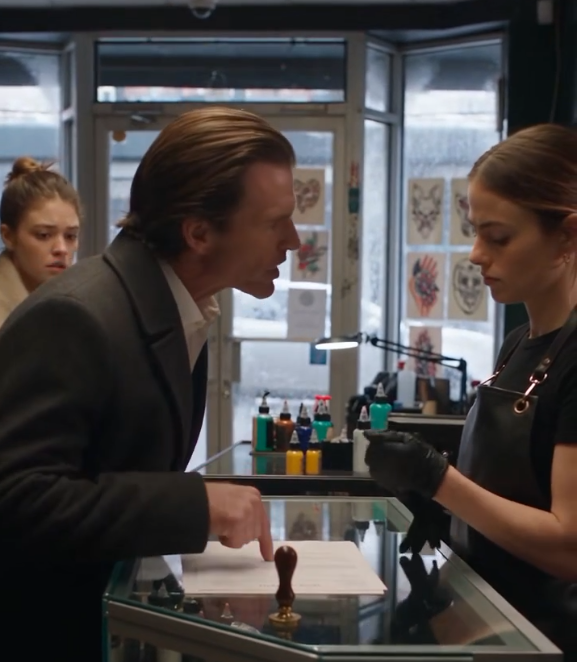
The heavy brass bell above the oak door had stopped vibrating, but the front display window was still trembling from the draft of Preston Hilliard’s black Mercedes pulling away from the curb. Outside, the gray Richmond sleet was turning the cobblestones of West Cary Street slick as wet slate.
Inside my studio, the only sound was the low, electric purr of Javier’s power pack, which he had forgotten to turn off.
“Maya,” Javier whispered from the rear booth, his face the shade of bleached cotton. “The Board of Barbers and Cosmetology doesn’t issue administrative warnings when a Montgomery gets hospitalized. They suspend the facility license by emergency order and confiscate the client logs.”
“Turn the power supply off, Javi,” I said without looking back. My fingers were pressed flat against the glass counter on either side of the glossy hospital prints.
The color photographs were crisp, taken under the sterile 5000-Kelvin surgical lights of the VCU Health emergency wing. The cellulitis was angry, a violent crimson halo creeping outward from the puncture lines, but my gaze stayed glued to the needle trail.
The stroke was erratic, gouged too deep into the hypodermis. An amateur’s heavy hand, pulling down and to the right, dragging the magnum pins at a thirty-degree tilt that had pulverized the delicate cap of the hair follicles. A left-handed artist pulls up and away from the palm, floating the round liner on the surface of the basement membrane to let the capillary pressure carry the ink.
And then there was the ink itself.
Under the bright examination bulbs, the weeping edges were not dark slate or mineral charcoal. They were iridescent violet—Phthalo Violet 23, a cheap, synthetic aniline dye banned by the European Union and removed from every reputable studio in the Commonwealth because of its propensity to cause severe delayed-type hypersensitivity. I hadn’t kept an aniline pigment on these shelves since my father, Thomas Vance, spent three months testing medical-grade carbon blacks after his first bout with arthritis in 2004.
I picked up the forged intake waiver.
The paper stock was wrong. It was standard twenty-pound copier bond from an office-supply box, smooth and flimsy. Our genuine studio intake slips were letterpress-printed on heavy eighty-pound Strathmore cotton vellum, rough under the thumb, designed to take the crisp mechanical bite of my father’s hand-machined solid brass dogwood embosser without tearing the grain.
Where the three-dimensional relief of the five-petaled blossom should have been embossed into the fiber, there was only empty white space.
Yet there, at the bottom of the form, inked in hasty, uneven strokes with a rollerball pen, was the lot number:
LOT-2023-KW-0941
My pulse hammered behind my ears like a piston.
Three weeks ago, Preston had arrived with two private structural evaluators from the city’s historic preservation board, claiming he needed to measure the load-bearing brick lintels behind our rear washroom for a scheduled seismic audit. He had demanded the key to the locked cedar supply closet where we kept our medical reserves. When I unlocked it, he had lingered inside for ten minutes while his men measured the floor joists with laser levels.
The next morning, Javier noticed that an unopened sleeve of twenty Kwadron three-round liners was missing from the top shelf. We assumed an inventory discrepancy or a miscount from the distributor in Baltimore.
It wasn’t a miscount. It was a setup. Preston hadn’t just stolen the needles to manufacture a paper trail; he had taken the exact tools so the hospital biopsy and the intake sheet would show a matching manufacturing identifier.
“Javier,” I said, my voice steadying as the ice in my chest hardened into focus.
“Yeah?”
“Finish Miss Laura’s linework. Clean her down with witch hazel, seal it with medical polyurethane film, and send her home with an extra tube of aftercare butter. Tell her the appointment is on the house.”
Laura, sitting in the hydraulic chair with her sleeve rolled past the elbow, shook her head frantically. “Maya, I heard him. If they lock your doors—”
“They won’t lock these doors,” I said, meeting her eyes through the glass partition. “Not tomorrow. Not ever. Javi, when you’re done, lock the front deadbolt, turn the window sign to ‘Private Procedure,’ and do not open that door unless you hear my father’s knock on the glass.”
“Where are you going?” Javier asked, stepping forward with his nitrile-covered hands clasped together.
“To find out who actually held the machine,” I said.
I grabbed my father’s brass dogwood embosser from behind the register, its heavy three-pound base cold in my grip, slipped it into my canvas rucksack along with a macro-lens inspection loop, and pulled on my oilcloth jacket.
Ten minutes later, my boots were pounding up the rain-slicked granite steps of the Jefferson Hotel on Franklin Street.
The Montgomery family didn’t live in the modern glass penthouses overlooking the James River. They occupied a sprawling red-brick Georgian estate in Windsor Farms, but Genevieve spent her afternoons in the Palm Court of the Jefferson, where the Richmond society debutantes gathered for high tea beneath the stained-glass skylights.
When Preston stepped out of the studio forty minutes ago, he had escorted Genevieve to his Mercedes, but he hadn’t driven toward the expressway. He had headed straight down Franklin Street toward the hotel district.
I stepped through the heavy revolving doors of the Jefferson, shaking the cold water from my shoulders. The air smelled of old mahogany, floor polish, and hot Earl Grey tea.
Genevieve Montgomery was sitting alone at a marble-topped corner table near the marble statue of Thomas Jefferson, her cashmere coat draped over an empty armchair. A porcelain cup sat untouched before her. She was staring at her left wrist, which was wrapped in thick white sterile gauze from the knuckles to the mid-forearm.
She looked up as my shadow fell across the linen cloth.
Her skin, already pale, blanched until her lips were nearly the color of her pearls. Her fingers flew to her wounded wrist, clutching the bandage against her ribs.
“Maya,” she breathed, her voice cracking beneath the soft murmur of the tea room. “What are you doing here? If Preston sees you—”
“Preston isn’t here, Genevieve,” I said, pulling out the carved cherry-wood chair across from her and sitting down. I didn’t drop my voice, but I kept the cadence flat and measured, the tone an EMT uses when pulling someone out of an overturned car. “He’s at his lawyer’s office on Main Street, filing the emergency injunction against my lease.”
“You have to leave,” she whispered, her eyes darting nervously toward the grand rotunda. “He warned me… he said if you came near me, he’d have the magistrate issue an immediate protective order.”
“He can issue whatever he wants,” I said, leaning forward and resting my forearms on the marble. “Let’s talk about that bandage.”
“I don’t want to talk about it,” she stammered, pulling her wrap tight. “The doctors already cultured it. It was staph. It was an unsterilized needle from your shop. The form—”
“The form was printed on eighty-gram Hammermill bond, Genevieve,” I interrupted cleanly. “My shop hasn’t used twenty-pound copy paper since the turn of the century. My intake forms are letterpress cotton vellum.”
I reached into my canvas bag, pulled out my father’s heavy brass embosser, and set it down onto the linen between her teacup and the silver sugar bowl. The cold brass clunked against the marble with a dull, unmistakable authority.
Genevieve stared at the solid metal cylinder, her pupils expanding.
“That’s my father’s seal,” I said. “Thomas Vance hand-cut that die on a toolmaker’s lathe in 1978. Every single waiver that passes my register has the impression of that dogwood bloom pressed three millimeters deep into the corner. Your waiver doesn’t have it.”
“He… he must have missed it,” she mumbled, looking away toward the fountain.
“And my needles don’t drag,” I continued. “I was born left-handed, Miss Montgomery. My machine travels right to left, canted inward at twelve degrees toward my chest. The photograph your fiancé dumped on my counter shows an entry tract angled forty degrees to the right, dragged across the dermis by someone who doesn’t even know how to float a needle on an outline.”
I reached across the table, took her uninjured right wrist with firm, gentle fingers, and turned it over.
Her fingers were slender, her nails manicured, but on the first knuckle of her middle finger sat a fresh, hard yellow callus—the distinctive friction mark of an amateur draftsman who grips a steel tattoo tube like an ordinary school pencil, pressing down until the cartilage bruises.
Genevieve tried to pull her hand back, but her strength melted as our eyes locked. A single, silent tear spilled over her lower lid and traced down her cheek.
“You didn’t get that infection in my studio,” I whispered. “You did it yourself.”
Her chest hitched. She buried her face in her right hand, her shoulders shaking violently beneath the expensive cashmere.
“I didn’t mean to,” she sobbed, the sound muffled by her fingers. “I swear to God, Maya, I didn’t want to hurt anyone. I just wanted… I just wanted to leave.”
“Leave Preston?”
She nodded, wiping her cheek with a trembling napkin. “Three months ago, I told him I couldn’t marry him. He… he doesn’t let things go. He told me that if I broke the engagement, his family’s development trust would call the commercial mezzanine loans on my mother’s historic galleries on Monument Avenue. He holds four million dollars of her paper. He said we would be ruined by Christmas.”
I kept my hand resting near the brass embosser, waiting.
“Two weeks ago,” Genevieve said, her voice dropping into a ragged, broken cadence, “Preston brought a rotary machine and a cardboard box of supplies back to his penthouse on Cary. He told me it was an antique kit he bought from an estate in Henrico. He said he had an artist who was going to teach him to do American traditional linework. He set it up on the dining table.”
“And the lavender sprig?” I asked.
“My grandmother’s name was Lavender,” she wept softly. “When I was nineteen, before I met Preston, I told him I wanted a sprig of English lavender tattooed over the scar on my wrist where I broke my arm riding horses. He hated tattoos. He called them degenerate marks for dockworkers and convicts.”
She swallowed hard, her throat working against her collar. “Three nights ago, he came home with a bottle of champagne. He was drinking heavily. He pulled out the machine, set the voltage, and told me that if I wanted a tattoo so badly, he would give it to me himself. He told me to sit in the kitchen chair.”
The air in the Palm Court seemed to freeze solid around us.
“He held my arm down across the table,” she whispered, her voice barely carrying above the clink of porcelain three tables away. “He was laughing. He told me that since I loved low-class art so much, he’d make sure I was branded like one of his cattle. He didn’t wear gloves. He didn’t use green soap. He took a bottle of purple calligraphy ink from his study desk, dumped it into a shot glass, and tore open one of those plastic needle packages he took from your shop.”
My jaw tightened until the enamel of my molars ground together. “He used calligraphy ink?”
“It had shellac in it,” she shuddered, tears dropping onto her linen skirt. “The needle was jumping. It was ripping my skin. I screamed until the neighbors pounded on the floorboards, and then he finally threw the machine against the kitchen cabinet and broke the casing. By the next morning, my entire arm was purple and black. When the fever hit, he panicked. He didn’t take me to St. Mary’s. He took me to VCU Health, and while I was in triage, he came into the room with that printed form and told me what I had to say.”
“He told you to swear it happened at my shop,” I said.
“He said if I told the emergency physician the truth, he would call the mezzanine note on my mother’s gallery before noon the next day,” she said, looking at me with eyes hollowed out by terror. “He said you were just an ex-convict’s daughter who didn’t belong in the Fan District anyway. He said he was doing the neighborhood a favor by clearing out an old eyesore.”
I looked down at the brass embosser on the table.
My father had spent forty-two years on Cary Street. When the textile mills shut down and the crack epidemic emptied the storefronts in the eighties, Thomas Vance stayed behind his plate-glass window, sweeping the sidewalk every morning at dawn, tattooing the sailors on weekend leave from Norfolk, mentoring every runaway kid who had an eye for an outline and nowhere else to sleep.
He had taught me that a tattoo needle is not a pen; it is a surgical scalpel that carries a person’s memory into their living blood. To take that instrument and use it as a weapon of domestic terror was an offense that went far beyond an illegal lease eviction.
“Genevieve,” I said, leaning in until her eyes were locked onto mine. “Where is the machine Preston used?”
She blinked, wiping her nose with her napkin. “He… he threw it into the industrial trash compactor behind his residential tower on Canal Street.”
“And the broken needle?”
“No,” she whispered. “He didn’t throw the needle in the trash. When the emergency doctor asked for the packaging to verify the sterile lot code, Preston had it in his coat pocket. But the actual bent cartridge he used on my skin… he dropped it into the leather console of his car when he drove me to the emergency room.”
“In his Mercedes?”
“In the center armrest compartment,” she said, nodding slowly. “Under his registration binder. He told me he was keeping it to show his lawyer so the forensic team could compare the metal gauge with your shop inventory.”
I stood up from the table and pulled my canvas rucksack over my shoulder.
“Genevieve,” I said, looking down at her. “Does your mother know about the mezzanine note?”
“She knows Preston holds it,” she said miserably. “She doesn’t know he threatened to execute it.”
“Call her,” I told her. “Tell her to meet us at the Virginia Department of Professional and Occupational Regulation on Maywill Street at eight tomorrow morning.”
“Maya, she can’t fight him,” Genevieve cried softly. “He has the entire municipal board—”
“He doesn’t have the Board of Barbers and Cosmetology,” I said, tapping the heavy brass die against my palm. “The chairman of the state tattoo licensing board is Marcus Holloway. He served three tours in Da Nang with my father, and he has a black panther tattooed across his left shoulder blade that my father outlined in 1971. If Preston Hilliard wants an administrative hearing, we’re going to give him one he will never forget.”
I left the tea room, the heavy oak doors closing behind me as I walked out into the freezing Cary Street wind.
I didn’t take a cab. I walked three blocks down to the corner of 12th and Main, where the Hilliard Urban Holdings corporate headquarters occupied the top two floors of the Dominion Tower.
The black Mercedes S-Class was parked in the private executive berth behind the building’s loading bay, parked directly beneath an exterior security camera that blinked with a steady green light.
I walked straight past the car and into the lobby.
The night security desk was manned by an older man with gray hair, wearing a navy uniform with a silver badge that read Richmond Private Patrol Services.
His name tag read: T. CALLAHAN.
I stopped at the counter. Behind him, on the wall of CRT security monitors, the rear loading bay was visible in high contrast black-and-white.
“Can I help you, ma’am?” Callahan asked, looking up from an evening copy of the Richmond Times-Dispatch.
I didn’t answer with words. I unzipped my oilcloth jacket, reached into my collar, and pulled out my state master tattoo license, laminated in thick plastic, stamped with the blue seal of the Commonwealth of Virginia.
Beneath the laminate was my father’s business card from thirty years ago: Vance Fine Line — 1412 West Cary Street.
Callahan’s eyes flickered down to the card, then up to my face.
A slow, wry smile cracked the corners of his mouth. He looked at the heavy brass embosser hanging from the canvas strap at my hip, then pulled his reading glasses off his nose.
“You’re Tommy Vance’s girl,” Callahan said, his voice dropping into a thick, low-country drawl.
“I am,” I said. “And you used to sit in my father’s back booth on Friday nights after the late shift at the shipyard.”
Callahan let out a soft, dry chuckle, turning his left forearm over to reveal a faded, flawless fouled anchor inked in deep mineral carbon—an outline that was forty years old and still crisp as a copperplate engraving.
“Your old man never charged me for the shading on the flukes,” Callahan murmured, his thumb rubbing over the vintage ink. “Said a man who walks a night beat shouldn’t have to pay for iron on his skin.”
He leaned over the counter, his eyes sharpening as he looked past me toward the cold sleet outside. “What’s the trouble, Maya?”
“Preston Hilliard has a stolen surgical cartridge inside the center console of his Mercedes in your loading bay,” I said evenly. “It contains human blood and a trace of toxic shellac-based calligraphy ink that he used to assault his fiancée three nights ago. Tomorrow at eight, he’s presenting a forged medical affidavit to the state board to pull my operating license and seize my shop.”
Callahan didn’t blink. He didn’t ask for a warrant. He didn’t pick up his desk phone to call his supervisor.
He reached into the wooden drawer beneath the sign-in log, pulled out a heavy steel ring containing three master keys, and set them on the granite counter.
“The executive garage has an automated fire-suppression test scheduled for seven-thirty tonight,” Callahan said, looking at the large wall clock behind him. It read 7:18 P.M. “During the test, the garage roll-up door is locked in the open position for ventilation, and the primary vehicle monitors are switched to administrative loop for twelve minutes.”
He pushed the keys across the counter until they clicked against my father’s brass embosser.
“Mr. Hilliard left his car keys on the board for the night valet,” Callahan added softly. “Key tag seventy-four. If an authorized inspection officer needed to verify the VIN plate through the driver-side window, I wouldn’t be able to leave this desk until the alarm cycle clears.”
I looked at the veteran guard. “Thank you, Mr. Callahan.”
“Don’t thank me, girl,” the old man said, turning back to his newspaper. “Just make sure Tommy’s sign stays on that window on Cary Street. There ain’t many real men left in this town, and there sure as hell aren’t many real artists.”
Twelve minutes later, I was back on the sidewalk with the evidence tucked into a sterile biohazard tube inside my rucksack: the crushed Kwadron three-round liner, its needle cluster bent at a ninety-degree angle, crusted with dark, dried blood and iridescent purple shellac.
Alongside it lay Preston’s personal receipt from an art supply store on Broad Street, dated four days ago, for one two-ounce jar of Higgins Waterproof Drawing Ink in Violet.
The administrative hearing was scheduled for 8:30 A.M. at the headquarters of the Department of Professional and Occupational Regulation on Maywill Street.
The hearing room was located on the fourth floor, behind heavy double doors of polished walnut. When I arrived at 8:15 A.M., the corridor outside was already crowded with suits.
Preston Hilliard stood near the water cooler, flanked by two attorneys from McGuireWoods in dark pinstripes, holding thick leather presentation binders. He was wearing an Italian wool coat, his hair slicked back with pomade, a look of serene, untouchable confidence on his face.
When he saw me walk out of the elevator, dressed in my clean black canvas work shirt and heavy boots, his smile spread into a wide, predatory grin.
“Maya,” he said, loud enough for the three state compliance officers to hear. “I’m surprised you showed up. Surrendering your license by mail would have saved you the public embarrassment.”
I didn’t answer him. I walked straight past him and took my seat at the respondent’s table.
Beside me, the door opened, and Genevieve Montgomery walked in.
She was not wearing her cashmere wrap. She wore a simple dark wool dress, her left arm bare from the shoulder to the wrist, the angry, swollen cellulitis on full display for every person in the room.
Walking directly behind her was her mother, Eleanor Montgomery, her chin high, carrying a certified banker’s draft from the Bank of America.
Preston’s smile vanished like grease wiped off a hot skillet.
“Genevieve?” Preston took a step forward, his voice cracking with sudden panic. “What are you doing here? You’re supposed to be resting at home—”
“Sit down, Mr. Hilliard,” a voice barked from the elevated dais at the front of the room.
The five members of the Virginia Board for Barbers and Cosmetology took their seats. At the center of the bench sat Marcus Holloway, sixty-eight years old, his silver hair cropped close in a military high-and-tight, his broad shoulders filling his navy blazer.
Holloway adjusted his reading glasses and looked down at Preston’s lead attorney.
“Counsel,” Holloway said, his voice like iron sliding across stone. “You filed an emergency complaint alleging that Vance Fine Line Studio operated with unsterilized equipment, resulting in a Class One bacterial infection of a client, supported by an intake waiver from November eleventh.”
“Yes, Mr. Chairman,” the attorney said, rising smoothly to his feet and opening his binder. “We have the certified records from VCU Health, the sworn affidavit of Miss Montgomery, and a matching lot number from a Kwadron needle cartridge that originated in Miss Vance’s locked supply cabinet.”
“Is that so?” Holloway asked. He looked over his glasses at Genevieve. “Miss Montgomery. Please step to the witness microphone.”
Genevieve walked forward, her boots clicking softly against the linoleum. She didn’t look at Preston, who was now gripping the edge of his table so hard his knuckles had turned yellow.
“Miss Montgomery,” Holloway asked gently. “Did Maya Vance perform the procedure on your arm?”
“No, sir,” Genevieve said. Her voice did not waver; it filled the quiet hearing room with absolute, crystalline clarity. “She did not.”
The room erupted into an immediate, furious chorus of whispers. Preston’s attorney leaped up. “Mr. Chairman, this witness is heavily medicated with antibiotics—”
“Sit down, Counsel!” Holloway bellowed, slamming his gavel onto the sounding block with a crack that silenced the chamber instantly. “Let the witness speak!”
“Maya Vance has never tattooed me,” Genevieve stated, raising her infected left arm toward the board members. “On the night of November twelfth, Preston Hilliard held me down on the dining room table of his apartment on Canal Street. He used a stolen tattoo machine and waterproof drawing ink from an art supply store to carve this into my flesh because I refused to proceed with our wedding.”
Preston jumped up from his chair, his face crimson, his neck veins bulging against his stiff collar. “She’s lying! She’s mentally unstable! I have the signed waiver from her own hand!”
“Bring the waiver to the bench,” Holloway commanded.
The state compliance clerk took Preston’s photocopied waiver and laid it before the board chairman.
I stood up from my seat, walked to the dais, and set my father’s three-pound brass dogwood embosser onto the bench beside the paper.
“Mr. Chairman,” I said, my voice carrying the steady rhythm my father had used when explaining line-depth to the apprentice board thirty years ago. “The document provided by Mr. Hilliard is a forgery. It is printed on commercial twenty-pound paper that has never entered my shop. More importantly, it lacks the embossed seal required on every official document issued by Vance Fine Line.”
Holloway picked up the brass tool. He didn’t look at the die; his fingers traced the worn letters stamped into the base: T.V. — 1978.
“I know this die, Maya,” Holloway said softly. “I watched your daddy machine the brass on an engine lathe behind his shop when we came home from Da Nang.”
He looked down at the forged waiver, then looked up at Preston Hilliard.
“Mr. Hilliard,” Holloway said, his voice dropping into a register that made the pinstriped attorneys shrink into their chairs. “The board’s forensic investigator has just reviewed the physical evidence surrendered to the Richmond Police Department twenty minutes ago by Officer Callahan.”
Preston’s breath caught in his throat.
“The bent needle cartridge recovered from the console of your vehicle has been positively identified,” Holloway continued, his eyes cold as flint. “The dried biological material matches the staph culture from Miss Montgomery’s arm. And the ink in the cartridge contains four hundred parts per million of ammonium shellac—the identical chemical composition of the drawing ink purchased on your corporate credit card four days ago.”
Preston didn’t speak. He reached out to catch himself on his attorney’s shoulder, but the lawyer stepped back, leaving the executive standing alone in the center of the floor.
Eleanor Montgomery stood up from the gallery bench. She stepped forward, laid the certified cashier’s check on the table in front of Preston’s lead counsel, and looked the developer directly in the eye.
“That is the full principal and accrued interest on the mezzanine loan for my gallery, Mr. Hilliard,” Eleanor said with the cold, quiet elegance of old Virginia money. “You have sixty minutes to sign the release of mortgage, or my attorneys will file a criminal extortion complaint with the Commonwealth’s Attorney before the courthouse closes for lunch.”
Holloway brought his gavel down with a single, thunderous blow.
“The complaint against Vance Fine Line Studio is dismissed with prejudice,” Holloway ruled. “The board finds the allegations to be fraudulent, malicious, and criminal in nature. The hearing record and all physical exhibits are hereby referred immediately to the Richmond Commonwealth’s Attorney and the Department of Criminal Justice Services for felony indictment on charges of aggravated assault, perjury, and the unauthorized practice of medicine.”
Holloway stood up, looked past Preston, and met my gaze.
“You keep that shop open, Maya,” the chairman said, nodding once. “Your father would have been proud of the line you drew today.”
By noon, the rain had stopped over the city.
The clouds had broken over the James River, sending pale, cold winter sunlight streaming down West Cary Street, illuminating the gold-leaf lettering on our front bay window.
Inside, the studio smelled of fresh green soap, sterile isopropyl, and warm beeswax.
Javier was in the back booth, his machine humming smoothly as he laid down the bold black outlines of a traditional swallow on Laura’s shoulder blade.
I stood behind the glass counter, holding the heavy brass dogwood embosser in my left hand.
I took our new stack of seventy-two-month commercial lease renewal agreements—signed and executed by the court-appointed receiver for Hilliard Urban Holdings—and slid the first page into the die.
I pressed the heavy brass lever down with the heel of my palm.
Clack.
The paper groaned softly as the metal teeth met, leaving a crisp, permanent three-dimensional bloom pressed deep into the heart of the cotton cardstock.
A mark that could never be erased, never be forged, and never be moved from the place where it belonged.