The Barefoot Boy’s Offer—and the Secret His Little Friend Had Been Told to Keep
Chapter 1: The Hand He Offered
“Let her try standing,” the barefoot boy said, reaching for the girl’s hand. “Stop,” her father snapped.
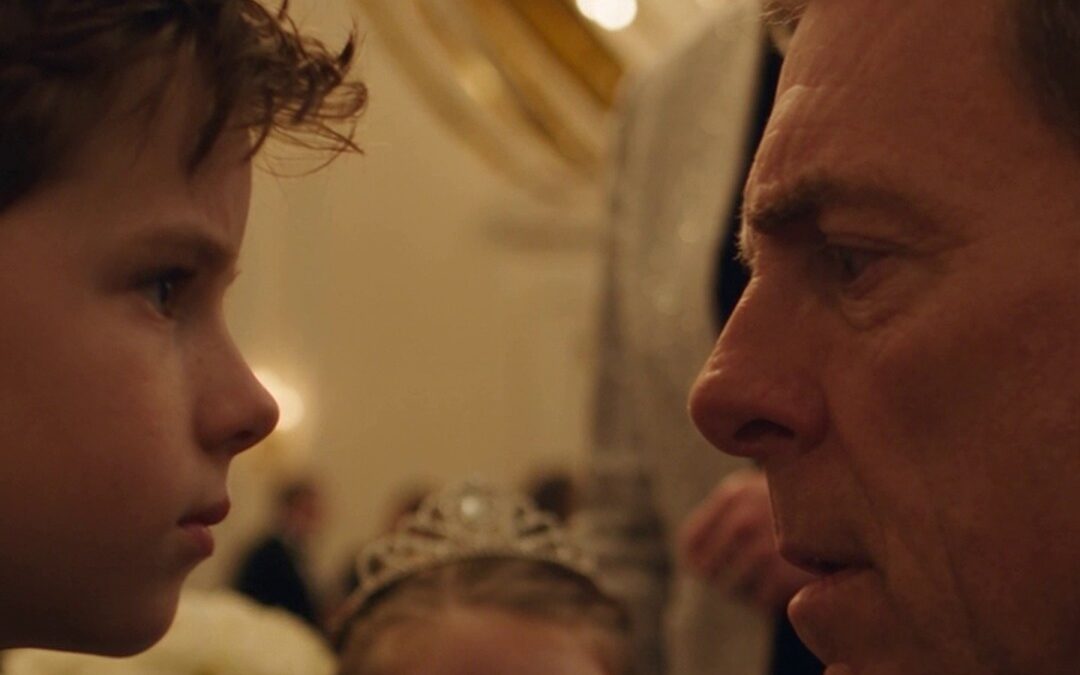
The ballroom paused around them. Warm chandeliers lit cream walls, gold ribbons, and bowls of white roses. Six-year-old Nora wore a pale-blue dress and a tiny tiara. Her father, Daniel, stood behind her wheelchair in an emerald tuxedo, both hands closing around its handles. The boy looked about six, with tousled dark hair, a worn gray-brown shirt, and a torn knee in his trousers.
“She can’t stand,” Daniel said. “Her therapist told us not to try.”
A woman beside the cake murmured, “Someone should get security.”
Nora looked from her father to the boy. “I know him.”
Daniel’s grip tightened. “From where?”
“Tuesday at the rehab center,” the boy said. “I was waiting for my grandma. You stood by the yellow wall with Ms. Lena. You said, ‘Count the stars.’”
Nora’s eyes widened. “There were stickers.”
“Five,” he said. “You stood while she held you.”
Daniel glanced toward Lena Ortiz, Nora’s physical therapist, who had come as a family friend and now stood near the dance floor. “Is that true?”
“It is,” Lena said. “Nora’s practiced a brief, supported stand as part of her plan. I’m here, and I can confirm it’s safe to repeat if Nora wants. She doesn’t have to.”
“I want to,” Nora said. “Just a little. Then I want cake.”
The boy lowered his hand but didn’t pull away. “You can hold mine if you want.”
Daniel leaned closer to his daughter. “You don’t have to prove anything to anybody.”
“I’m not.” Nora’s voice stayed small and steady. “I want to show you.”
Lena moved beside the chair. “We’ll keep this exactly to what she’s practiced. Nora, still your choice.”
Nora reached for the boy’s offered hand. Daniel hesitated, then eased his hold on the chair. Lena supported Nora as she rose only briefly, her blue skirt settling around her knees. The guests had gone quiet. Nora’s fingers stayed wrapped around the boy’s.
“I did this before,” she told her father. “Ms. Mara said not to tell you.”
Chapter 2: What the Room Heard
For a moment, the ballroom held its breath.
Nora was still upright, supported by Lena at her side and holding Eli’s hand. Daniel’s hands hovered above the wheelchair handles, close enough to steady the chair but no longer locked around it. The boy looked at Nora, not at the guests. Her skirt had settled in a soft blue ring around her knees. The tiara stayed level on her dark curls.
“I did this before,” she told her father. “Ms. Mara said not to tell you.”
Daniel’s face changed, but he did not move toward Nora. He kept his voice gentle.
“Do you want to sit?”
Nora nodded. “Yes, please.”
Lena helped her return to the chair, then waited while Nora settled her skirt and placed both hands on the armrests. Eli released her fingers only when she did. The movement was brief and careful, exactly as Lena had said it would be. Nora didn’t look triumphant. She looked relieved to be seated again.
“Are you comfortable?” Lena asked.
“Yes. My legs feel wiggly.”
“Do you want a minute before we talk?”
“No. I want to talk.” Nora glanced at the cake table. “But I want a cupcake after.”
“All right,” Daniel said. “A cupcake after.”
Eli shifted his bare feet on the polished floor. He glanced at the faces turned toward them, then at Daniel. “Am I in trouble?”
“No,” Daniel said, looking up at him. “You’re not in trouble.”
He said it quickly, then saw Eli’s eyes flick toward the guests again. The boy’s shoulders had drawn up under his worn gray-brown shirt. One trouser cuff was frayed, and the bare toes he’d planted on the floor curled once against the shine of it.
Daniel made himself keep his hands away from the chair.
“You can go back to your grandma whenever you want,” he added. “Nobody’s going to make you stay.”
Eli nodded, but didn’t move.
A man in a silver tie stepped forward from the guests. He was older, white-haired, and dressed in a navy suit with a boutonniere matching the flowers. He had been standing near the ballroom entrance, watching with the tight-lipped concern of someone trying to decide whether a scene belonged to him.
“Daniel,” he said, “perhaps this is best handled privately.”
“It will be handled carefully,” Daniel replied. “Not by removing the boy.”
The older man’s brows rose. “I meant the child shouldn’t be caught in a family matter.”
“He’s already in it,” Nora said.
Her voice was small but clear. The older man blinked, then looked down at her. She kept her hands on the chair arms. Her chin lifted a little, though she still looked tired.
Daniel looked at her too. “You’re right. He can stay if he wants to. But no one is going to ask him to explain more than what he saw.”
Eli’s shoulders loosened a fraction. “My grandma said I could wait by the kitchen door. She works here.”
A catering manager at the ballroom entrance raised a hand. “That’s right, sir. His grandmother, Mrs. Cole, is on the evening crew. He was sitting with her in the service hall. He saw Nora when she came in with Ms. Lena.”
“Thank you,” Daniel said. “Could you ask his grandmother to come here? No security.”
The manager nodded and left.
The mention of security made the nearest guests shift. Daniel had seen two of them already glance toward the ballroom doors as if they expected someone to arrive and take charge. He looked at the older man in the silver tie.
“Mr. Vale, I know you’re trying to help,” he said, keeping his voice low. “Please tell the staff nobody is to escort Eli anywhere. He can leave if he chooses, with his grandmother.”
Mr. Vale’s expression softened. “Of course.”
“I’d like people to give Nora some room, too.”
The older man turned toward the nearest tables. “Everyone, the band is taking a short pause. The celebration is continuing. If you’ll give the family a little space.”
A few guests looked embarrassed. One woman put down her glass. The man beside her leaned in and whispered something Daniel couldn’t hear. The crowd loosened, although people kept their eyes on the wheelchair.
Daniel turned back to Nora. “When did you stand with Ms. Mara?”
“Not with Ms. Mara. With Ms. Lena.” Nora frowned. “At the yellow wall.”
“Today?” Daniel asked.
“Before. Tuesday.”
“Which Tuesday?”
“The one when you went to the airport.”
He remembered the trip. He had been gone overnight for a meeting in Chicago. Mara Bell, Nora’s longtime caregiver, had said Nora had a rough appointment and was tired. Daniel had texted from the gate. Mara’s reply had been brief: *No changes. Same limits. She’s worn out.*
He had read the message between calls, standing beside the boarding line. It had reassured him. The appointment had been difficult, he’d decided, and Nora needed rest. The words “same limits” had fit what he already feared: that one hopeful moment might disappear as quickly as it came.
He remembered his carry-on tilted against his ankle, a boarding announcement cutting through the airport, the unanswered email open on his phone. He had typed, *Okay. Tell her I love her*, and put the phone away.
He had not asked what made the appointment rough. He had not called Nora. He had been relieved to have a short answer.
Now the phrase sounded different. Same limits. No changes. Nothing in the text had said Nora hadn’t stood with support. He had supplied that meaning himself.
“Did Ms. Lena tell you to keep it from me?” he asked.
“No.” Nora glanced at Lena. “She said I could tell you. Ms. Mara said you didn’t need to know yet.”
Lena’s mouth tightened, then softened. She stood near Nora’s right side, close enough to help if asked, but she did not reach for her. “That’s not what I said. I told Mara I would send a progress note through the family portal, and I did.”
Daniel stared at her. “You sent a note?”
“I sent it to both your account and Mara’s, as the portal is set up. I didn’t know you hadn’t seen it.”
“I never got it.”
“That may be a problem with the account settings,” Lena said. “I can check the delivery record, but not from my phone. I can tell you what I documented: Nora stood briefly with support at the rail. She did not walk. I recommended continuing the same plan and checking in again in two weeks.”
Daniel looked at Nora. “You stood more than once?”
“Two times. Maybe three.” She lifted one shoulder. “I liked it the first time. The second time my legs felt tired, so I stopped.”
“Did you tell Mara?”
“Yes.”
“And what did she say?”
Nora traced a seam on her dress. Her attention dropped to the little silver beads at the hem. She moved one fingertip along them, back and forth, as if finding the words required counting.
“She said not to make it a big deal. She said you’d ask me to do it again and again.”
Daniel crouched beside the chair, leaving a little space between his knee and the wheel. He wanted to reach for Nora’s hand, but he didn’t know whether she wanted him to.
“Did I ever ask you to do something you didn’t want to do?” he asked.
“Sometimes you say, ‘Show me,’ when I tell you a thing.”
The answer stayed between them. Daniel’s hands settled on his own knees.
“I’m not mad at you,” he said. “I’m trying to understand. Do you want to talk here, or would you rather take a break?”
“Here,” Nora said. “I want you to know.”
“Okay.”
“But I don’t want to do it again.”
“You don’t have to.”
“Not later either?”
“Not unless you want to.”
“Even if Grandma asks?”
“Even then.”
Nora watched him for a second, as if weighing the promise against other things he had said. “I’m not trying to prove anything to anybody.”
“I understand.”
“I want cake.”
“I’ll make sure you get cake.”
She glanced toward the cake table. A tiered white cake stood beneath a spray of fresh flowers, and beside it the cupcakes were arranged in neat rows with pale-blue icing. The room’s gold and cream decorations looked almost too cheerful around the questions passing between them. A bandleader stood near the piano with his hands folded, waiting to learn whether he should start the music.
A woman near the nearest table lowered her phone, though it was unclear whether she had been taking a picture. Another guest turned away and pretended to inspect the centerpiece. The room was beginning to breathe again, but all the attention still pressed in from the edges.
Lena stepped a little closer to Nora. “You did exactly what you wanted to do. You’re done for today. No more standing.”
Nora nodded. “I’m done.”
“Thank you for telling me,” Lena added. “And you can tell me if you want a break from questions.”
“Okay.”
Daniel drew a careful breath. “Lena, I need to know what you told Mara. And what you told me.”
“I can explain the general point now,” she said. “But Nora’s detailed care information should be discussed somewhere private. I can confirm the supported stand we just saw matches the movement she practiced with me. That’s all this demonstrates. It doesn’t mean she’s ready to walk on her own.”
“I understand.”
“Her chair remains necessary. She gets tired. She needs support for that brief stand. We’ve been careful not to turn one success into a promise about the next one.”
Nora looked at her father. “You don’t have to look sad.”
“I’m not sad that you can stand a little.” Daniel searched for words that wouldn’t make her responsible for his feelings. “I’m upset that you thought you had to hide it.”
“Ms. Mara said it was safer.”
“Safer how?”
Nora pressed her lips together. For the first time since speaking, her eyes moved toward the guests rather than the adults beside her.
“She said if I got excited and it didn’t happen next time, I’d be sad. She said you’d be sad too.”
Daniel’s gaze went toward the wide ballroom doors. “Where is Mara?”
“She’s in the garden room,” said the catering manager, returning with a woman in a black service jacket and a white apron tied over it. “She asked me to tell you she’s coming.”
Mara entered quickly, eyes moving first to Nora, then Daniel, then Lena. She was in her early fifties, with silver threads in her dark hair and the familiar canvas tote she carried everywhere. She had been with Nora since the accident, through hospital stays and long stretches of therapy, and had become the person who knew where every cup, blanket, and favorite story belonged.
Her gaze stopped briefly on Eli’s bare feet. Then she looked at Nora’s face.
“What happened?” Mara asked.
Daniel stood. “Nora stood briefly with Lena’s support. She told me you said not to tell me.”
Mara’s face lost color. “Nora—”
“Don’t ask her to take it back,” Daniel said. He kept his voice low, though the guests could still hear the edge in it. “Ask me whatever you need to ask.”
Mara looked at him, wounded and defensive at once. “I was trying to keep this from becoming a spectacle.”
“She chose to show me.”
“She’s six. She doesn’t understand what you do when you get hopeful.”
Daniel flinched. He glanced at Nora, then back to Mara. “Tell me what you mean.”
Mara drew in a breath and held it for a beat. Then her eyes went to Nora. “The last time she made a little progress, you asked her to repeat it for your mother, then your brother, then the family video call. She kept trying long after she was tired. You were excited. You didn’t mean to push her, but she felt pushed.”
Nora’s chin lowered. “I didn’t want to do it for Uncle Ben.”
Daniel remembered the video call. He had heard Nora say she was tired. He had said, “Just one more, sweetheart.” Then he had sent the clip to his family because it was the first time she had moved her foot without assistance. He had not known she cried afterward. Mara had told him Nora was “overstimulated,” and he had let the phrase stand.
He could remember his mother’s voice on the tablet, bright with surprise. He could remember telling Nora, “That was wonderful. Can you show Grandma one more time?” The phone had been propped on the arm of the couch. Nora’s face had gone still, but he had taken stillness for concentration.
“You should have told me she didn’t want to,” he said.
“I did. You said it was a good day and we shouldn’t waste it.”
He had said that. He could hear his own voice now, buoyant and impatient, as if progress belonged to him because he loved her.
“I was wrong,” he said.
Mara’s expression changed, almost imperceptibly. “I didn’t want her to have to perform for you.”
“So you told her to keep a safe, therapist-approved movement secret from me?”
“I told her not to announce it until we knew it was consistent.”
“That wasn’t your decision to make alone.”
“No,” Mara said. “But you weren’t there.”
The words landed in the center of the room. Around them, guests had started to move again, though slowly. Someone laughed too loudly near the bandstand. A server carried a tray of lemon tarts through the open space, bright yellow against white porcelain.
Daniel glanced at the guests who still watched. It would be easy to send everyone away, tell himself the important part was family business, then let the conversation disappear into a closed room. He had done versions of that before: cancel a meeting, delegate an appointment, trust the person standing closest to Nora. This time, if he used the crowd as an excuse to end the conversation, he would leave Nora with the same unanswered questions she had just risked asking.
“I missed appointments,” he said. “I know that. I let you handle the portal, the calendar, the calls. I thought I was trusting you. I didn’t realize I had given you the only route through which I heard about Nora’s care.”
“Because you wanted one person to manage the details,” Mara said. “You told me that yourself.”
“I did.”
“You were taking meetings. You were traveling. You asked me to keep you updated only if something changed.”
“I asked you to keep me updated. I never said you could decide what counted as a change.”
Mara folded her hands around the edge of her apron. “I thought this was a small thing. A brief stand. I thought waiting two weeks would protect her from disappointment.”
“Did Lena tell you to wait?”
“No.”
“Did she say Nora shouldn’t stand?”
“No. She said to keep practicing with her support.”
“Then why tell Nora not to tell me?”
Mara looked at Nora. “Because I knew he’d want to see.”
“Did you tell her I would be mad?”
Mara looked at Nora again. “I said he might be disappointed if she couldn’t do it in front of him.”
Nora’s voice was almost lost beneath the music. “You said he’d be sad.”
Mara shut her eyes briefly. “I did. I shouldn’t have.”
Daniel’s anger rose, then stalled at the look on Nora’s face. She was not looking at Mara as if she expected a fight. She looked uncertain, like someone who had asked a question and was waiting to learn which adult would answer it.
“Did you tell her not to show Lena?” Daniel asked.
“No. I didn’t.”
Lena nodded. “Nora told me she was worried her father would ask for a video. I reminded her she could share or keep the experience private. I didn’t know anyone had told her to stay quiet.”
“Why didn’t you call me after you heard that?” Daniel asked.
“I should have. I wrote it in my note as a concern about performance pressure, but I didn’t realize she meant an adult had told her to stay quiet. I didn’t want to overstep the family arrangement.”
Daniel looked at her. “I need to know what you documented and what I missed.”
“I can show you the note through the authorized portal after we leave. I can also make a separate call tomorrow with you and Nora, if she wants to join for any of it. But we shouldn’t discuss her detailed records in front of guests.”
“Agreed.”
Mara’s shoulders sagged. “I did not change the clinical report. I didn’t lie about what Lena said.”
“Did you tell me the appointment showed no changes?”
Mara hesitated. “I said there was no major change.”
“Those aren’t the same.”
“No. They aren’t.”
“Did you see my response to the portal note?”
“I saw your name on the recipient list. I assumed you’d read it.”
“I didn’t.”
“I know that now.”
Daniel heard the quiet trap in that exchange. He could turn the missed message into proof that Mara had hidden something; he could also turn his own failure to read the portal into an excuse to stop asking. Neither conclusion was enough. The record might show what Lena sent and who opened it. It would not say what Mara meant when she said Nora should stay quiet, or how long Nora had felt she had to obey.
The catering manager had stayed near the entrance, hands clasped loosely in front of her. She spoke quietly. “Would you like the side room? It’s still light in there. There’s a table, and I can keep the cake service out of the way.”
Nora looked toward the doorway. “Can the boy come?”
Daniel answered before anyone else. “Yes, if he wants to stay.”
The boy looked toward the service hall. “My grandma said I can come back after the music starts.”
“You should ask her,” Daniel said. “You don’t have to stay because of us.”
“I want to see if the band plays the fast song.”
“Then we’ll make sure you can.”
Mara touched the strap of her tote. “I should go.”
“Not yet,” Daniel said. “I want you to stay for this conversation, but Nora gets to decide whether you’re in it.”
Nora looked from Mara to Daniel. “I want Ms. Lena. I want Dad. I want the boy to stay until his grandma comes. Ms. Mara can stay too, but don’t make her talk for me.”
“Understood,” Daniel said.
Mara’s face crumpled, but she kept her voice level. “I can do that.”
They moved into the side room, where tall windows looked onto a small courtyard. Sunlight fell across a cream tablecloth and a vase of yellow tulips. The room was close enough to the ballroom that the music came through the open doors, soft and cheerful. Guests went on with the celebration beyond it, giving them a little privacy without pretending nothing had happened.
The boy stayed near Nora’s chair. Daniel pulled a chair beside her but didn’t sit until she nodded. Lena stood near the window. Mara remained by the door, holding her tote as if she might leave at any moment.
Daniel looked at Nora. “Would you like me to close the door?”
“No. I want to hear the band.”
“Okay.”
“Can I have the cupcake now?” Nora asked.
Daniel almost laughed, then stopped himself from turning the request into a moment of relief. “Yes.”
The catering manager brought a plate with a small vanilla cupcake and a blue sugar flower. Nora inspected it. She held the fork poised above the icing but didn’t cut into it yet.
“This flower is too big.”
“Want me to take it off?” Daniel asked.
“No. I want it. It just looks like a hat.”
The boy smiled. “A flower hat.”
Nora took a bite. “You can have the other half if you want.”
“I don’t eat frosting,” he said.
“Why not?”
“It sticks to my teeth.”
“That’s the best part.”
He considered it, then accepted the tiny broken edge she offered. “Maybe a little.”
Nora watched to see what he’d do with it. He put it in his mouth, made a face, and then swallowed.
“It’s sticky,” he said.
“I told you.”
“But it tastes good.”
“I told you that too.”
Daniel watched them talk. The boy’s bare feet were dusty at the toes. His trousers were patched at one knee. He was not a symbol, not a witness to be summoned and dismissed, not a tool to make Nora’s movement meaningful. He was a child who liked fast songs and disliked frosting.
He understood, suddenly, how close he had come to deciding the boy was an intruder because he had crossed the room with an offer Daniel hadn’t approved. Daniel had known nothing about him but his bare feet and worn clothes. The simple fact of the boy’s poverty had made Daniel more ready to see danger in him than in the adults he trusted.
He looked at the boy. “Can I ask your name?”
“Eli.”
“I’m Daniel. Nora’s dad.”
“I know.”
“Your grandma is working tonight?”
“She’s helping in the kitchen. She said I could sit near the door where she can see me. Then the music got loud and I saw Nora.”
“Did you come over because you remembered her from the center?”
“Yeah. She was at the wall with the stars. She looked like she wanted to say something, but the grown-ups were talking.”
Nora picked at the blue sugar flower. “I was telling Ms. Lena I wanted to wear my tiara.”
“I heard you say the princess hat was too itchy,” Eli said.
“It is. This one is better.”
“Do you like parties?” Daniel asked.
“Sometimes,” Nora said. “I like the cake. I don’t like when people say, ‘What happened?’”
Daniel nodded. “I’ll tell them to stop asking.”
“Don’t tell everybody my stuff.”
“I won’t.”
“What if they ask why I use my chair?” Nora asked.
“Would you like me to answer?”
“No. Just say, ‘Ask Nora if she wants to tell you.’”
Daniel repeated it, slowly. “Ask Nora if she wants to tell you.”
“And if I don’t?”
“Then they leave it alone.”
Nora took another bite of cake, satisfied with that answer for now. She scraped the fork over the paper liner, collecting a bit of icing. Daniel sat still beside her chair. He had spent the first minutes of the encounter trying to stop an action and then trying to make sure nobody would take the boy away. Now the next thing he could do was wait.
Mara set her tote down, then seemed to think better of it and moved it away from the edge of the door. “That’s something I should have done more clearly. I tried to keep people from asking, but I also made Nora feel she couldn’t tell you.”
“Why did you do that?” Daniel asked.
“Because I was afraid.” Mara’s answer came quickly, then slowed. “When she first came home from the hospital, you weren’t there most nights. You had to work. I was the one who saw the hard parts. I watched her get angry when she couldn’t do something, and I watched her shut down when someone praised her too loudly.”
“I know you were there.”
“I don’t think you do. Not fully. You thanked me. You trusted me. But you didn’t ask what she wanted. You asked whether she was safe and whether the schedule was on track.”
Daniel looked at Nora. “Is that true?”
“Sometimes you asked if I was safe.”
“That’s good.”
“It is. But you didn’t ask if I was bored.”
The sentence found a place he hadn’t expected. He reached for his own chair, then stopped.
“What do you want to do when you’re bored?” he asked.
“Draw. Watch the fish at the library. Go to the bakery with Ms. Mara. I like the lemon cookies.”
Mara smiled faintly. “You always pick the ones with too much sugar.”
“They’re lemon.”
“Those things can both be true.”
Daniel looked at Mara. “You took her to the bakery?”
“On days the weather was good and she was up for it. We’d sit by the front window.”
“I didn’t know.”
“I told you we went out.”
“You told me you took her for a short ride.”
“That was part of it. I thought you wanted the logistics.”
“I thought you were giving me the update.”
“Maybe we both kept the details small.”
The room went quiet. The music drifted in from the ballroom, and someone outside laughed. Nora scraped a bit of frosting from the plate. The guests were still close enough that the celebration could be heard, but not close enough to make every sentence feel like a speech to the room.
“Can I go to the fish place again?” Nora asked.
“Yes,” Daniel said. “We can go this weekend, if you want.”
“Not if you film me.”
“I won’t film you.”
“Not even the fish?”
“Not even the fish.”
She seemed to consider him. “You can take a picture of the fish if I say yes.”
“I’ll ask.”
Mara looked down at her hands. “I should have let her tell you about the stand. I thought I was shielding her from your expectations. I was also protecting myself from being the person who had to manage another difficult conversation.”
“Thank you for saying that.”
“I don’t expect that to make it all right.”
“It doesn’t.”
Mara nodded. “I know.”
Nora watched her. “Did you think I’d fall?”
Mara’s mouth parted. She looked at Lena before she answered, then seemed to realize Nora had asked her, not the therapist.
“I worried you might get tired,” she said. “I didn’t think Lena would let you do something unsafe.”
“Did you think I couldn’t do it?”
“I thought it might not work every time.”
“It didn’t work every time,” Nora said. “The first time I couldn’t stay long.”
Mara sat on the edge of the chair by the door, still leaving space between herself and the rest of them. “I know.”
“Then why couldn’t I tell Dad?”
“I thought he’d want you to repeat it whenever he felt worried.”
Daniel looked down. “I did ask you to repeat things when I was worried.”
Mara’s expression sharpened. “You did. You would see one good moment and want it to reassure you.”
“I shouldn’t have put that on her.”
“No,” Mara said. “You shouldn’t have.”
Nora looked at her father. “I don’t mind when you’re happy.”
Daniel met her eyes. “I like being happy with you.”
“But when you take the phone out, everybody says it again.”
“I’ll stop filming unless you ask me to.”
“I don’t want to ask you every time.”
“Then I won’t.”
“And if I say I did something, you can just say, ‘That’s nice’?”
“Would you like that?”
“Sometimes. Or you can ask if I want to tell more.”
“All right.”
Nora took the last bite of cupcake and licked a little icing from her lip. Daniel offered her a napkin, and she accepted it. He resisted the urge to wipe her face himself. She wiped her own mouth, then looked at the napkin.
“There’s blue on it.”
“That’s the flower hat,” Eli said.
“It looks like paint.”
“Could be paint.”
“It’s sugar.”
“Maybe sugar paint.”
Nora smiled. The moment was brief, ordinary, and not an argument. Daniel let it be brief and ordinary.
He turned to Lena. “What exactly did Nora practice, and what does the note say?”
“I can summarize what we did today. She has had a mobility plan for months. The chair remains her primary way to move around, because distance and fatigue are still difficult. At the rail, she’s been practicing a brief supported stand when she wants to. We began that after she showed she could bear weight with support during a regular session. We are not treating it as independent walking.”
“Was I told any of that?”
“The last note I sent said we were introducing a short supported stand at the rail. It also said she was not ready to walk independently and should continue using her chair.”
“When did you send it?”
“Two Tuesdays ago. It went through the portal.”
“Can you verify that?”
“Yes, with the portal’s delivery record. I can’t show you the full clinical note here, but I can confirm the date and the summary once we’re in the secure account.”
Mara said, “I remember the note.”
Daniel looked at her. “You told me the appointment showed no major change.”
“I did.”
“Why not say she had begun standing?”
“Because you were on the phone with your mother, and Nora was in the next room. You said you had ten minutes before a board call. I thought I’d tell you later.”
“Did you?”
“No.”
“What happened later?”
“I forgot. Then I told myself it wasn’t important because Lena had said not to expect walking.”
Lena spoke carefully. “I did say we shouldn’t expect independent walking at this point. I didn’t say her supported standing was meaningless. Those are different things.”
Mara shook her head. “I know that now.”
“Did you know it then?” Daniel asked.
“I knew she could stand with help. I didn’t think you needed to know that day.”
“Did you tell Nora I would be disappointed?”
“I said you might be.”
“Why?”
“Because you had been disappointed before.”
Daniel began to reply, then stopped. He had an answer ready and knew it would only be another defense of his intentions.
“I have been frightened before,” he said. “I may have looked disappointed.”
“You did,” Nora said.
He turned toward her. “When?”
“When I couldn’t do the step in the hallway.”
“That wasn’t your fault.”
“I know. But you got quiet.”
He remembered the hallway practice, the walker in the corner, the way he’d looked away so Nora wouldn’t see his face. He had thought silence was a kindness. She had seen it anyway. He had stood there with his hands in his pockets, wanting to ask whether she was tired, wanting to tell her it was okay, and had said nothing because he feared the wrong words would make her feel worse.
“I was scared you’d lose what you had worked for,” he said.
“I didn’t lose it. I just didn’t do it then.”
“You’re right.”
“I don’t like when you get quiet and then everybody says you’re fine.”
Daniel nodded. “I’ll try to tell you the truth. If I’m scared, I’ll say I’m scared. I won’t make it your job to fix that.”
Mara’s eyes shone. “That’s what I was trying to prevent. I saw how much the whole room could land on her.”
“You could have told me that.”
“I did, but I didn’t keep insisting.”
“And I didn’t make enough room for it.”
Lena drew a chair closer but didn’t sit until Daniel gestured for her to. “There’s a difference between protecting Nora from pressure and controlling what she can disclose. She needs room to say no, and she also needs the adults around her to communicate accurately.”
“I agree,” Daniel said. “I want the communication set up so she can tell me herself, and so I’m not relying on one person’s memory of a portal note.”
“Then we should review the contact settings and the family meeting plan,” Lena said. “The clinic can include you directly as the primary contact, and Mara can remain copied if you both want that. Nora can join the parts she chooses, in age-appropriate terms.”
Mara crossed her arms. “If I’m copied, will I still be allowed to care for her?”
The question surprised him. It carried fear under the defensiveness. Her hands, crossed tightly over her apron, made her look less like someone trying to control the room and more like someone waiting to learn whether she had already lost her place in Nora’s life.
“I’m not deciding your job in this room,” Daniel said. “But I am changing the communication arrangement. You won’t be the only person who sees her care notes, and you won’t be asked to tell her what she may tell me.”
“I never meant to keep her from you.”
“I believe that you meant to protect her. I also believe you silenced her.”
Mara’s face tightened. “I did.”
Nora set her empty plate aside. “Are you still going to come to the bakery?”
Mara looked at her. “If you want me to.”
“I do. But if I tell Dad something, you can’t say I’m not supposed to.”
“I won’t.”
“Promise.”
“I promise.”
Daniel said, “I want to hear her directly too. I’ll come to the bakery with you if you want me there.”
Nora pursed her lips. “Maybe the first time just me and Ms. Mara. Then you can come another time.”
“All right.”
This was the first choice that cost him something small but real: not being included simply because he was her father. He had to accept that Nora’s trust could not be claimed by title. He had wanted to fix the evening by making a plan for all three of them to go to the bakery together. He saw the urge for what it was: a way to demonstrate that everything could be repaired on his timetable.
“All right,” he said again. “You and Mara first.”
Nora nodded.
Mara let out a small breath. “I’ll take her whenever she wants.”
“After the next appointment,” Lena said, “we can talk about the schedule and what support she needs for outings. But that doesn’t have to be a bigger conversation tonight.”
Nora frowned. “I can go to a bakery.”
“You can,” Lena said. “I’m not saying you can’t. I’m saying we can make sure the grown-ups have the right information about the outing, and you get a say in it.”
“I want lemon cookies.”
“That seems like important information.”
“They’re not too sweet,” Nora said.
Mara smiled. “They are extremely sweet.”
“They’re lemon.”
“Those things can both be true,” Daniel said.
Nora glanced at him. “You listened.”
“I did.”
The ballroom doors opened. A woman in a catering uniform entered, carrying a folded cardigan. “Mara, your mother’s here.”
Mara looked toward the doorway. “She’s still working?”
“Mrs. Cole’s finishing the dinner service. She asked whether Eli was all right.”
The boy straightened. “She’s my grandma.”
Daniel glanced at him. “Would you like to go back to her now?”
“I want to hear the fast song first.”
Nora’s eyes lit. “They’re playing it soon.”
The bandleader, visible through the doors, lifted a hand. The next song began with a quick, bright beat. Several guests laughed and moved toward the dance floor. The quick rhythm reached the side room before the melody did. Eli tipped his head toward it.
“Is that the fast one?” Nora asked.
“I think so,” he said.
“I want to hear it.”
Daniel stood. “Nora, do you want to stay here, go out to hear the song, or take a break?”
“Go out. But I want to be by the edge.”
“We can do that.”
“Eli can come.”
“If his grandmother agrees,” Daniel said. “We’ll ask.”
The catering manager returned with Mrs. Cole, a short, sturdy woman with flour on one sleeve and a hairnet tucked into her pocket. She had the same dark eyes as Eli.
“There you are,” she said to the boy. “I could see you from the service door. You all right?”
“Yes. I’m going to hear the fast song.”
“Are you sure?”
He nodded. “Nora said I can.”
Mrs. Cole looked at Daniel. “I’m sorry he wandered over.”
“He didn’t wander into danger. He came to say hello to someone he remembered.”
“I know. He saw her at the center, waiting with her father?”
“No,” Eli said. “With Ms. Lena. Dad wasn’t there.”
Daniel caught the distinction. He did not correct the boy or take offense. It was simply true. He hadn’t been there.
Mrs. Cole glanced from Eli to the girl in the wheelchair. “You remembered Nora from the Tuesday room?”
“Yes,” Eli said. “The yellow wall with the stars.”
“He sits with me when I’m on the early shift,” Mrs. Cole said. “The center’s next door to the day-care place where his mom used to drop him off. We wait for his after-school pickup now. There’s a little table by the reception desk.”
Daniel had not known the ordinary route that brought Eli there. The boy hadn’t been wandering around a private clinic. His grandmother’s work schedule and his school pickup had put him in the same public waiting area as Nora, once or twice a week.
Mrs. Cole’s hand rested briefly on Eli’s shoulder. “He’s meant to stay where I can see him. Sometimes he forgets when he sees somebody he knows.”
“I came to say hello,” Eli said.
“I know, sweetheart. We’ll talk about asking first next time.”
Eli glanced toward Nora. “I was going to ask her.”
“You did,” Nora said. “You asked me to stand.”
“I asked if you wanted to.”
“You said, ‘Let her try.’”
“That’s because your dad said no.”
Daniel accepted the correction without defending himself. “You’re right. I did.”
Mrs. Cole looked between them. “Did he do anything unsafe?”
“No,” Lena said. “I was there. Nora chose a movement she’s practiced. Eli offered his hand. He didn’t pull her.”
Mrs. Cole’s face eased. “Thank you for telling me.”
Daniel nodded. “No one is going to blame him for the offer. I want to be clear about that.”
Eli had been watching Daniel. “Can I stay until the song ends?”
Mrs. Cole looked at him, then toward the kitchen door. “You can stay by me. When the song ends, we go back. The dinner service is nearly done, but I still have to finish.”
“Okay.”
Daniel looked at the older man in the silver tie, who had followed them into the doorway. “Mr. Vale, could you let the guests know the celebration is continuing? No photos of Nora without her permission.”
Mr. Vale studied him. “Of course.”
“And if anyone asks about what happened, tell them it’s not a performance.”
The older man nodded. “I’ll do that.”
Nora’s father released the chair handles entirely. He moved to her side and waited. The chair hadn’t moved while they talked. Its position, just behind Nora, still marked the boundary Daniel had first used to hold her in place. He looked down at his hands and noticed the pale dents the handles had left against his palms.
He stepped to her left, leaving the path clear.
“Can we go?” she asked.
“Yes.”
He waited.
Nora’s eyebrows lifted. “You can push me.”
“Do you want me to?”
“Yes. Just not fast.”
“I won’t.”
He set his hands on the handles lightly, then looked to Lena. She gave a small nod. It was permission to proceed with the ordinary support she’d already said was appropriate, not approval for anything more.
Daniel pushed the chair at Nora’s pace through the side door. Lena walked beside them, while Eli and his grandmother followed. The guests parted, not into an aisle of honor, but into an ordinary path wide enough for the chair.
One guest stepped back too sharply and nearly bumped the dessert table. “Sorry,” she murmured.
“It’s okay,” Nora said.
A little boy in a navy jacket stood beside the table, watching the wheels. His mother took his hand. She didn’t pull him away; she simply gave Nora space and let him keep looking.
At the edge of the dance floor, Nora watched the musicians. The room was still bright with cream, gold, and blue. The song had a lively, quick rhythm, and people were clapping on the offbeat. Eli shifted from foot to foot, eager, while Mrs. Cole watched him from a few steps back.
“Do you want to dance?” Daniel asked.
“Not standing.”
“I didn’t mean standing.”
Nora looked at him. “You can dance with the chair?”
“Only if you want.”
“Not fast. It makes my head feel funny.”
“Slow, then.”
She held out one hand. Daniel offered his, palm up, and waited.
Nora set her fingers in his. He moved the chair in a small turn, no more than a gentle sway. Lena stayed nearby, and Daniel kept his eyes on Nora’s face rather than on the guests. He moved only as far as Nora’s hand and expression invited him to.
Eli watched, then copied the rhythm with his bare feet, careful not to kick anyone. Nora laughed when he missed the beat.
“You’re bad at dancing,” she told him.
“I’m better at the fast song.”
“Show me.”
He glanced at his grandmother. She nodded. Eli danced three quick steps in place, then spun once, his worn shirt lifting at the hem. He stopped at the edge of the dance floor and offered Nora his hand again.
“Want to do the chair turn?” he asked.
Nora looked at her father. Daniel loosened his fingers and stepped back, leaving the choice with her.
“Yes,” she said.
Nora took Eli’s hand, and this time Daniel kept his own hands open at his sides.