PART 2: The Bedrock Datum Plate Protects Section Four as Jesse Vance Defends the Historic Graves from Developers
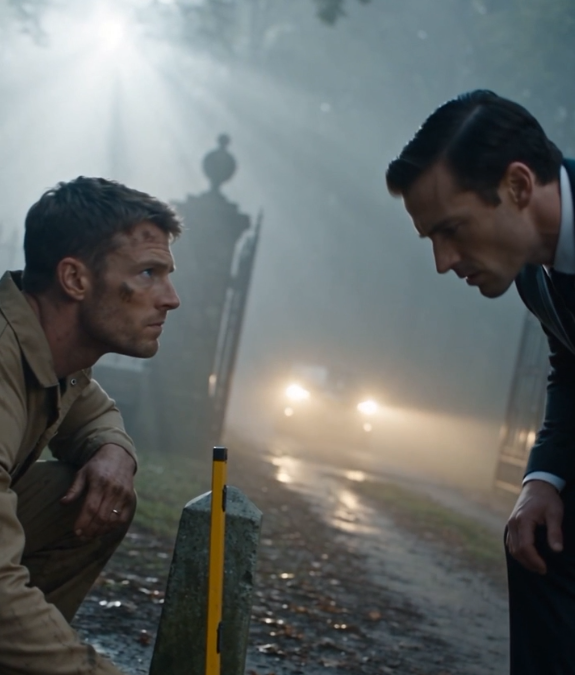
The flashing yellow headlights of the Miller family hearse reflected off the iron gate rails fifty yards down the hill.
Lance Rourke did not look toward the road.
“Tell your friends down at the gate to back out onto the shoulder,” Lance said, turning his shoulder to the wind.
“Interfering with a licensed funeral service in the Commonwealth of Virginia is a class one misdemeanor, Lance,” I said, keeping my boots planted in the red clay.
“Nobody is interfering with their grief,” Lance replied smoothly.
“They have a designated garden plot on the lower terrace, fully sodded and manicured.”
“Edgar Miller purchased this family plot in 1968,” I told him, pointing the bronze sounding rod toward the row of cedar trees behind my backhoe.
“His wife buried their first daughter here fifty-four years ago, and she is going into the ground beside her child today.”
The taller security guard stepped across the open cut, his heavy boots crushing the spade-turned sod.
“Mr. Rourke gave you a directive, buddy,” the guard said, resting a palm on his utility belt.
“The gate stays chained until our survey crew stakes the excavation perimeter.”
I lifted the bronze rod out of the test hole, wiped the wet red silt with my thumb, and turned toward the gatehouse path.
“If you lay a hand on me while I clear an active burial route, your company takes the liability before noon,” I said.
The guard glanced at Lance, hesitating just long enough for me to clear the limestone terrace.
I walked down the gravel drive with my key ring out, passing the row of granite markers carved with names from the Second World War.
At the main entrance, Warren Price, the funeral director from Buena Vista, stood beside the hearse with his black umbrella tucked under his elbow.
Behind him, four sedans carrying the Miller children and their gray-haired mother sat idling with their hazard lights blinking.
“What is happening here, Jesse?” Warren asked quietly as I reached the padlocked chains.
“New management bought the town’s maintenance contract yesterday, Warren,” I said, fitting my grandfather’s long iron skeleton key into the gate’s historic mortise lock.
Lance had wrapped a modern hardened steel chain through the ornate pickets, securing it with a yellow commercial padlock.
I walked to the stone pier, lifted the rusted cast-iron cover of the emergency fire box, and pulled out the heavy forged bolt cutters my family kept for winter storms.
With one hard press of my chest against the handles, the cheap hardware-store chain snapped and dropped into the grass.
“Jesse, that’s private property!” Lance shouted from halfway down the slope, jogging awkwardly in his dress shoes.
“The Commonwealth requires unobstructed ingress for funeral processions once a county burial transit permit is issued,” I said, swinging the heavy iron leaves inward.
Warren gave me a solemn nod and climbed back into the hearse.
The black car rolled forward slowly, its tires crunching across the damp limestone gravel toward the upper ridge.
Lance caught up to the gates breathing hard, his silk tie whipped across his lapel by the mountain draft.
“You just committed criminal property destruction on corporate real estate,” Lance hissed, his face mottled red.
“Call Sheriff Armentrout,” I told him, stepping past him toward the tool barn.
“Tell him Jesse Vance is burying a veteran’s widow in Section Four, and make sure he brings his deed ledger.”
Lance pulled a sleek smartphone from his coat and tapped the screen with a trembling thumb.
“I don’t need the sheriff to break an hourly laborer, Jesse,” he said, staring at my back.
“By two o’clock this afternoon, our heavy excavators will be on this ridge, and your grandfather’s junk will be sitting in the county dump.”
I did not answer him as I walked up the hill behind the hearse.
At the gravesite, the Miller family gathered under the green canvas canopy while the minister opened his worn black Bible.
I stood twenty paces back near the shade of an old sugar maple, holding the bronze sounding rod straight against my leg.
Sarah Miller, sitting frail in her folding chair, looked across the trench and caught my eye through her black veil.
She offered a brief, fragile nod, knowing that fifty years ago my grandfather had dug the small grave three feet to her left.
Behind the maple grove, two of Lance’s clipboard-carrying surveyors were already setting up yellow tripod lasers on the crest.
They spoke in hushed voices, pointing digital rangefinders directly over the heads of the mourners toward the western view of the valley.
The view was what Lance was really selling.
Section Four sat on the highest limestone shelf of the entire ridge, overlooking forty miles of rolling pasture toward the Blue Ridge crest.
To an out-of-state investment group, eighty square feet of consecrated ground was an absurd waste of high-margin panoramic acreage.
A four-story glass columbarium with climate-controlled brass niches could generate eight million dollars on the exact dirt where old Edgar Miller had planted his cedars.
When the minister finished the final benediction, the family stepped forward one by one to lay white carnations on the bronze casket lid.
Thomas Miller, the oldest son, walked over to me as the rest of the family moved slowly back toward the limousines.
“Warren told us what happened at the gate, Jesse,” Thomas said, offering a calloused hand shaped by years in the rail yards.
“Your mother deserves her rest without corporate lawyers hovering in the trees, Thomas,” I said, taking his grip.
“We heard rumors in town that the council sold the cemetery to cover the municipal water bond deficit,” Thomas said, looking back at the yellow tripods.
“The council had no legal right to sell Section Four,” I answered quietly.
“Then don’t let them move my sister, Jesse,” he said, his voice dropping low.
“I won’t,” I promised.
Once the last car had cleared the gate, I lowered the casket into the concrete vault with the hand winches, sealed the heavy tongue-and-groove lid, and began the slow, rhythmic work of backfilling.
I shovelled for two hours until the mound was crowned and dressed with fresh sod from the nursery bed.
My shoulders burned with familiar, honest exhaustion, but my mind was fixed on the dull iron ring I had felt beneath the bronze rod that morning.
I shouldered my spade, clipped the sounding rod to my belt, and walked down to the small brick gatehouse at the bottom of the hollow.
The gatehouse had been built in 1912 out of local river brick, featuring a single iron stove, a heart-pine desk, and a basement vault set directly into the bedrock.
Lance had already plastered a bright orange notice of eviction across the heavy oak door.
I pulled my personal brass key from my pocket, turned the deadbolt, and stepped inside.
The smell of dry paper, floor wax, and damp lime mortar hung thick in the shadowed air.
I lit the overhead bulb and walked down the narrow stone stairs into the dry cellar vault where the county archives had deposited the original township cemetery records eighty years ago.
In three heavy steel fireboxes sat forty-two canvas-bound ledger books, detailing every interment since the first settler fell to fever in 1841.
I opened the 1888 volume, the year the Cedar Crest Township Cemetery Association was chartered after the old church burned.
My great-grandfather, Silas Vance, had signed the charter as Custodian of the Freehold.
I turned the brittle, yellowed rag-paper pages until I found the surveyor’s plot map for Section Four.
The township had not created the cemetery out of public lands.
In October of 1888, the four upland acres had been deeded to the cemetery association by Silas Vance under a strict testamentary deed of trust.
The ink was faded iron gall, written in a clean copperplate script that belonged to my blood.
“Said four acres of the Highland Crest shall remain forever under the sole care, tenure, and custody of Silas Vance and his lineal descendants, held in sovereign trust for the unplotted dead of the Shenandoah, free from all municipal debt, levy, or commercial partition.”
I ran my calloused finger along the bottom margin.
“The boundary thereof shall be reckoned from the central datum plate set into the limestone bedrock, accessible only by the Custodian’s graduated sounding measure.”
I looked down at the hexagonal bronze rod resting on the pine table beside me.
The notches etched along its length were not merely inch indicators for vault depth.
The rod was an 1888 surveyor’s alignment gauge, cut to measure specific offsets from the benchmark plate Silas had buried in the subsoil.
A loud thud shook the ceiling above my head, followed by the scrape of heavy metal across the porch floorboards.
I closed the ledger, slid the sounding rod into my belt sheath, and climbed the basement stairs.
Standing inside my office was Lance Rourke, flanked by two men in bright orange high-visibility vests and an armed county deputy I did not know.
“I told you to clear your belongings by two, Vance,” Lance said, leaning over my desk with a clipboard.
“Deputy Miller is here to serve your formal trespass exclusion.”
The young deputy looked uncomfortable, adjusting his gun belt while keeping his eyes on the floor.
“Afternoon, Jesse,” the deputy muttered.
“Afternoon, Kevin,” I replied evenly.
“Did Sheriff Armentrout send you out here to evict a freeholder without a court hearing?”
“Sheriff Armentrout is at the regional conference in Roanoke,” Lance cut in, slapping the clipboard against the desk.
“This is an administrative order signed by Magistrate Lindner pursuant to Virginia code governing commercial property access.”
“Cedar Crest Operating LLC is the recorded entity on the municipal tax rolls,” Lance continued, his tone dripping with practiced authority.
“Shenandoah Memorial Holdings purchased one hundred percent of the LLC’s membership shares and assumed the town’s three-hundred-thousand-dollar maintenance lien.”
“We hold the registered certificate of transfer from the town council,” he said, tapping a red seal on the top sheet.
“The town council never owned the underlying fee simple of Section Four, Lance,” I said, pointing down toward the cellar.
“They owned an operating franchise that allowed them to collect maintenance fees on Sections One through Three.”
Lance let out a sharp, dismissive sigh.
“Every backwoods ditch digger thinks he’s a constitutional lawyer,” Lance said, turning to the two workers in vests.
“Change the locks on this door right now.”
“Pack every box on these shelves into the industrial dumpster behind the barn.”
“Touch one historical ledger in that cellar, Lance, and you will be facing state felony charges under the Virginia Antiquities and Cemetery Protection Act,” I warned, stepping between his workers and the vault door.
Lance waved the workers back with an irritated flick of his wrist.
“Deputy, remove this man from the premises,” Lance ordered.
Deputy Kevin Miller took a cautious half-step forward, his voice apologetic.
“Jesse, look, I don’t want to drag you off in cuffs, but Mr. Rourke has a certified operating license from the Department of Professional and Occupational Regulation.”
“Until a circuit judge says otherwise, the paper he’s holding gives him possession of the gatehouse.”
“I understand your position, Kevin,” I said, holding the deputy’s gaze.
“I’ll leave the office for now, but Section Four remains under active custodial hold.”
“You have no hold on anything,” Lance sneered, pocketing his pen.
“The drilling rig arrives at seven tomorrow morning to core-sample the ridge for our foundation pilings.”
“If you set foot on that grass after sunrise, you will be booked into the county jail before breakfast.”
I took my jacket from the wall hook, grabbed my grandfather’s field notebook, and walked out into the cold afternoon fog.
Behind me, the sharp whine of a cordless drill began tearing into the antique brass latch of the gatehouse door.
I got into my beat-up Ford pickup and drove three miles down the valley road toward the old limestone mill where my uncle, Eli Vance, ran his small surveyor repair shop.
Eli was seventy-one, with bad knees and hands stained permanently with machine oil, but he had spent forty years as the chief deputy surveyor for Rockbridge County before he retired.
When I walked through the screen door of the shop, the familiar clinking of brass gears and the smell of mineral spirits welcomed me.
Eli sat behind an antique transit scope mounted on a heavy wooden tripod, adjusting a vernier scale with a tiny screwdriver.
“You’re walking like a man who just had his toes stepped on by a flatlander, Jesse,” Eli said without looking up from the lens.
“Shenandoah Memorial Holdings locked the gatehouse, Eli,” I said, setting the notched bronze rod on the counter.
Eli stopped what he was doing and turned around on his swivel stool.
He picked up the bronze rod, feeling the clean hexagonal flats with his weathered fingers.
“Did you take this to Section Four?” Eli asked quietly.
“I sounded the subsoil beside the Miller plot this morning,” I answered.
“I struck the datum plate at fourteen inches.”
Eli let out a low whistle, setting the rod back on the velvet cloth on his bench.
“Your grandfather told me before he passed that nobody had put a plumb over that plate since the flood of sixty-nine,” Eli said.
“Lance Rourke claims the township charter transferred the fee simple when the council ceded the maintenance debts,” I said.
“Lance Rourke is a slick paper-pusher from Northern Virginia who thinks land only exists inside a digital GIS database,” Eli spat.
He stood up, walked over to a green metal filing cabinet in the corner, and pulled out an old cloth-backed survey map from 1954.
He unrolled it across the counter, weighing down the corners with two brass plumb bobs.
“Look right here, Jesse,” Eli said, tapping a red line drawn across the ridge.
“In 1888, when your great-grandfather Silas created the cemetery trust, the state of Virginia had just overhauled its corporate cemetery statutes.”
“Silas knew that private cemetery corporations had a habit of going bankrupt, leaving graves abandoned when the money dried up.”
“So he created a split-estate conveyance that was completely airtight under Virginia common law,” Eli explained.
“The operating company received the surface easement for perpetual care and interment fees on the lower terraces.”
“But the fee simple absolute of Section Four—the entire upland crest—was deeded to the Custodian of the Freehold as an unalienable trust.”
“Who holds the custodial seal now, Eli?” I asked.
Eli looked directly into my eyes, a faint, proud smile touching the corners of his mouth.
“The seal isn’t a piece of paper, Jesse,” Eli said, tapping the bronze sounding rod.
“The seal is that rod.”
“Silas had the county surveyor cut that hexagonal bronze bar out of an old church bell casting in 1888.”
“The bottom six inches carry the thread pitch that matches the inspection plug inside the bedrock datum plate.”
“Unless a surveyor uses that exact rod to unscrew the datum seal and certify the corners, no subdivision, grading permit, or excavation on Section Four can ever be legally recorded in Rockbridge County.”
“Does Lance know the datum plate exists?” I asked.
“Lance doesn’t even know what a sovereign datum is,” Eli said, picking up his car keys from the pegboard.
“He thinks every boundary in America can be established by a GPS satellite and a county tax map.”
“Where are we going?” I asked.
“We’re going to Lexington to see Martha Higgins at the land records office before she locks the vault for the night,” Eli said.
“And then we’re going to pay a visit to County Surveyor Lyle Patterson.”
We drove into Lexington as the streetlights were flickering on along Main Street.
The county courthouse was quiet, but Martha Higgins, a woman who had worked the deed indexes since the Nixon administration, was still sitting at her desk behind the wire counter.
“Eli Vance, you know recording closes at four-thirty,” Martha said, peering over her half-moon glasses.
“I don’t need a recording, Martha,” Eli said, leaning over the wooden counter with a friendly grin.
“I need you to pull Deed Book 44, page 312, and the original chancery roll for the 1888 October term.”
Martha shook her head, but she was already reaching for her key ring.
“Only you would come looking for nineteenth-century chancery paper on a rainy Tuesday evening,” she murmured.
Ten minutes later, Martha laid two massive, leather-bound books across the high consultation desk.
The chancery decree was preserved under preservation plastic, crisp and clear despite the passage of one hundred and thirty-six years.
Eli pointed to the judicial signature at the bottom: Circuit Judge Archibald Stuart.
“Read paragraph four out loud, Jesse,” Eli said.
I leaned over the yellowed page and read the faded script.
“Decreed that the four acres designated as Section Four of Cedar Crest shall remain an indefeasible common freehold under the perpetual guardianship of the Custodian, to be held in trust for the burial of those who possess no estate, and no corporate entity, town council, or creditor shall have power to alienate, mortgage, or disturb said ground so long as the Custodian maintains the registry of the unplotted dead.”
Martha pushed her glasses higher on her nose and looked at me.
“Jesse, that developer filed an administrative merger petition this morning claiming Section Four was abandoned surplus municipal property,” Martha said.
“Did the county surveyor sign off on their preliminary plat?” Eli asked sharply.
“Lyle Patterson refused to sign it this afternoon,” Martha revealed, leaning in closer.
“Lyle told their attorney that their survey coordinates didn’t match the historical benchmarks on the ridge, and he wouldn’t certify the boundary without field verification.”
“Where is Lyle right now?” I asked.
“He’s at his office across the square, tearing his hair out over their filings,” Martha said.
Eli and I crossed the wet courthouse square through the driving rain.
Lyle Patterson’s office was located in a narrow brick row building between a bail bondsman and a title company.
Lyle was sixty-four, a meticulous engineer who still preferred hand-drafted linen plats to computer screens, and he looked up with relief when Eli and I walked through his door.
“Eli, thank God,” Lyle said, tossing a red pencil onto a sprawling blueprint.
“Lance Rourke’s Richmond attorneys have been calling my cell phone every twenty minutes threatening to sue the county if I don’t sign this plat by eight tomorrow morning.”
“What did they submit to you, Lyle?” I asked, stepping up to the drafting table.
“They submitted a digital drone survey that treats the entire crest of Section Four as vacant upland brush,” Lyle said, tapping the drawing with his knuckles.
“They claim there are zero interments between the Miller plot and the western stone wall.”
“That ridge isn’t vacant brush,” I said, setting my grandfather’s field notebook on the edge of the desk.
“Between 1918 and 1932, the old county foundry ran full shifts during the flu epidemic and the early depression years.”
“Men died with no family, no money, and no church affiliation in the valley.”
“My great-grandfather and my grandfather buried eighty-two foundry workers, stonecutters, and their infants in Section Four without granite headstones.”
“They used red cedar stakes and limestone field markers, and my grandfather recorded every single coordinate in this ledger using the datum plate as the zero benchmark.”
Lyle pulled the notebook toward him, his eyes widening as he turned the pages filled with my grandfather’s neat pencil notations.
“Every burial has an azimuth bearing, a distance to the tenth of a foot, and a sounding depth,” Lyle whispered, looking up at Eli.
“If there are eighty-two unplotted historical graves on that crest, Lance Rourke’s columbarium project isn’t just invalid,” Lyle said.
“Under Virginia Code 18.2-126, disturbing known unmarked graves without a circuit court disinterment permit is a Class 4 felony carrying up to ten years per count.”
“Can you verify the datum plate with us at sunrise, Lyle?” I asked.
Lyle looked at the bronze sounding rod on my belt, then reached for his rain jacket on the coat stand.
“I won’t wait until sunrise,” Lyle said, grabbing his yellow hard hat.
“If Lance brings a core-drilling rig onto that ridge at dawn, he could destroy the primary benchmark before we can record the baseline.”
“We go out there tonight, sound the plate, verify the coordinates, and I will issue an immediate stop-work order under county survey authority before he turns a single wheel.”
We drove back to Cedar Crest under the cover of a dense valley darkness, the headlights of Lyle’s county truck cutting through the sheets of mist.
The cemetery was dead quiet when we pulled off the road fifty yards short of the chained main gates.
We climbed the steep wooded embankment on foot, carrying Lyle’s electronic total station, a heavy car battery for lighting, and my grandfather’s sounding rod.
The cold rain seeped through my canvas coat as we reached the crest of Section Four.
The red clay around the Miller grave had washed smooth under the downpour, the white carnations lying limp against the wet mound.
I dropped to my knees in the tall, wet bluegrass twenty feet west of the trench.
I held the bronze sounding rod plumb, aligned the tapered hexagonal tip with the faint depression in the sod, and pressed down with all my weight.
Twelve inches down, the tip met the hard, unyielding resistance of the cast-iron datum plate with that same sharp ring.
“Clear the sod, Jesse,” Lyle whispered, shining a high-intensity work light over my hands.
Eli handed me an entrenching shovel, and I carefully sliced a twelve-inch square of wet turf, lifting it away like a carpet flap.
Beneath the grass roots lay a circular cast-iron plate, eight inches across, encrusted with eighty years of red clay and mineral scale.
In the center of the plate sat a raised square lug, flanked by deeply stamped lettering that had been protected from the air by the packed subsoil.
Lyle sprayed the iron with mineral spirits, scrubbing the surface with a stiff wire brush until the lettering shone dull gray under the halogen beam.
“SURVEY DATUM NO. 1 — CEDAR CREST FREEHOLD — 1888,” Lyle read aloud, his voice trembling slightly with professional reverence.
“CUSTODIAN’S PERPETUAL TRUST.”
Eli pointed to the center of the plate.
“The square lug isn’t a bolt, Lyle,” Eli said.
“It’s a threaded cap.”
I lifted the bronze sounding rod and inverted it.
The heavy bronze T-handle had a precision-broached square recess cut into its central boss, sized perfectly to fit the iron lug.
I set the handle over the iron square and leaned my chest into the turn.
For a second, the century-old threads refused to budge.
Then, with a sharp metallic crack that echoed across the dark ridge, the seal broke.
I turned the handle three full counterclockwise rotations until the threaded iron plug lifted free in my hand.
Inside the hollow core of the datum housing sat a cylindrical copper container, sealed with beeswax around its threaded brass rim.
Lyle held his breath as I lifted the heavy tube out of the bedrock sleeve.
I twisted the brass cap, breaking the dry wax seal, and slid a rolled parchment scroll into Lyle’s waiting, gloved hands.
At dawn, Lance Rourke marched up the ridge beside a roaring core-drilling rig, his face triumphant until he saw Sheriff Armentrout standing beside County Surveyor Lyle Patterson.
“Shut those diesel engines down right now,” Sheriff Armentrout ordered through his cruiser’s megaphone, holding up Lyle’s emergency stop-work injunction.
Lyle unrolled the copper-encased 1888 freehold deed across the hood of the patrol car, displaying Judge Stuart’s original chancery decree and my great-grandfather’s surveyed burial register.
“You don’t own Section Four, Mr. Rourke,” Lyle announced firmly, pointing Lance toward the eighty-two verified coordinates of the historic graves lying beneath his tracks.
“The Commonwealth’s Attorney has already revoked your corporate grading permit, and disturbing this consecrated ground will result in immediate felony warrants for your entire executive board.”
Lance stared at the indisputable legal chain, his jaw tightening as the intimidated drilling crew killed their throttles and began backing down the gravel drive.
By noon, Magistrate Lindner had formally dismissed my trespass exclusion, ordering corporate security to surrender the gatehouse keys and vacate Cedar Crest before sundown.
The town council voted unanimously that evening to reconfirm the Vance family’s perpetual freehold custody over the entire highland crest.
With the ridge quiet again, I knelt beside the fresh earth of the Miller plot, resealed the bedrock datum cap, and felt the notched bronze sounding rod hum steady against the eternal Shenandoah clay.