A Powerful Man’s Crying Baby Fell Silent in the Courthouse—Then a Mother Found a Note That Put Her Son in Danger
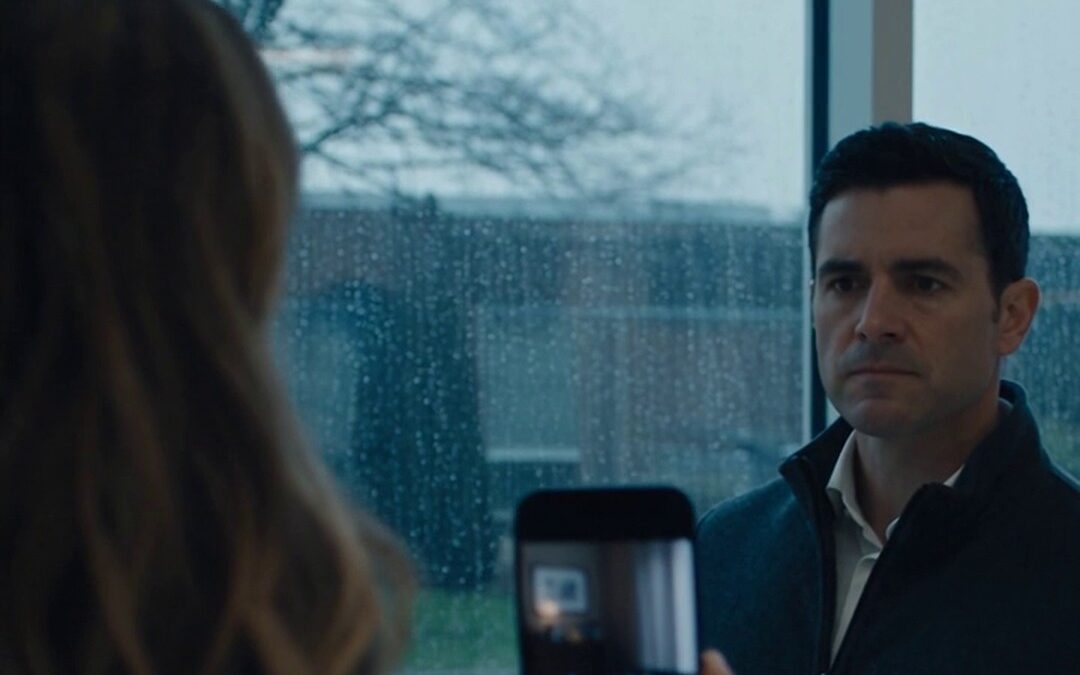
Chapter 1: The Note Under the Tray
The baby began crying when the courthouse evacuation alarm started.
Mara Bell stood in the family-services corridor with her six-year-old son, Eli, gripping his blue wool dinosaur, while every adult turned toward the man in the charcoal coat. Rafael Voss, the city’s most feared labor negotiator, held the infant against his shoulder and barked for security, a pediatrician, anyone.
Mara watched the baby’s left hand instead. The fingers opened whenever the alarm paused, then clenched at the next burst. Beside the stroller lay a small brass music box, its lid jammed shut.
“May I try something?” Mara asked.
Rafael’s eyes fixed on her. “What are you?”
“A mother who is asking.”
For one strained second, he refused. Then the baby coughed between cries, and Rafael nodded.
Mara moved Eli behind the receptionist’s desk, where clerk Nessa Ortiz agreed to watch him. She wrapped the music box in her scarf, muffling its loose metal rattle, and asked Rafael to turn the baby away from the flashing exit sign. He did.
The crying softened.
Rafael’s face changed—not relief, but recognition.
“That box was in the nursery,” he whispered.
Mara unfolded her scarf. Beneath the music box was a handwritten strip of paper.
Her own address was written on it.
Chapter 2: What the Music Box Remembered
Mara did not touch the paper again.
She stood in the courthouse corridor with one hand still holding the corner of her scarf, as though the cloth had become a boundary no one was allowed to cross. The evacuation alarm had stopped, but its afterimage remained in the room: red lights blinking above the doors, people speaking too loudly, the sour smell of dust shaken from the ceiling vents.
The baby whimpered against Rafael Voss’s shoulder.
Rafael looked at the strip of paper. Then at Mara. Then at Eli, who was peering around the receptionist’s desk with his blue wool dinosaur tucked beneath his chin.
“What does it say?” he asked.
Mara kept her voice level. “My address.”
Nessa Ortiz, the clerk, rose halfway from her chair. “Your address?”
“Don’t read it aloud,” Mara said.
Nessa stopped.
Rafael’s security chief, a broad woman with silver-threaded hair and a courthouse visitor badge clipped to her lapel, stepped toward them. “Mr. Voss, we should move.”
“No,” Rafael said.
The woman’s eyes sharpened. “The building isn’t secure.”
“That is exactly why we are staying where there are witnesses.”
His voice was quiet now. It carried farther than his earlier commands. People in the corridor glanced over and then looked away. A bailiff who had been ushering families toward the stairwell slowed near the water fountain.
Mara studied Rafael’s grip on the baby. He was not squeezing. He was supporting the infant carefully, one palm beneath the diapered bottom, the other spread between the shoulder blades. But his thumb kept moving in a small, frantic circle.
“Your baby needs to be checked,” Mara said.
“He has a pediatrician waiting downstairs.”
“Then take him downstairs. I’m not telling you not to.”
Rafael’s eyes remained on her. They were gray, tired, and rimmed red from a night without sleep.
“You think the note is a threat.”
“I think somebody put my address under your child’s music box in a public building. That makes it a fact before it makes it a threat.”
The silver-haired woman gave a clipped nod. “I’m Lenora Shaw. Mr. Voss’s head of protection.”
“Mara Bell.”
“I know.”
That answer landed harder than the alarm.
Eli emerged from behind the desk. “Mom?”
Mara turned immediately. “Stay with Ms. Ortiz.”
“But—”
“Eli.”
He stopped. He knew the tone. She had used it when he had wandered toward the hotel pool, when a kettle had fallen, when his father’s voice had risen over the phone. Not frightened, exactly. Firm enough to lend him her steadiness.
Nessa crouched beside him. “You can help me count the blue folders.”
Eli looked at Mara for permission. She nodded.
Rafael watched the exchange.
“You brought him to a custody hearing?” he asked.
“My hearing was moved to this building because the family court annex lost power.”
“You’re here for your own case.”
“Yes.”
“And someone knows your address.”
“Apparently.”
He glanced toward the brass music box. Its lid had a painted bluebird on it, the paint worn away at the beak. “That belonged to my sister.”
Mara waited.
Rafael lowered his eyes to the infant. “Sofia died six weeks ago.”
The baby shifted, face pressed into his collar. A wet cough caught in his throat. Rafael’s jaw tightened.
“Her son?” Mara asked.
“Tomás. Four months old.”
“Where is his regular caregiver?”
“His mother is in a hospital in Albany. Sofia’s partner. She had complications after delivery and has been sedated for three days.” His words came out with the precision of someone who had repeated them to lawyers, doctors, and police. “The nanny who knew his routine quit yesterday. The replacement was supposed to meet us here.”
“Supposed to?”
“She never arrived.”
Lenora touched the radio at her shoulder. “We have not located her.”
Mara looked toward the stairwell. “And you brought a four-month-old into a courthouse during an evacuation alarm because?”
“Because the judge ordered an emergency kinship review this morning,” Rafael said. “If I missed it, the temporary placement would go to county care.”
His expression did not ask for sympathy. It offered a defense.
Mara understood that kind of expression. She had worn it while explaining to a landlord why a late payment did not mean she was irresponsible, to a caseworker why Eli’s father had not collected him, to her own mother when she admitted that her marriage had become a room where every door locked from the outside.
“What have you tried?” she asked.
Rafael’s eyes flickered toward the baby.
“Bottle. Pacifier. Walking. White noise. A warmed blanket. The music box.”
“Did the music box play?”
“It’s broken. It belonged to Sofia. Tomás used to settle when she wound it.”
“Does he have reflux? Fever? Trouble breathing?”
“We called his pediatrician from the car. No fever. He’s taking some formula, wet diapers normal. The cough started after the alarm.”
“Then the pediatrician still needs to examine him.”
“I know.”
The answer was so immediate that Mara believed him.
A courthouse nurse appeared at the end of the corridor, pushing a small medical cart. She introduced herself as Dana Patel and asked permission to check Tomás. Rafael moved toward her, but Mara noticed the baby’s fist tighten as the alarm light flashed again.
“Could you take him under the stairwell?” Mara asked. “The light is still cycling.”
Dana looked at Rafael.
He nodded.
They moved together into the recessed area beside the stairwell. It was not quiet; a vent rattled overhead, and somewhere below them a door slammed. But the red light did not reach the corner directly. Mara guided Eli closer to Nessa’s desk and kept him in sight.
Dana listened to Tomás’s chest. The baby fussed, then coughed once.
“Breathing is clear,” Dana said. “I’d still like his pediatrician to see him as soon as possible. He may be overstimulated.”
Mara nodded. “Can I ask one more thing?”
Rafael’s shoulders rose.
“May I hold the music box?”
He hesitated, then placed it in her palm.
It was heavier than it looked. The brass casing was scratched near the hinge. A narrow strip of paper protruded from beneath the base, not the original note but a second piece, folded tightly.
Mara felt a cold line travel down her back.
“Was that there before?” she asked.
Lenora leaned in. “No.”
“How do you know?”
“Because I inspected the box in the car.”
Rafael took the folded strip from Mara without opening it. His fingers were steadier than hers.
“Do you know who touched this?” Mara asked.
Lenora’s gaze moved to the corridor, measuring faces. “I do not.”
“Who had access to the baby?”
“Me, Mr. Voss, the driver, the court officer who brought us through the side entrance, and the nanny who failed to arrive.”
“Anyone else?”
“Medical staff at the hospital.”
Mara looked at the bluebird. “And your sister’s house?”
“Was searched after she died.”
“By whom?”
“Police. My attorneys. Me.”
The baby began crying again, lower this time, more exhausted than panicked.
Mara held out her hand. “I can try something, but only if you agree.”
Rafael stared at it.
“I’m not going to feed him or give him anything,” she said. “I’ll sit beside you and use the music box as a visual cue. If he gets worse, Dana takes over. If he resists, we stop.”
His gaze shifted to the woman holding the medical cart, then to Eli, then back to Mara.
“Agreed.”
He sat on the bottom stair. Mara knelt at his side, leaving a full arm’s length between them. She placed the music box on the floor where Tomás could see the bluebird. Then she tapped the brass lid twice with her fingernail—soft, even, repetitive.
Tomás’s crying snagged.
Mara tapped again.
The baby’s fingers opened.
“Your sister used a pattern,” Mara murmured.
“She sang,” Rafael said.
“Maybe the song mattered less than the predictability.”
She tapped a third time, then paused. Tomás watched the box. His lower lip trembled.
Rafael lowered his voice. “Sofia used to hum when she was afraid.”
Mara glanced at him. “Was she afraid often?”
His eyes went to the empty corridor. “Not of what people thought.”
Before Mara could ask, Tomás reached one hand toward the music box. Rafael shifted him slightly so the baby could see without being passed across.
The infant’s breathing slowed.
Rafael’s face softened. For the first time, Mara saw the uncle beneath the public reputation: a man terrified that every decision he made would become evidence against him.
“Don’t open the second note here,” Mara said.
“I wasn’t going to.”
“You were.”
He almost smiled, but it disappeared before becoming one.
Dana checked Tomás again. “He’s settling. That’s good, but it doesn’t tell us why he was crying. We still need an exam.”
“We’ll go now,” Rafael said.
Mara stood. “I need to leave too.”
Lenora’s head turned. “You should not walk out alone.”
Mara felt irritation cut through her fear. “That is not your decision.”
“No,” Lenora said. “But someone has your address.”
“And someone may have placed it there because they want me to panic. I’m not going to let a stranger decide whether I miss my hearing.”
Rafael rose with Tomás. “What hearing?”
“Emergency custody review. My former husband is asking for unsupervised visitation after two years of missed payments and six months of threatening messages.”
The words came out before she could stop them.
Rafael did not react with the hungry curiosity she had learned to fear. He only looked toward Eli.
“Is he here?”
“No.”
“Could he know your address?”
“He already knows it.”
“Then the note may be about him.”
“Or about you.”
“Yes.”
The admission silenced them.
At the far end of the hall, a man in a courthouse maintenance vest appeared beside the elevators. He carried a red plastic bucket and kept his head down. He did not look at Rafael. He looked at the music box.
Mara saw it.
So did Lenora.
Lenora’s hand moved toward her radio.
The maintenance worker turned away.
“Mr. Voss,” Lenora said, “we need to move.”
This time Rafael did not argue.
They went downstairs through the secured stairwell. Nessa brought Eli along, still carrying three blue folders as if he had been assigned an important job. Dana walked beside Rafael, watching Tomás’s color and breathing. Mara followed with one hand on Eli’s shoulder.
At the first landing, the lights went out.
Eli gasped.
Mara pulled him against her. “I’ve got you.”
Emergency lamps flickered on a second later, pale and weak. Below them, a door opened. A man’s voice said, “They’re moving through the east stairs.”
Lenora froze.
Rafael’s expression changed. The fear did not vanish; it narrowed into attention.
“That isn’t courthouse security,” Lenora whispered.
“How do you know?” Mara asked.
“Security uses names.”
The voice below came again. “Voss is with the baby. Woman and boy behind him.”
Mara felt Eli’s fingers clamp around her coat.
Rafael looked at her. “Can you get him back upstairs?”
“I can get him anywhere if someone tells me where.”
Lenora pointed upward. “Third-floor records room. One door, no public access. I’ll clear it.”
“And you?” Mara asked.
“I’m staying between you and the stairs.”
Rafael shook his head. “No. You’re taking Dana and Tomás. I’ll—”
“You are not a shield,” Lenora said. “You are carrying an infant.”
The bluntness startled him into obedience.
They climbed. Rafael kept Tomás tucked against his chest. Mara held Eli’s hand and moved behind Dana. From below came the measured sound of footsteps, not hurried, not confused.
The records room door opened onto rows of metal shelving and banker’s boxes. A clerk inside gave a startled cry.
“Out,” Lenora said. “Now.”
The clerk left without asking questions.
Mara guided Eli behind a shelf. “Stay where I can see you.”
“Are we hiding?”
“Yes.”
“Is the baby sick?”
“Not right now.”
“Is the man bad?”
Mara looked at Rafael. He stood in the doorway, listening.
“I don’t know yet,” she said.
Rafael heard her. Something in his face accepted the answer.
Lenora locked the door. Dana took Tomás’s temperature and listened to his breathing again. The baby had fallen into a thin, uneasy sleep.
Rafael opened the folded note.
Mara did not move closer.
He read it once. Then again.
“What?” Lenora asked.
Rafael handed it to her.
Lenora’s mouth tightened. “It says, ‘Ask Bell what happened to the blue room.’”
Mara’s stomach dropped.
Eli looked up. “Mom?”
She took the note from Lenora. The handwriting was blocky, deliberate. She had never seen it before, but the phrase was familiar.
The blue room had been the spare bedroom in the apartment she shared with her former husband, Owen Bell. It was where they had kept Eli’s crib before he was born. It was also where, three years ago, Mara had found Owen’s locked metal case after he told her she was imagining things.
She had never told anyone about the case.
Not the police. Not her mother. Not her lawyer.
She had opened it once and found photocopies of children’s birth certificates, school schedules, and photographs of houses. She had closed it and left the apartment with Eli that night. Owen later called it a misunderstanding. He said the documents belonged to a friend.
Mara had believed only one thing: whatever the case meant, she did not want to know.
Rafael watched her face. “What is the blue room?”
“An old room.”
“That is not what the note says.”
“No.”
Lenora studied Mara. “Who knew that phrase?”
“Owen.”
“Your former husband?”
“Yes.”
“Anyone else?”
“Maybe his sister. She lived upstairs for a year.”
Rafael shifted Tomás carefully. “Is Owen connected to Sofia?”
“I don’t know.”
“You need to tell us everything.”
Mara looked at him sharply. “No. I need to decide what is relevant.”
“Someone followed us into a courthouse.”
“Someone used my address and a phrase from my marriage.”
“And you think you can keep this separate?”
“I think powerful men are used to turning other people’s fear into a command structure. I’m not handing you mine because you look capable of carrying it.”
For a moment, the room held only the sound of Tomás’s breathing.
Rafael nodded once. “Fair.”
The word disarmed her more than anger would have.
Dana’s phone vibrated. She answered, listened, then covered the speaker. “The pediatrician is waiting at St. Anne’s. I can arrange an ambulance entrance, but the courthouse is delaying all exits until police clear the building.”
Lenora checked her radio. “We have officers on the second floor now.”
A thud sounded against the records-room door.
Eli flinched.
Mara crouched in front of him. “Look at me.”
“I am.”
“Count the shelves.”
He glanced around. “One, two, three, four—”
“Keep counting.”
Another thud.
Rafael’s voice came softly from the doorway. “The door is reinforced.”
“That is not comforting,” Mara said.
“It was intended to be.”
Despite herself, she almost laughed. The sound became a breath and disappeared.
Lenora moved to a narrow interior window. Through the wired glass, she watched the corridor. “Two men. One maintenance vest, one gray jacket. They’re not trying to force entry.”
“Then what are they doing?” Rafael asked.
“Waiting.”
His phone began to ring.
No one spoke.
Rafael looked at the screen. “It’s my driver.”
“Answer on speaker,” Lenora said.
He did.
A man’s voice came through, breathless. “Sir, I’m at the lower garage. The courthouse police say the east gate is locked.”
“Where is the vehicle?”
“Bay four.”
“Who has the keys?”
A pause.
“Sir?”
“Who has the keys?” Rafael repeated.
“I gave them to the court transport officer. He said you authorized a change.”
Rafael’s face went still.
Lenora stepped closer. “Which officer?”
“Officer Haines.”
“Name confirmed?” she asked.
“I thought so.”
“Describe him.”
“Mid-fifties. Balding. Blue tie.”
Lenora looked at Rafael. “There is no Officer Haines assigned to family court today.”
The driver said, “Someone is coming down the ramp.”
The line went dead.
Dana looked at Tomás. “We need to leave through another route.”
Mara thought of the maintenance worker’s voice: Voss is with the baby. Woman and boy behind him.
They knew the order of people. They knew the baby. They knew her child was present.
She turned to Rafael. “The note wasn’t meant to make me panic.”
“What was it meant to do?”
“To make me identify myself.”
He understood. “They wanted to know whether you recognized the phrase.”
“And when I did, they knew the right woman was with you.”
A second sound came from outside the room: a soft scrape, metal against metal.
Lenora lifted her hand. Everyone went quiet.
The doorknob turned.
It stopped against the lock.
Then someone slid an envelope beneath the door.
Eli leaned forward. Mara caught his shoulder before he could reach it.
Rafael looked at her. “Do not touch it.”
“I wasn’t planning to.”
Lenora used a pen to pull the envelope farther into the room. It was plain white, damp along one edge. No name. No stamp.
Inside was a photograph.
Mara recognized the building first: the narrow brick apartment complex where she and Eli had lived after leaving Owen. The photograph had been taken from across the street. Eli was visible near the front entrance, much younger, holding the same blue wool dinosaur. Mara stood beside him with a grocery bag.
On the back, someone had written:
SHE REMEMBERS THE ROOM. SHE DOESN’T REMEMBER THE LIST.
Mara’s hand went numb.
Rafael did not take the photograph. He kept his eyes on her.
“What list?” he asked.
“I don’t know.”
That was true. Or close enough.
She remembered the metal case. The copied documents. A list of names in Owen’s handwriting taped to the inside of the lid.
She remembered one name because it had frightened her: Sofia Voss.
At the time, she had assumed it was a coincidence. Owen had done contract work for dozens of people. He had been an insurance investigator, then a private compliance consultant, then something less clearly named.
Mara had never told anyone.
Rafael saw the answer arrive before she spoke.
“My sister’s name was in that case,” she said.
His face emptied.
Lenora took the photograph from her. “When?”
“Three years ago.”
“Sofia was alive then,” Rafael said.
“I know.”
“What else was on the list?”
“I don’t remember.”
“Try.”
“I remember names. Dates. A column of initials. I don’t remember what it meant.”
“You saw my sister’s name and walked away?”
Mara met his anger without stepping back. “I was twenty-nine, alone, frightened, and trying to keep a four-year-old safe. Owen had threatened to take Eli. I did not know your sister. I did not know whether the papers were real. I did what I could understand.”
Rafael’s eyes flashed. “You could have called someone.”
“I called the police. They said it was probably employment material and asked whether Owen had physically harmed me.”
“Had he?”
“Not in a way they could photograph.”
The room changed around them. Rafael looked away first.
Tomás stirred. His face puckered, and a thin cry began.
Mara stepped toward him, then stopped herself. “May I?”
Rafael nodded.
She tapped the music box twice.
Tomás’s cry caught, as before. Rafael lowered himself onto a box, keeping the baby turned away from the emergency light. Dana watched his breathing while Mara repeated the small pattern against the brass.
The baby quieted.
Rafael stared at the bluebird.
“My sister used this when she met with people,” he said. “She kept it in her bag. I thought it was sentimental.”
“Was she afraid?”
“She told me she was helping families leave bad employers. Domestic workers. Caregivers. People whose passports or wages were being withheld.”
Mara’s mouth went dry.
“Owen investigated labor brokers,” she said.
Rafael looked at her.
“He said he was finding fraud. He had files on employers, contractors, families. I thought he was collecting evidence for lawsuits.”
“Maybe he was.”
“Maybe he was selling it.”
Lenora took out her phone. “I can contact the police captain.”
“No,” Rafael said.
She turned. “Why not?”
“Because someone inside this building knows our movements, and someone had access to my driver. We cannot assume the first official who answers is clean.”
“That does not mean we avoid law enforcement.”
“I said we verify the contact.”
Mara watched the tension pass between them. Rafael had authority, but Lenora did not obey him automatically. She reached for a printed card in her wallet.
“This is Inspector June Alvarez,” she said. “Public integrity, not courthouse security. She handled Sofia’s death inquiry.”
Rafael’s jaw tightened. “Sofia died from complications.”
“That was the preliminary finding.”
“Are you suggesting otherwise?”
“I’m suggesting she asked me to call if your protection team ever found a connection between Sofia’s charity work and the Bell case.”
Mara looked at her. “You knew my name?”
“Not until this morning.”
“Then why did you have my number?”
“I didn’t.”
“Who did?”
No one answered.
Inspector Alvarez arrived twelve minutes later through the records room’s interior stairwell, accompanied by a uniformed officer whose identification Lenora checked twice. Alvarez was a compact woman in her forties, with a rain-darkened coat and an expression that made the room feel less crowded.
She did not reach for the notes or photograph until Mara gave permission.
“Tell me what you remember,” Alvarez said.
Mara told her about the blue room, the case, the documents, and the list. She left out nothing she could bring to mind. She described Owen’s threats, the custody dispute, the day she found the case, and the reason she had never reported the names.
When she finished, Alvarez asked, “Where is the case now?”
“I don’t know.”
“Did Owen keep it?”
“He moved out six months after I left. The apartment was emptied.”
“By whom?”
“His lawyer arranged the removal.”
“Name?”
Mara gave it.
Alvarez wrote it down. “And your former husband’s current address?”
Mara supplied that too.
Rafael remained silent throughout. Tomás slept against him, one tiny fist tucked beneath his chin.
Alvarez examined the music box. “Where did this come from?”
“My sister’s nursery,” Rafael said. “The house was sealed after her death. The nanny had access.”
“The nanny who didn’t arrive today?”
“Yes.”
“Name?”
“Petra Mendez.”
Alvarez’s gaze moved to the brass box. “Did Petra know the box’s history?”
“She worked for Sofia for eleven months.”
“Did she know Mara?”
“No,” Rafael said.
Mara looked at him. “Are you sure?”
He frowned. “Why?”
“Because the note used my address. Someone connected me to the box. That connection may not run through Owen.”
Alvarez folded the paper into an evidence sleeve. “We need to ask whether Sofia’s records contained your name.”
Rafael’s eyes narrowed. “Her files were taken.”
“By whom?”
“By the estate administrator.”
“Who is—”
“My uncle, Anton Voss.”
Mara watched him say the name. It was the first time his composure cracked.
Alvarez noticed. “What is his role in the kinship review?”
“He petitioned for guardianship before I did.”
“Why?”
“Because he controls the Voss Foundation, the company trust, and the property where Sofia lived.”
“Does he want the baby?”
Rafael looked down at Tomás. “He wants control of whatever the baby inherits.”
There it was: the limit of Rafael’s power. He could command security, pressure a courthouse, secure a pediatrician, but he could not simply keep Tomás because he loved him. The judge still had to decide. Sofia’s hospital records still mattered. The child’s father, if identified, still had rights. And if her death had been mishandled, the truth would not belong to Rafael alone.
Alvarez asked, “Why did you bring the baby here personally?”
“Because Anton’s lawyers argued I was unstable and absent. I wanted the court to see that I was caring for him.”
“Were you?”
Rafael’s expression tightened. “I was trying.”
The honesty seemed to matter.
Mara looked at Tomás. “The baby’s regular routine was built around Sofia’s music box.”
Rafael nodded.
“Then whoever placed the note understood that the box would be brought here.”
Alvarez turned to Lenora. “Who packed the nursery items?”
“Petra.”
“Who transported them?”
“The driver.”
“Who inspected them?”
“I did.”
“Where did the first note come from?”
Mara answered. “Under the box, inside my scarf.”
Alvarez’s eyes sharpened. “Your scarf?”
“I wrapped the box because it was rattling.”
“Had anyone touched the scarf before that?”
“Eli had been wearing it around his shoulders in the waiting area.”
Eli looked up from behind the shelf. “I wasn’t wearing it. Mom put it on the box.”
Alvarez crouched so she was at his height. “Did anyone touch the box before your mother?”
Eli thought. “The man with the bucket.”
“What did he do?”
“He looked at the bluebird.”
“Did he say anything?”
“He said, ‘Wrong room.’”
Mara felt the blood leave her face.
Rafael’s head lifted.
Eli hugged his dinosaur. “I thought he meant the bathroom.”
Alvarez stood. “That is useful.”
“Is he in the building?” Lenora asked.
“Probably not,” Alvarez said. “But we can pull camera footage.”
“Can you trust the courthouse cameras?” Rafael asked.
“No,” Alvarez replied. “Not automatically.”
The answer pleased Lenora more than certainty would have.
A court officer arrived to say the evacuation had been contained. Alvarez ordered the records room held as a potential scene. She arranged a protected route to St. Anne’s through the underground loading entrance, but she did not promise safety. She assigned two inspectors from outside the courthouse district and called the judge’s clerk to document why Mara’s hearing had been interrupted.
Mara wanted to leave with Eli.
Rafael said, “You should come with us to the hospital.”
“No.”
“You may be connected to the case.”
“That is exactly why I should not be seen leaving with you.”
Alvarez intervened. “She is right. Separate transport is safer.”
Rafael looked at Mara. “Then let me arrange a car for you.”
“No.”
“Why?”
“Because I have a bus pass, a son, and a hearing rescheduled for tomorrow. I cannot let this become a new dependency.”
His face showed hurt before he hid it.
Mara softened, but not enough to surrender the point. “You can pay for an escort through the courthouse security office if Inspector Alvarez approves it. You cannot become the person who gets me home.”
Rafael nodded. “Understood.”
It was the second time he accepted a boundary without bargaining.
Before they separated, he handed her the music box.
She stared at it. “Why?”
“Because it was used to reach you.”
“That makes it evidence.”
“Then give it to Alvarez.”
“I will.”
He held on for one second longer. “But before you do, look at the hinge.”
Mara turned the box over. Along the brass hinge was a narrow black smear, almost invisible against the worn metal. She rubbed it with the edge of her sleeve. A symbol appeared: two interlocking circles stamped into the brass.
She knew it.
Owen had used the same mark on the metal case.
Alvarez saw her expression. “What is it?”
“A seal.”
“Whose?”
“I don’t know.”
Rafael’s voice was low. “Sofia used that mark on her files.”
Mara looked at him. “You said you thought the box was sentimental.”
“I did.”
“Then how do you know?”
“Because I found the mark on a letter after she died.”
“Where is the letter?”
“Anton took it.”
The hospital route was arranged. Dana accompanied Rafael and Tomás with the outside inspectors. Lenora stayed beside them, speaking to no one on the radio unless Alvarez verified the channel.
Mara and Eli left through the courthouse’s public entrance after Alvarez confirmed two officers would walk them to the bus stop. Reporters had gathered behind the barricades, drawn by the name Voss and the false alarm. Cameras lifted when Rafael emerged from the lower exit with the baby.
He did not look toward them.
Mara saw the choice. He could have used the cameras. He could have made himself visible, made the crowd become his shield. Instead, he turned his body so Tomás was protected from the lenses.
Eli noticed too.
“Is he famous?” he asked.
“Influential,” Mara said.
“What’s the difference?”
“Famous people are recognized. Influential people make things happen.”
Eli considered this. “Did he make the alarm happen?”
“No.”
“Did he make the baby stop crying?”
Mara watched Rafael pause beside the ambulance doors while Dana checked Tomás’s face. “No,” she said. “He let someone help.”
At the bus stop, Alvarez gave Mara a card and an instruction.
“Do not return to your apartment alone tonight.”
Mara looked at the card. “I have nowhere else.”
“Can you stay with your mother?”
“She lives four hours away.”
“A hotel?”
“I can’t afford one.”
Alvarez hesitated, then said, “The family-services office has an emergency room for witnesses. It is not comfortable, but it is secure.”
Mara looked at Eli. He was sitting on the bench, dinosaur in his lap, trying to knot his shoelace.
“Will the school know?”
“We can arrange a late arrival.”
Mara breathed through the pressure in her chest. Her housing was already unstable. She had missed two shifts at the library because of the custody hearing. Owen had filed complaints claiming she was unreliable. If she left the apartment without documenting the condition, he could accuse her of abandonment. If she returned, someone might be waiting.
“I need to go home for clothes,” she said.
“Then we go with you.”
Mara expected a fight from herself, but relief came first.
At the apartment, the door was locked. Nothing appeared disturbed. Eli’s shoes were lined beneath the radiator. The blue ceramic bowl remained on the counter. A grocery receipt lay beside the sink.
Mara entered slowly, scanning the room.
Alvarez stayed behind her. The officers checked the closets and bathroom. No one was inside.
“Your address was written on the note,” Alvarez said. “Who knew you were in this courthouse today?”
“My lawyer. The court clerk. Owen.”
“Anyone else?”
“The library supervisor.”
“Could the address have come from public records?”
“Possibly.”
Mara went to the bedroom. She packed two changes of clothes for Eli, his toothbrush, medication for his asthma, and the dinosaur. From her own drawer she took an envelope containing court documents.
At the back of the closet, she found the old blue room key.
She had kept it without understanding why.
The room itself was now Eli’s bedroom. His bed stood beneath the window. A paper moon hung from the ceiling. The metal case had once been under the loose floorboard beside the radiator.
Mara knelt and lifted the board.
The hollow beneath it was empty except for dust and a narrow brass shaving.
She touched it.
Behind her, Eli said, “Mom, there’s writing.”
He was pointing to the wall beside the closet. A child’s height, nearly hidden beneath layers of pale paint, was a blue circle with a second circle inside it.
Mara stared.
The symbol had been there all along.
Alvarez photographed it. “Did Owen draw this?”
“I don’t know.”
“You lived here.”
“I know.”
Eli turned his dinosaur over. “The same circles are on Mr. Bluebird.”
The music box was in Alvarez’s evidence bag, but the brass mark remained in Mara’s mind.
At the hospital, Rafael waited outside the examination room while the pediatrician checked Tomás. He did not enter until the doctor invited him. The baby had no fever, clear lungs, and signs of exhaustion. The doctor recommended observation, a quieter feeding routine, and follow-up with Tomás’s regular pediatrician.
“His distress may have been sensory overload,” she said. “But if the cough worsens, if he becomes difficult to wake, refuses feeds, or changes color, you come back immediately.”
Rafael asked questions and wrote down every answer.
Lenora stood by the window. “Inspector Alvarez says the courthouse officer was real but was diverted from the east entrance by a fake call.”
“Can we identify the caller?”
“Not yet.”
“Petra?”
“Phone off.”
“And Anton?”
“On a flight from Denver. His assistant says he landed two hours ago.”
Rafael looked through the glass at Tomás. “He knew about the review.”
“Everyone in the foundation knew.”
“Who packed the music box?”
“Petra.”
“Who hired Petra?”
“Sofia did.”
“Who recommended her?”
Lenora paused.
Rafael turned. “Who?”
“Anton’s office.”
The baby began to cry inside the room. Rafael stepped toward the door, then stopped when the nurse lifted Tomás.
He looked at Lenora. “I want a court order preventing Anton from removing him.”
“You do not have enough evidence.”
“I want the judge to see the evidence we have.”
“Evidence includes an unverified note and a mark you cannot explain.”
“It includes an intruder in a secured courthouse.”
“It includes a driver whose keys changed hands and a missing nanny. It may be enough for an emergency hearing. It is not enough to accuse Anton publicly.”
Rafael’s hands closed at his sides.
Lenora continued, “If you turn this into a war before we know the chain, Anton will call it proof of instability.”
He looked toward the room where Tomás was being settled.
“Then what do I do?”
“Let the investigators work.”
The question seemed to cost him. “And Mara?”
“Keep her separate from the Voss family until we know whether someone is using her to reach you.”
“She is already involved.”
“She is also a witness who needs her own lawyer.”
Rafael nodded. “Pay for one.”
Lenora’s expression hardened. “Offer a list. Do not choose for her.”
He met her gaze.
“Protection without control,” she said.
The phrase stayed with him.
The next morning, Mara attended the emergency hearing by video from a secure office. Eli sat beside her with headphones on, watching a cartoon without sound. Rafael appeared from a hospital consultation room. Anton Voss joined from a polished office with a wall of books and no visible dust.
He was older than Rafael by twenty years, silver-haired, elegant, and mild. His face belonged to a man who apologized while ruining lives.
The judge reviewed the courthouse incident, the missing caregiver, and the concerns regarding Tomás’s placement. Anton’s attorney argued that Rafael had created unnecessary danger by bringing the infant into a public building and involving an unrelated mother in the child’s care.
Mara’s lawyer, assigned through the witness office, asked permission to submit the notes and photograph.
Anton’s expression changed only when the blue-room phrase was mentioned.
Mara saw it.
Rafael saw it too.
The judge ordered temporary supervision of Tomás, barred Anton from removing him from the hospital without notice, and required the foundation to preserve all records connected to Sofia’s charity work, caregiver contracts, and estate files. She also ordered Mara to give a formal statement to Inspector Alvarez.
It was not a victory. It was a delay with paperwork.
After the hearing, Mara met Rafael in a small hospital courtyard. He stood beneath a bare fig tree, no security around him except Lenora at a discreet distance. Tomás slept in a bassinet beside a nurse.
“You saw Anton react,” Mara said.
“Yes.”
“You know him better than I do. What was it?”
“Recognition.”
“Of the phrase?”
“Of the risk.”
Mara held the evidence photograph in a plastic sleeve. “I remembered something else.”
Rafael waited.
“The list in Owen’s case included Sofia’s name. Beside it was a date. March seventeenth, three years ago.”
“Sofia met a group of caregivers that day.”
“Where?”
“An old hotel near the river.”
“Owen had a client there.”
Rafael’s eyes darkened. “What client?”
“I don’t know. But I remember a brass seal on the documents. Two circles.”
He looked toward the bassinet.
“Anton used that seal on foundation correspondence,” he said. “Sofia hated it. She said it made charity work look like ownership.”
“Did she tell you what she was investigating?”
“She said someone was selling private schedules of vulnerable families. Children’s medical appointments. School pickups. Domestic workers’ addresses.”
Mara felt the courtyard tilt.
“Not just workers,” she said. “Families.”
Rafael’s eyes met hers. “Your address was on the note because your old file was part of the same network.”
“And Sofia found it.”
“Or Owen did.”
“Or both.”
A nurse approached the bassinet. Tomás stirred and began to fuss. Rafael looked at Mara but did not ask her to intervene.
Mara waited.
The nurse checked the baby’s position and offered the music box, now sealed inside a clear evidence pouch. Tomás watched the bluebird through the plastic. His breathing steadied.
Rafael exhaled.
“You don’t have to use the pattern every time,” Mara said.
“I know.”
“Do you?”
He looked at her.
“The point isn’t that I can calm him,” she said. “The point is that we noticed what helps and we keep checking whether he needs something else.”
Rafael absorbed that.
“I have spent my life assuming a problem is solved when everyone stops objecting,” he said.
“That is not the same as solved.”
“No.”
The nurse wheeled Tomás back inside.
Lenora approached with a folder. “Inspector Alvarez found the maintenance worker.”
Mara’s body tightened.
“His name is Colin Reeve,” Lenora said. “He was contracted through the courthouse’s temporary staffing agency. He left before the alarm ended.”
“Where is he?” Rafael asked.
“Police have him at a transit station. He says he was told to deliver the envelope and leave.”
“By whom?”
“He does not know the name. He received cash and a photograph of the music box.”
Mara looked at the folder. “The photograph of me and Eli?”
“No. A photograph of the box.”
“Who gave it to him?”
“A woman.”
“What woman?”
“Petra Mendez.”
The missing nanny had been found.
But Lenora’s face did not suggest relief.
“Petra says she never entered the courthouse,” she continued. “She says Anton’s assistant hired her to pack Sofia’s nursery items and told her the box was to be delivered to Rafael. She denies writing the notes.”
“Do you believe her?” Mara asked.
“No,” Lenora said. “But I believe she is afraid.”
Rafael’s phone rang. This time he did not answer immediately. The screen showed an unknown number.
Mara looked at it.
“Don’t,” Lenora said.
The call ended.
A message appeared.
Rafael read it. His face changed.
“What?” Mara asked.
He turned the screen toward her.
It was a photograph of the secure hospital courtyard, taken from above. Mara, Rafael, Lenora, and the nurse were visible beneath the fig tree.
The message contained six words:
THE BLUE ROOM WAS NEVER EMPTY.
Mara looked toward the hospital windows.
Eli was inside the security office with her lawyer.
Tomás was inside with the nurse.
Rafael’s first instinct was to move toward the building. His second was to reach for Mara’s arm.
He stopped before touching her.
“Stay here or come with me?” he asked.
The question mattered.
Mara looked at the photograph again. In the upper corner, reflected in the hospital glass, a small shape hung from a ceiling.
A paper moon.
Her apartment bedroom.
The image had been taken from inside her home before she left.
“Neither,” she said. “We go to the police station.”
Rafael nodded.
“Separate cars,” Mara added.
“Separate cars.”
“And no one moves Tomás until Alvarez signs it.”
“Agreed.”
They walked toward the hospital entrance. Rafael went first, but he kept his pace slow enough for Mara to choose her distance. Lenora spoke to the officers. The nurse secured the bassinet.
At the doors, Mara’s phone buzzed.
A new message appeared from an unknown number.
You forgot the names.
Then another image loaded.
It showed the underside of the brass music box, where a narrow panel had been pried open. Inside was a strip of paper covered in tiny handwriting.
At the bottom, beneath a row of names, was one final line:
BELL — CHILD: ELI — SAFE LOCATION: BLUE ROOM.
Mara stopped walking.
Rafael turned, waiting.
She looked through the glass at her son, at the blue dinosaur in his lap, at the hospital corridor reflected over his small face.
For three years, she had believed the blue room was the place she escaped.
Now she understood it had been a place someone had been watching.
And beside Eli’s name, written in the same careful hand, was a date.
Tomorrow.