A Little Girl’s Broken Pearl Necklace Stopped a Luxury Gala Cold—and Exposed the Family Secret No One Wanted Her to Find
Chapter 1: The Floor Between Them
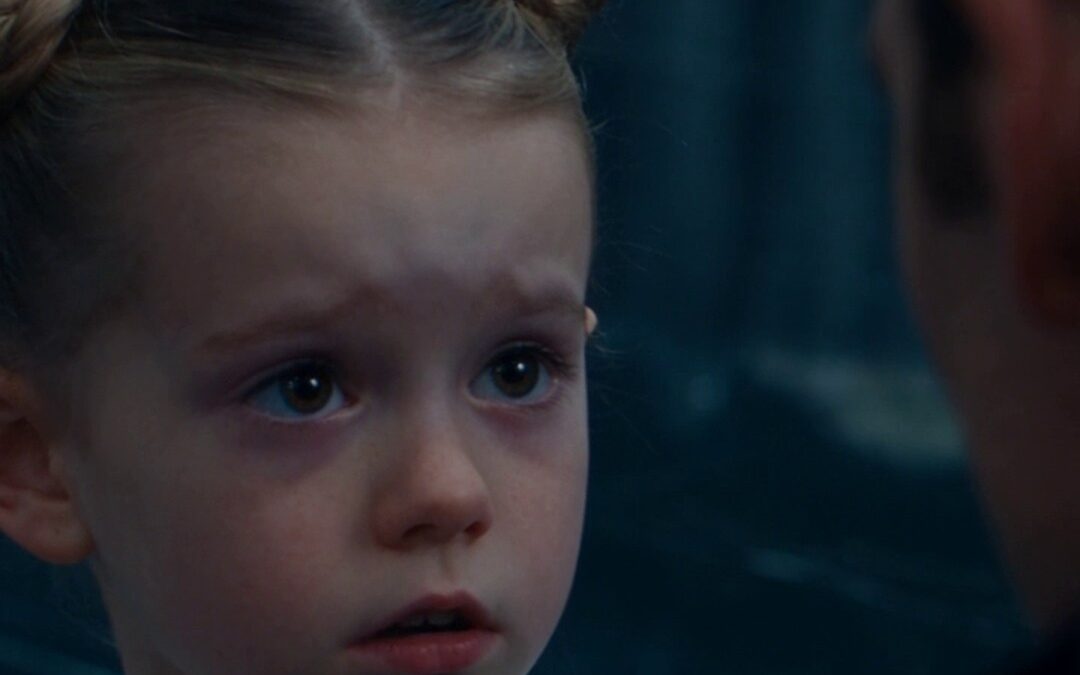
Lily Carter knelt on the polished ballroom floor among scattered white pearls, her white shoes tucked beneath her. She cried as she tried to gather them with trembling fingers. One pearl rolled away from her hand, flashing beneath the cool blue lights.
“Pick them up,” Celeste Vale said, standing over her in a sparkling silver gown. “All of them. You’ve made enough of a scene.”
Lily’s dark hair was parted neatly beneath two low side buns. Her white long-sleeved dress had slipped crooked at one shoulder. She reached for a pearl near Celeste’s silver heel, then stopped when the woman’s shadow covered it.
“I’m sorry,” she whispered.
Celeste pointed toward the floor. Around them, guests in black and silver formalwear had gone quiet. White flowers rose from the center of round tables dressed in linen. “Then stop crying and pick them up. And when you’re finished, leave.”
Adrian Vale stepped away from the guests beside him. He crossed the gleaming floor in his black tuxedo and knelt at Lily’s side.
“Don’t bother,” Celeste said. “She can handle it.”
Adrian reached for a pearl beneath a table. “She’s seven.”
“I’m seven,” Lily sobbed. “I can do it.”
“I know,” he said gently. “I’m helping anyway.”
Together they collected the pearls, one by one. Lily tried to pinch each slippery bead between her fingers, but her hands shook. Adrian placed the ones he found in her open palm. The nearest guests watched, then looked away as if embarrassed to have seen her cry. Lily kept trying to apologize. Adrian told her she didn’t have to.
At the edge of the scattered strand, he found a pearl slightly larger than the rest. It had rolled beside a silver shoe, where the ballroom lights shone in its smooth surface. A tiny shield had been engraved into it.
His hand went still.
The noise of the ballroom seemed to fall away. Adrian turned the pearl under the cool lights. There was the Vale crest: a small rising sun above a river line. He had seen it in his grandmother’s jewelry case, on the handful of pearls she’d commissioned decades ago.
He looked at Lily. She was still crying, her little hands cupped around the pearls.
“Where did you get this?” he asked.
“My mom.”
“What’s your mom’s name?”
“Anna Carter.”
Adrian’s face changed. He looked down at the crest again, as if he could make it say something else.
Celeste took a half step forward. “That can’t be right. Those are family pieces. Her mother could have bought them secondhand.”
Adrian closed his fingers around the pearl. “Did your mom tell you where the pearls came from?”
Lily nodded, wiping her face with her sleeve. “Grandma gave them to her.”
“Lily,” Adrian said carefully, “what’s your grandmother’s name?”
She blinked through her tears. “Eleanor Vale.”
For one breath, he couldn’t move.
Chapter 2: The Name They Buried
Adrian stopped breathing for a second.
The pearl rested in his palm, cool and small. Lily’s wet eyes stayed on his face, waiting to see what he would do. Celeste’s silver shoes gleamed in the polished floor between them.
“That was my grandmother,” he said.
Lily looked from him to the pearl. “The one who gave it to my mom?”
“Maybe. We’ll find out.”
Celeste’s smile had disappeared. “Adrian, this is not the place.”
“You’re right.” He slipped the pearl into his jacket pocket. “Lily, are you hurt?”
She shook her head.
“Did the necklace scratch you?”
“No.”
“Can I see your hands?”
Lily opened them. Her palms were pink from clutching the pearls, but unhurt. Adrian waited while she let him check the other hand.
“Could we sit somewhere quieter?” he asked.
Lily glanced at Celeste. “Am I in trouble?”
“No,” Adrian said. “You didn’t do anything wrong.”
Celeste gave a tight laugh. “You don’t know that.”
“I know she’s a child crying on the floor, and you’re standing over her.”
A woman in a black dress with an event badge came over. Adrian recognized her as the floor manager.
“Mr. Vale, shall I bring Lily some water?”
“Please. And call Anna Carter. Her number should be on Lily’s emergency card.”
Celeste stepped between them and the tables. “You can’t summon people on the basis of a costume necklace.”
“She said her mother gave it to her.”
“She said her grandmother gave it to her. Children mix up what they hear.”
Lily’s chin quivered. “I didn’t.”
Adrian bent closer. “I believe you.”
Celeste’s eyes shifted to his pocket. “Those pearls belong to the Vales. Anna had no right to possess them.”
Adrian looked at her. Lily hadn’t said they belonged to the Vale family. She hadn’t told Celeste where they came from.
“How did you know what it was?”
“I recognized the crest when you held it up.”
“You were across the room.”
“It’s distinctive.”
The floor manager returned with water. Lily drank from the glass with both hands. Adrian sat back on his heels so he wouldn’t loom over her.
“What happened?” he asked.
“The necklace got caught.” Lily touched the empty place at her collar. “I tried to keep it in my hands, but they went everywhere.”
“Do you want to come to the staff room? It’s quiet, and your mom can find you there.”
Lily looked at Adrian. He nodded.
“I’ll go with you,” he said.
Celeste’s voice sharpened. “You cannot take her away from the event.”
“I’m walking her to a quiet room with the floor manager.”
“You’re making a spectacle.”
“I didn’t point at a child on the floor.”
A murmur passed through the nearest tables. Celeste flushed and looked toward the ballroom doors, where two security staff stood.
“Don’t involve security,” Adrian said. “No one is taking her anywhere she doesn’t want to go.”
Lily slid off her knees and stood. Her dress was dusty at the hem. She took the floor manager’s hand.
At the staff room, Lily sat on a padded chair with the pearls spread over a clean napkin. Someone brought tissues. Adrian stood near the door while the floor manager called Anna from the number on Lily’s emergency card.
He heard Lily say, “Mom? The necklace broke, but I’m okay.”
A pause.
“Adrian is here. He picked up the pearls.”
Another pause. Lily’s shoulders straightened. “No, I’m not in trouble.”
Adrian walked farther down the hall.
The name Anna Carter had opened a door he thought was shut years ago. He was eleven when Anna used to sit beside him on Eleanor’s terrace, drawing houses on napkins while the adults talked indoors. She was older, quiet, and funny when she trusted someone. Eleanor called her “my dear girl” and touched her hair with easy affection.
Then one summer, Anna stopped coming.
At first, Adrian asked where she was. His father said the Carters had gone. His aunt said Anna’s mother had troubled Eleanor. Later, he heard Anna had appeared after Eleanor’s death, demanding a share and inventing a family connection.
He had believed the adults. The story had been delivered as settled fact.
The floor manager came into the hall. “Her mother’s on her way. She asked that Lily stay with you and not return to the ballroom.”
“I agree.”
“She sounded frightened.”
Adrian looked through the door’s window. Lily was counting the pearls in groups of five. “Did she say why?”
“She said she’d explain when she got here.”
Lily had made a neat row. Her breathing was steadier, though her lashes were still wet.
“Let’s count together,” Adrian said.
They counted twice. There were twenty-two ordinary pearls and the engraved one.
“Twenty-three,” Lily said.
“Twenty-three.”
“Mom says things should come back the way they were.”
Adrian looked at the broken clasp. “A jeweler can repair it.”
“Will they take it away?”
“Only while they work. Your mom can stay with it.”
“Good.”
He asked no more. He did not ask why Anna had left, what Eleanor had told her, or what else Lily knew. Those questions belonged to adults. He was beginning to understand how many adults had failed to ask Anna the right ones.
When Anna arrived, she came through the staff entrance in a plain black coat over a dark green dress. She saw Lily first.
“Sweetheart.”
Lily ran to her. Anna dropped to her knees and gathered her close.
“Are you okay?” Anna asked.
“I’m okay. It broke.”
“I know. I’m sorry.”
“It wasn’t my fault.”
“No,” Anna said, kissing her temple. “It wasn’t.”
Only then did she look at Adrian.
He had imagined seeing her again a dozen ways. None included a child’s necklace in his pocket and a roomful of people outside.
“Anna.”
“Adrian.”
“I’m sorry.”
“For what?”
“For what happened tonight. For Celeste. For not knowing you were coming.”
“I wasn’t coming to meet you. Lily was invited to the children’s choir table. I was helping with coats.”
“The pearls—”
“Not here.”
“Of course.”
Anna stood, keeping a hand on Lily’s shoulder. “You found the engraved one.”
“I did.”
“And now you know.”
“I know it has my grandmother’s crest.”
“You know that much.”
He brought out the pearl. Anna looked at it but did not reach for it.
“It belongs with the others,” she said.
“I’ll give it to you.”
“Thank you.”
He placed it on the napkin.
Lily watched them. “Mom, he said Grandma was his grandma too.”
“He is Eleanor’s grandson,” Anna said.
“Then are they cousins?”
Anna looked at Adrian. “That’s what we need to talk about.”
The floor manager offered them the staff room for as long as they needed. Anna agreed. Adrian asked whether she wanted him to leave.
“I want Lily comfortable,” Anna said. “You can stay if she wants you to.”
Lily nodded. “I want him to stay. He helped.”
So Adrian remained while Lily drank water, Anna beside her with one arm around her back.
“Did Celeste say anything?” Anna asked.
“She said the pearls were Vale family jewelry and that you had no right to possess them.”
Anna’s fingers tightened on Lily’s shoulder.
“She knew what they were?” Adrian asked.
“She knew what they could mean.”
“What did she mean by ‘no right’?”
“I don’t want Lily hearing all of it tonight.”
“I can take her home.”
“I can manage.”
“You’re right,” he said. “I shouldn’t decide for you.”
That answer seemed to surprise her.
“What do you intend to do with the pearl?” she asked.
“Return it to you. Find out what happened to the records. Learn why the family believed you stole it.”
A short, humorless breath left her. “Quite a list.”
“I know.”
“You were a boy when I left. You didn’t choose the story they told you.”
“I repeated it when I was old enough to know better.”
“When?”
“At dinner years ago. My father said you’d tried to claim part of Eleanor’s estate. I said people who did that should expect to be challenged.”
Anna looked away.
“I’m sorry,” he said.
“Did you ever wonder why a girl who grew up around Eleanor would need to invent a connection to her?”
“I should have.”
“Yes.”
Lily had started rubbing her eyes. Anna gathered the pearls into a cloth pouch from her purse.
“Can we go home?” Lily asked.
“Yes.”
“I’ll walk you to the car,” Adrian said.
“I can manage.”
“I know. The ballroom doors are crowded.”
She let him walk with them through a service corridor to a side entrance. Rain had begun outside. Anna’s car was beneath a stone arch across the courtyard.
At the door, Lily looked up at him. “Will you fix the necklace?”
“I’ll find a jeweler you and your mom trust.”
“I’ll decide about that,” Anna said.
“Of course.”
Lily hugged her mother’s waist. “He helped me count.”
“Then thank him.”
“Thank you.”
“You’re welcome.”
Anna opened the car door, then turned back to Adrian. “If you investigate, do it for the truth. Don’t use Lily to get access to me. Don’t come to our home without asking.”
“I won’t.”
“Say it like you mean it.”
“I won’t come without asking. I won’t make Lily carry messages, and I won’t ask you to forgive me because I’ve decided to look.”
Anna searched his face, then nodded.
The car pulled away into the rain.
Adrian returned to the ballroom alone. The music had resumed, the white flowers still bright beneath the blue lights. Guests had gone back to their conversations. Celeste stood near the stage talking with two trustees. She watched him cross the room.
“Did Anna tell you a story?” she asked.
“She told me the necklace was her mother’s.”
“That doesn’t mean anything.”
“Eleanor gave it to her.”
“Perhaps. Or perhaps she let her borrow it.”
“You called them stolen before you knew how they got here.”
“I said Anna had no right to them.”
“That’s the same assumption.”
“Take this home,” Celeste said in a low voice. “Don’t have an old family dispute in public.”
“This isn’t about embarrassment.”
“Everything at this gala is public.”
“Not everything that matters.”
She looked past him at the guests. “There are trustees here who don’t want old disputes reopened. Think before you make claims.”
“I’m trying to find out what’s true.”
“Truth can be complicated.”
“Then it can survive being examined.”
He left her there.
At home, Adrian set the engraved pearl on his desk and searched for Anna Carter in the Vale family’s digital archive. No results. The public annual reports showed her once, in a program for Eleanor’s garden benefit, listed as a volunteer coordinator.
The foundation correspondence index, which he had received when he joined its board, had an entry under Eleanor’s estate files:
**Carter branch acknowledgment request; referred to family counsel. Related correspondence retained in paper files.**
He had seen it before and assumed it referred to a former employee’s family. The paper records sat in a storage room at the family office, access limited to senior staff and trustees.
He called Mrs. Ellis, the records manager.
“Do you still have Eleanor’s correspondence files?”
“Some. The estate files went to counsel.”
“What’s in the Carter branch folder?”
“I’d have to check.”
“The index lists it.”
“Yes. That entry was made after the estate closed.”
“Can you look for photographs from Eleanor’s garden benefit? And request whatever correspondence the foundation can access?”
“I’ll need a written reason.”
“An item bearing Eleanor’s crest turned up at tonight’s gala. Its owner says Eleanor gave it to her. We need to verify provenance.”
“I’ll put in the request.”
The next morning, Adrian called his father.
“I need to ask you about Anna Carter.”
Silence.
“What about her?”
“Do you remember the pearls Eleanor gave her?”
“I don’t know what you’re talking about.”
“She says they belonged to her mother.”
“Anna says a great many things.”
“Did Eleanor have a daughter named Ruth?”
Another silence.
“Who told you that?”
“Lily Carter.”
Graham exhaled. “So she’s brought a child into it.”
“Lily is seven. She brought a necklace to a gala and it broke.”
“Your grandmother’s jewelry is not a reason to reopen every old claim.”
“Was Ruth Eleanor’s daughter?”
“Eleanor had a daughter. Ruth left the family years before you were born.”
“Was Anna Ruth’s daughter?”
“Anna was raised by the Carters.”
“That isn’t what I asked.”
“Your grandmother’s relationship with Ruth was complicated.”
“Complicated enough to pretend she didn’t exist?”
“Nobody pretended.”
“The archive has no record of Anna.”
“Not everyone who spends time at a house belongs in the family records.”
“She was in Eleanor’s benefit program.”
“She helped at events, as many people did.”
“Did Eleanor give her the pearls?”
“Those were Eleanor’s. She could give them to whomever she wanted.”
“So she did.”
“Adrian, don’t turn this into a spectacle. Anna came after the estate was settled and claimed a share. The lawyers handled it.”
“What did she actually ask for?”
“She wanted recognition, then money. There was a trust involved.”
“Which trust?”
“I’m not discussing this over the phone.”
“Then let’s meet.”
“I have no interest in revisiting a settled matter.”
“It wasn’t settled for Anna.”
“She made her choices.”
“And the family made theirs.”
Graham ended the call.
The records manager called back that afternoon. She had found a garden benefit scrapbook with a photograph of Anna wearing the pearls. Eleanor sat beside her at a table, holding her hand. The caption, in Eleanor’s handwriting, read: **Anna wore her mother’s pearls today. She looks so much like Ruth when she laughs.**
Adrian read it twice. It established that Eleanor knew Anna and knew the pearls had belonged to her mother. It made the family’s claim that Anna stole them harder to sustain.
He called Anna.
“I found a photograph from Eleanor’s garden benefit. You’re wearing the pearls. Eleanor wrote that they were your mother’s.”
“Where did you find it?”
“In the foundation scrapbook.”
“Send it to me.”
He emailed her the scan. She called ten minutes later.
“I thought the family had destroyed those,” she said.
“Some are still in the office.”
“Eleanor gave me the strand after my mother died. It was one of a set of twenty-four. She said my mother wore them at family gatherings before she left.”
“Why did no one tell me you were her granddaughter?”
“You were a child.”
“Afterward.”
“Because I stopped coming around.”
“Why did you stop?”
“Your father told me I wasn’t welcome.”
“Graham?”
“He said Eleanor’s will had been settled and I wasn’t to keep asking about my mother.”
“You were asking to be recognized?”
“I was asking them not to erase Ruth. Eleanor’s will set aside a trust for Ruth’s descendants. It wasn’t a fortune. It could have helped with school, medical expenses, and upkeep on a small property. Your family’s lawyer said there were no living beneficiaries.”
“Did you tell them you were one?”
“I gave them my birth certificate and my mother’s. They said it wasn’t enough. Then they asked for a DNA test. I was nineteen, scared, and working two jobs. I couldn’t afford a lawyer. They said that if I pursued it, they’d challenge the trust and make me pay costs.”
“That sounds like a threat.”
“They called it a warning.”
“Why didn’t you tell me?”
“You were sixteen when I left. You’d already heard their version.”
“I’m sorry.”
“You’ve said that.”
“I’m saying it again because I should have asked.”
“What would you have done if I’d told you?”
“I don’t know.”
“Neither did I.”
He let the silence sit.
“Was Celeste involved?” he asked.
“She was younger then. She wasn’t the person who told me to leave. But she was in the room when Graham said I was trying to steal from the family.”
“Did she know you were Ruth’s daughter?”
“Yes. She knew Eleanor kept a file for me. She knew about the pearls.”
“Why tell me this now?”
“Because she tried to make Lily feel like a thief.”
“I’m sorry.”
“Adrian, finding a photograph doesn’t fix this.”
“I know.”
“Do you?”
“I’m trying to.”
“Then don’t promise me a family. Find out what the family did.”
He wrote the words down after they hung up. Find out what the family did.
The old foundation minutes showed that Eleanor had established a family history fund and a maintenance trust for Ruth’s descendants. After Eleanor died, the trustees suspended payments pending “verification of the Carter line.” A later entry read “claim withdrawn; no qualifying beneficiary verified.”
“Who withdrew the claim?” Adrian asked Mrs. Ellis.
“The minutes don’t say.”
“Was it formally denied?”
“I don’t see a denial. Just the notation that the claim was withdrawn.”
The old attorney, now retired, had returned the files under a restricted archive agreement. Graham controlled access.
Adrian drove to the family office. His aunt Margaret met him in the lobby.
“I heard you’re asking questions,” she said.
“I’m looking for the Carter correspondence.”
“Why?”
“The index refers to it. Anna says she was asked to prove she belonged.”
“Anna made a claim.”
“Was she Eleanor’s granddaughter?”
Margaret folded her hands. “Ruth was Eleanor’s daughter. Anna was Ruth’s child.”
“Why was she not recognized as a beneficiary?”
“She was.”
“The minutes say no qualifying beneficiary was verified.”
“Her documents were incomplete.”
“Were they?”
“I haven’t seen them in years.”
“Did you ask for her birth certificate?”
“I believe the attorney did.”
“She gave it to him.”
“Then he must have found it insufficient.”
“Did you read it?”
“Adrian, you’re not conducting a trial.”
“I’m trying to understand why we told everyone Anna was a stranger.”
“You were young.”
“I’m not now.”
“She came after Eleanor died. She was angry and wanted access to a fund. It was an uncomfortable time.”
“Uncomfortable for whom?”
“For everyone.”
“Did she ask for a fortune?”
“No.”
“What did she ask for?”
Margaret looked away.
“She wanted Ruth acknowledged,” Adrian said. “And the trust honored.”
“Those are not always separate things.”
“But she wasn’t asking for the main estate.”
“She wanted the family to accept her as one of us.”
“She was one of us.”
“Her mother had left. Eleanor and Ruth had a painful history.”
“Anna didn’t create it.”
“No. She didn’t.”
“Where are the letters?”
“Ask your father.”
“I did.”
“Then you’ve done all you can.”
“I haven’t seen the file.”
“Sometimes every paper doesn’t make a thing clearer.”
“It might.”
“Or it might turn a young woman’s pain into an accounting problem.”
“I’m not trying to account for her pain.”
“Then what are you trying to do?”
“Make sure the truth isn’t still being hidden.”
Margaret went to the door. “If you find something, don’t assume it explains everything.”
“That’s fair.”
“And don’t assume a modern lawyer can reverse every old decision.”
“I won’t.”
She left.
That evening Mrs. Ellis found a reference in routine correspondence to a letter Eleanor had sent shortly before her death: “Please see Mrs. Vale’s letter concerning the Carter branch and the intended recognition of Ruth’s descendants.” Adrian had seen the reference before without understanding what it meant.
He asked the family attorney for access to the original. The attorney said foundation records were available to trustees, but personal estate correspondence required the executor’s consent. The executor was Graham.
Adrian called his father.
“I need Eleanor’s letter.”
“No.”
“Why?”
“It’s a private family letter.”
“It concerns the foundation trust.”
“It concerns wishes that were handled.”
“I know the letter existed. I need to know what it said.”
“It doesn’t change the outcome.”
“Did you read it?”
“Yes.”
“What did it say?”
“It said Eleanor wanted Ruth’s descendants acknowledged.”
“Then why were we told Anna had no claim?”
“She didn’t prove it.”
“She gave them birth records.”
“The attorney had concerns.”
“What concerns?”
“I don’t remember.”
“Did you ask Celeste to keep it quiet?”
“No.”
“Did you know she called Anna’s claim withdrawn?”
“I don’t know.”
“Would you let me see the letter?”
“No.”
“Then I’ll ask the court for access.”
“You’d take your own family to court?”
“I’d ask an independent court to review a document we’ve withheld while telling ourselves there was nothing to see.”
Graham’s voice softened. “You think you’re being brave. You’re stirring up a situation you don’t understand.”
“Then help me understand it.”
“I’ve said all I can.”
He ended the call.
The next morning Adrian met with Graham and Margaret at the family office. Celeste arrived carrying a leather portfolio.
“This is a family conversation,” Graham said.
“It’s also a foundation matter,” Adrian replied.
“Not anymore.”
“The trust is still in the foundation’s records. I want the letter and the correspondence about Anna’s claim.”
“What do you want?” Celeste asked.
“To know who closed the matter and why.”
“It was closed because she stopped responding.”
“What was she asked to provide?”
“Proof she was Ruth’s daughter.”
“She had a birth certificate.”
“Birth certificates can be amended.”
“Was hers?”
“I don’t know.”
“Did you see the file?”
“Yes.”
“Did the attorney say her certificate was invalid?”
“He said the evidence did not satisfy him.”
“Was that written?”
“I don’t recall.”
“Was Eleanor’s letter in the file?”
“Of course.”
“Did it say she wanted Anna recognized as Ruth’s daughter?”
“It said something like that.”
“Then why wasn’t she?”
“Because the trustees had to verify the claim.”
“She brought records.”
“Not enough.”
“What else did she need?”
“More confirmation.”
“From whom? Ruth and Eleanor were dead.”
Celeste sat back. “We were advised not to rely on recollections.”
“But you’re relying on yours.”
She gave him a cold look. “What does that mean?”
“You knew Eleanor gave Anna the pearls.”
“I knew Anna wore them.”
“You told me she had no right to them.”
“I recognized the crest.”
“You wanted Lily removed before I recognized it.”
“I wanted to prevent an incident.”
“You humiliated a child.”
“I asked her to pick up what she dropped.”
“While she cried on the floor.”
“It was a formal gala.”
“She was seven years old.”
“She was wearing a family heirloom in a room full of trustees.”
The room went still.
“You knew it was an heirloom,” Adrian said.
“I recognized the crest.”
“You said you recognized it after I held it up.”
“I did.”
“You knew Lily was carrying pearls connected to Anna.”
“I suspected.”
“And you wanted her gone before I knew.”
“I wanted to keep the evening from turning into a public confrontation.”
“You made a child the confrontation.”
Celeste looked to Graham. “Are you going to let him accuse me?”
“I want to know what happened,” Graham said.
“Show us the file,” Adrian said.
“The trust has been dormant for two decades,” Celeste replied. “There are beneficiaries who relied on the distributions.”
“Ruth’s line was named in Eleanor’s will.”
“Not as a fixed share.”
“Did Anna have the right to ask?”
“She did ask.”
“And the family stopped answering.”
“We did not.”
“Who sent the final letter?”
Celeste looked down at her portfolio.
After a pause, she said, “I did.”
“Why?”
“The attorney asked me to prepare a draft.”
“Did you tell Anna the claim was closed?”
“Yes.”
“Did she withdraw it?”
“She stopped responding.”
“That isn’t the same thing.”
“She had weeks to answer.”
“She was nineteen, and you told her the family had no record she belonged.”
“I told her what I was instructed to tell her.”
“By whom?”
“Your father.”
Graham’s face went pale. “I told you not to negotiate. I did not tell you to misstate her status.”
“I didn’t misstate anything.”
“You told her the trustees had no record of a verified claim,” Adrian said. “There was a record, including Eleanor’s letter.”
“That was the attorney’s language.”
“Did he say to call the claim withdrawn?”
She did not answer.
“Did you know Anna was Ruth’s daughter?”
“I knew that was the story.”
“Eleanor’s photograph says she was. Her letter says she was.”
“You haven’t seen the letter.”
“I know its reference.”
“An index is not evidence.”
“Your memory is?”
Celeste’s jaw tightened. “I was trying to protect the family.”
“From what?”
“From a claim that could destabilize the foundation.”
“Anna wanted her mother acknowledged.”
“You don’t know that.”
“Did she ask for the estate?”
“She wanted a place in the family record.”
“That isn’t a threat.”
“It could have become one.”
“You decided to shut her out.”
“I followed the family’s decision.”
“Whose decision?”
Celeste looked at Graham.
He spoke. “I ordered a pause on payments until the claim was documented. I didn’t tell anyone to erase her.”
“Did you read Eleanor’s letter?”
“Yes.”
“Did you tell me Anna was greedy?”
“I thought the matter was settled.”
“By her leaving?”
“She chose not to fight.”
“She was nineteen.”
“What would you have done at nineteen?”
“I don’t know. But I wouldn’t call walking away proof she was lying.”
Graham rubbed his forehead. “I was trying to protect the estate. There were other disputes. The trust language wasn’t clear.”
“Was the letter clear?”
“It was emotional.”
“Did Eleanor ask for Anna to be acknowledged?”
“Yes.”
“Then why wasn’t she?”
“Anna did not prove her claim.”
“She gave you records.”
“The attorney had concerns.”
Margaret spoke quietly. “Graham, you should have let Anna meet independent counsel.”
“I did.”
“You let her talk to our attorney.”
“That was standard.”
“Not when the family was the other party.”
“You agreed at the time.”
“I did. I was wrong too.”
Adrian looked from one to the other. Celeste had sent the letter. Graham had ordered the pause. Margaret had agreed. Each person could point to someone else.
“Who has Eleanor’s original letter?” he asked.
“Family counsel,” Graham said.
“Can we request it jointly?”
“No.”
“Then I’ll petition for access.”
“You’d bring legal action against your own father?”
“I’d ask a court to review whether the foundation followed the trust.”
Celeste stood, closing her portfolio. “This conversation is over.”
“Not for me.”
“Then talk to lawyers.”
“I plan to.”
As she left, Adrian saw a photocopy of the garden photograph in her portfolio.
“Why do you have that?” he asked.
“I was reviewing files.”
“You knew the photograph existed and didn’t mention it.”
“I brought evidence.”
“Evidence that Anna wore the pearls, after telling us she had no right to them.”
“I was taking it to the meeting.”
“Were you planning to remove it?”
“No.”
“Why didn’t you mention it at the gala?”
“Because we were standing over a child.”
“You had no problem speaking over her.”
Celeste put the photograph back in her portfolio.
“You’re looking for a villain because it makes the story simple.”
“I’m looking for the person who sent the letter.”
“I didn’t send a false letter.”
“Did you say Anna withdrew her claim?”
“I said she didn’t respond.”
“And then you called it closed.”
“Yes.”
“Did you tell her the family had no record that she was entitled to anything?”
“I used the language the attorney gave me.”
“Show us.”
“I don’t have it.”
“Then we’ll retrieve the file.”
“You’re making this worse.”
“For whom?”
Celeste left.
Graham remained seated. “Be careful, Adrian.”
“I am.”
“You’re angry.”
“I’m also careful.”
“Anna may not be right about everything.”
“Then the evidence will show that.”
“And if it shows she was wrong?”
“I’ll tell her.”
“What if Eleanor wanted to recognize her but the legal documents were insufficient?”
“Then we’ll acknowledge that.”
“What if the trust is already spent?”
“We’ll find out what remains and follow the law.”
Graham stared at him. “You’ve thought this through?”
“Not fully.”
“Then don’t act until you have.”
“I’ll act once I can see the records.”
Margaret touched Graham’s arm. “Let him request the file.”
He looked at her. “You too?”
“I should have pushed harder then. I won’t stop him now.”
The family attorney allowed Adrian and the foundation’s independent counsel, Priya Shah, to review the restricted records two days later. The folder contained a copy of Eleanor’s letter, Anna’s birth records, a note from the estate attorney, and the correspondence Celeste had prepared.
“Don’t treat the letter as a deed,” Priya said. “It’s evidence of intent. We need the trust instrument, independent records, and a careful review of what can still be corrected.”
“I understand.”
“Don’t promise Anna money. Don’t ask her to sign anything. We need an account of the trust before anyone makes an offer.”
“I won’t.”
Priya opened Eleanor’s letter. It was dated four months before her death.
**To my children and the trustees of the Vale Family Foundation:**
**Ruth’s daughter, Anna Carter, is my granddaughter. Her mother left this family when Anna was small, but Anna has never been a stranger to me. She is entitled to be remembered in the family history as Ruth’s child and mine.**
**I have given Anna the short pearl strand that belonged to Ruth. It is one of the small set I had made from the pearls that remained after Ruth left. The larger pearl bears the family shield. Anna understands it is a family object, not a claim against the estate.**
**The Ruth line is named in the education and maintenance trust. I want the trustees to contact Anna and explain what documentation they need, with patience and without making her feel she must beg for a place she already has.**
**Do not tell the family she came asking for money. If she asks what she is owed, give her the accounts. If she asks where she belongs, tell her the truth.**
Eleanor’s signature followed.
Adrian read it again. The letter said plainly that Eleanor had given Anna the pearls. It also said Anna was Ruth’s daughter and should be contacted about the trust.
The note from the estate attorney said Anna’s documents appeared “consistent with the reported line,” but recommended an independent confirmation because Ruth had left without updating several records. It advised the trustees to request a certified birth record and speak with two people who knew the family. It did not say Anna’s birth certificate was false.
Celeste’s draft letter read:
**The trustees have been unable to verify your asserted relationship to Eleanor Vale. Your request is considered closed unless you submit additional documentation within thirty days. The family has no obligation to keep the matter open.**
The attorney had changed “asserted relationship” to “reported relationship” and struck the last sentence. Celeste restored it. The final letter used “asserted relationship,” called the claim closed, and said “no further correspondence is anticipated.” It did not mention Eleanor’s letter or acknowledge the birth certificate.
An intake note read: **Anna Carter came to office with original records; copies taken. She requests historical acknowledgment and account of trust. No request for immediate distribution.**
A later note said: **No response within stated period. Claim closed.**
There was no record of a phone call, no second attempt, no inquiry to Eleanor’s witnesses, and no legal opinion that Anna’s documents were invalid.
“Was her certificate attached?” Adrian asked.
“Yes,” Priya said. “It identifies Ruth Vale as her mother and matches the dates and places we have.”
“Can we verify it?”
“We should request a certified copy and have counsel check the chain. We’ll also compare the family records.”
“Do that.”
“The letter doesn’t tell us what Anna is owed. It does show the family knew Eleanor considered her a granddaughter and wanted the trustees to contact her.”
“Celeste knew.”
“Celeste drafted the closure letter. Graham initialed the trustees’ acknowledgment. Margaret was copied. It would be hard for anyone to claim no one knew.”
“Did Graham read the letter?”
“His initials are on it.”
The old story had made Anna a warning: she wanted money, she made things up, she was unstable. The records showed people had known enough to question that story and had chosen not to.
Priya outlined the next steps. The foundation would commission a full accounting, suspend discretionary payments from the affected trust while the review was underway, and notify its beneficiaries. Anna would receive the records through counsel. The foundation would not ask her to attend a family meeting.
Adrian wrote Anna a separate letter. He said he had accepted the family’s story, repeated it, and failed to question the people who told him. He enclosed the photograph and a copy of Eleanor’s letter. He did not ask for forgiveness.
Anna called after receiving it.
“I read Eleanor’s letter,” she said.
“What did you think?”
“I cried. Then I got angry.”
“I’m sorry.”
“Eleanor wrote that they should tell me where I belonged. Instead, they sent a letter saying my relationship was asserted and the case was closed.”
“I know.”
“Do you? You still speak as if finding the letter is the end.”
“You’re right. It isn’t.”
“Priya Shah is handling the foundation review,” he said. “She’ll contact you about the certified records and accounting. You won’t have to deal with Celeste.”
“I don’t want a meeting.”
“There won’t be one unless you ask for it.”
“I don’t want to tell the story in front of trustees.”
“You won’t.”
“I don’t want Lily photographed or introduced as some surprise Vale heir.”
“She won’t be.”
“And I don’t want money offered as a substitute for saying what they did.”
“It won’t be.”
“What does Lily know?”
“She knows Eleanor was your grandmother. She asked whether she was a Vale.”
“What did you tell her?”
“That it doesn’t change who she is.”
Anna went quiet.
“She wants to know if Eleanor would have liked her,” Adrian said.
“You don’t know that.”
“I knew Eleanor.”
“You knew a version of her.”
“That’s fair. I can tell Lily what I remember, if you want.”
“I’ll ask her.”
The foundation requested certified records. They confirmed Ruth’s birth and Anna’s, listing Ruth as her mother. Names and dates matched Eleanor’s letter and the family records.
The independent counsel also contacted two people Eleanor had named. One had died. The other, retired housekeeper June Bell, lived outside the city. Anna declined to join Adrian and Priya on the visit.
Mrs. Bell opened the door with a cane in one hand and bright, alert eyes.
“You’re Eleanor’s grandson,” she said to Adrian.
“Yes.”
“I remember you. You used to hide biscuits in your pockets.”
“I was eleven.”
“You were a thief then too.”
Priya explained the reason for their visit. Mrs. Bell listened without interrupting.
“Anna was Ruth’s daughter,” she said. “Everyone in that house knew it.”
“Was she there often?” Priya asked.
“Every holiday until she was about thirteen. Then less often. Eleanor paid for schooling when she could. Ruth didn’t like taking help. Anna still came to read in the garden.”
“Did Eleanor give her the pearls?”
“Of course. They were Ruth’s. Eleanor kept them in the blue box after Ruth left. Before Eleanor died, she told me she wanted Anna to have them.”
“Do you remember the engraved pearl?”
“The big one. Eleanor showed it to me when she had the set made. She said the shield should sit among the ordinary pearls, so it wouldn’t look like a prize.”
“Did Anna ask for money from the trust?”
“She asked what it was for. Eleanor said it was for school and a roof over her head if she needed one. Anna asked if there was enough to fix her mother’s old house. Eleanor said there might be.”
“Did she ask for a share of the estate?”
“Not that I heard.”
“Did she want the Vale name?”
Mrs. Bell snorted. “She was proud of her mother’s name. She wanted the Vales to stop pretending Ruth had never lived.”
“Do you know what happened after Eleanor died?” Adrian asked.
“I know what I saw. Anna came to the house with papers in a folder. Celeste met her at the door.”
“What happened?”
“I don’t remember every word. Celeste said Anna could leave the papers with the attorney. Anna asked to speak with Margaret. Celeste said Mrs. Vale was busy. Anna sat on the bench outside and cried. I brought her tea. She said she didn’t know how to make them hear her.”
“Did you tell anyone?”
“I told Margaret. She said the family would handle it.”
“Did they?”
“Not well.”
Mrs. Bell was careful about the limits of her memory. “I didn’t hear everything,” she said. “Don’t write down that I did.”
“We won’t,” Priya replied.
Before they left, Adrian asked what he should tell Lily.
“Tell her Eleanor had people around her who remembered the truth,” Mrs. Bell said. “And tell her her grandmother was brave.”
When Adrian told Anna, she was quiet.
“June remembered?”
“She did.”
“I thought she might.”
“She said you were brave.”
“I was nineteen and frightened.”
“That can be brave.”
“Don’t make a story out of me.”
“I won’t.”
The foundation’s review took several months. It found that the trust had held funds and a small property interest intended for Ruth’s descendants. Some funds remained in a restricted account. Others had been folded into the foundation’s general investment pool after the trustees deemed the claim closed.
The accountants traced the transactions. The remaining balance was meaningful, but it could not replace every distribution the trust might have made over twenty years. The property interest had been sold after maintenance costs mounted. The sale was allowed under the trust’s terms, but Anna had not been notified because the trustees considered her claim closed.
Independent counsel recommended that the foundation acknowledge its failures, make a fair settlement from current unrestricted funds, restore Anna’s place in the family history archive, and let Anna have her own lawyer review any agreement. The affected beneficiaries would be informed.
Anna hired a lawyer and declined the first offer.
“They’re offering less than the trust would have grown to,” she told Adrian. “They say it’s all they can calculate.”
“Are they right?”
“Maybe. My lawyer wants an independent accounting.”
“Then ask for one.”
“I did.”
“Good.”
“You’re not going to tell me to be reasonable?”
“No.”
“Your father will.”
“My father can speak to his lawyer.”
She gave a reluctant laugh. “You’ve changed.”
“I hope so.”
“People don’t change because they feel bad.”
“I know.”
“Then what changed?”
“I learned the family story had been edited in front of me, and I kept repeating it because it was easier than questioning people I loved.”
“That’s a start.”
The independent accounting took another month. It separated what could reasonably have gone to Anna from what could not be calculated with confidence. The foundation made a higher offer. Anna accepted a portion for Lily’s education and a separate payment to herself. There was no confidentiality clause and no requirement that she attend a family event.
The foundation passed a resolution acknowledging Ruth Vale as Eleanor’s daughter and Anna Carter as Ruth’s daughter. It was brief and factual. It did not call Anna an heir to a society she had never asked to join.
Adrian insisted that the foundation publish the resolution in its annual report and place the original records in the archive with clear access rules.
Graham signed the resolution. Celeste did not.
The review found that Celeste had prepared the closure letter and added language the attorney had advised against. It did not establish that she had forged a document or taken money. It did establish that she had presented Anna’s claim as more doubtful than the records supported and helped close the matter without proper notice.
The trustees removed Celeste from her role overseeing archive access and suspended her from event hosting for the next season. She resigned from the foundation’s events committee before the vote.
At the first public board meeting afterward, Celeste waited near the exit for Adrian.
“I should have handled the gala differently,” she said.
“You should have.”
“I was afraid the pearl would become a claim.”
“It was already part of one. Eleanor wrote that.”
“I know.”
“You knew before that.”
She folded her hands. “I knew Anna was Ruth’s daughter. I thought she would pull the family into a fight we couldn’t control.”
“Did she?”
“No.”
“You treated her like a threat before she’d done anything.”
“Yes.”
“And then Lily walked in wearing the one piece of the history you couldn’t erase.”
Celeste looked at the floor. “I didn’t know it was Lily at first.”
“But you knew it was Anna’s.”
“I suspected.”
“That’s why you wanted her out.”
“I wanted to keep the evening from becoming a public confrontation.”
“You made a child the confrontation.”
“I’m sorry I frightened her.”
“Have you told her?”
“No. I thought it would be better not to involve her.”
“That’s Anna’s choice.”
“I understand.”
“I hope you do.”
Celeste reached for the door. “Will Anna ever come to a family event?”
“That’s hers to decide.”
“And you?”
“I don’t know.”
“Eleanor would have wanted us together.”
“Eleanor wanted Anna acknowledged. We can do that without asking her to sit in a ballroom with the people who hurt her.”
Celeste nodded and left.
Adrian told Anna about the conversation when she asked how Celeste had taken the review.
“She apologized to me,” he said.
“Did she apologize to Lily?”
“No.”
“Then she apologized to you.”
“Yes.”
“Maybe she’ll get there.”
“She might.”
“You don’t have to defend her.”
“I’m not.”
“Good.”
A month later, Anna invited Adrian to a neighborhood café near Lily’s school. She said Lily wanted to show him a drawing. He arrived early and waited by the window.
Anna came in carrying a cloth bag. Lily followed in her school uniform, a blue cardigan over her white shirt. Her dark hair was parted neatly, gathered into two short ponytails.
“You brought the pearl?” Lily asked.
Adrian set a small padded case on the table.
Anna opened it. The engraved pearl rested in a circle of soft cloth.
Lily touched the case, not the pearl. “Did the other ones get fixed?”
“They did,” Anna said. “The jeweler repaired the clasp and restrung them.”
“Can I wear it?”
“Not to school.”
“Why?”
“Because you run at recess.”
“I don’t run with my necklace.”
“You ran with it at the gala.”
“I was walking fast.”
“The jeweler used a stronger clasp,” Adrian said. “But your mom decides when you wear it.”
Lily nodded. She traced the shield through the clear cover.
“Does the pearl mean I’m a Vale?” she asked.
Anna’s face went still. Adrian let her answer.
“You’re Lily Carter,” she said. “Your grandmother was Eleanor Vale. That’s true whether you wear the pearl or leave it in the case.”
“Can I be both?”
“You can be whoever you are.”
Lily looked at Adrian. “Do you call me your cousin?”
“If you want me to.”
“Are you my cousin?”
“Your grandmother and mine were the same person. That makes us family.”
“Even if we don’t go to the same house?”
“Even then.”
She considered it. “Do you have a dog?”
“No.”
“Then you have to visit us. We have a dog.”
Anna laughed softly. “We have a very small dog.”
“His name is Pickle.”
“I’d like to meet Pickle,” Adrian said.
“Mom says he bites shoes.”
“I’ll wear old ones.”
Anna watched them. Her expression was guarded, but the tightness at her mouth had eased.
“Did the foundation put Grandma’s name in the book?” Lily asked.
“Yes,” Adrian said. “And your mother’s.”
“Is my grandma in the book too?”
“Yes. Eleanor, Ruth, and Anna.”
Lily looked at her mother. “Are you going to visit the house?”
“Not right now.”
“Maybe later?”
“Maybe. If I want to.”
“You don’t have to go,” Adrian said.
“I know,” Anna replied. “I don’t want Lily to think this is a door she has to walk through.”
“It isn’t. The record belongs in the family history. Lily doesn’t owe the family her time.”
“Do you?” Anna asked.
“No.”
Lily tilted her head. “What’s a trustee?”
“Someone who helps look after money for a group,” Adrian said.
“Do you do that?”
“Yes.”
“Is it boring?”
“Sometimes.”
“Then I don’t want to be one.”
“You don’t have to be.”
“Good,” Anna said. “That’s the first sensible thing anyone has said about the trust.”
A week later, Adrian arranged a meeting with a jeweler Anna chose. He offered to pay for the repair. She said the foundation could reimburse the cost as part of the review, but she would not accept a personal gift from him.
“Fair,” he said.
The jeweler, Maribel, examined the strand under a magnifier. She checked each pearl and the clasp.
“This is beautifully made,” she said. “The thread broke, but most of the pearls are in good condition. The engraved one has a small flaw near the edge. It doesn’t affect the engraving.”
“Can you repair it?” Lily asked.
“I can restring the strand and replace the clasp. The engraved pearl will go back where it was.”
“Can you make it stronger?”
“Yes. Pearls are still delicate, though. Your mom should keep it in a soft pouch, and you’ll need to take it off before playing.”
Lily looked at Anna. “I know.”
“You do,” Anna said.
“Will it still be Mom’s?” Lily asked.
“It will be yours to wear when I say you’re ready,” Anna said. “It came from my mother.”
Lily looked at Adrian. “Will it still be Mom’s?”
He understood the question.
“Yes,” he said. “It was always hers.”
Lily closed her hand around the engraved pearl.
The repaired necklace came a few days later. The pearls sat in a clean white strand, their little imperfections visible in the light. The engraved shield rested near the clasp, modest enough to miss unless someone knew to look.
Anna kept it in a cloth pouch on a high shelf. Lily could wear it at home while they sat together, but not at school. She asked whether the pouch could go in her backpack “just to visit Grandma’s pearl.”
“No,” Anna said. “It stays safe at home.”
“Can Adrian visit it?”
“If he visits us.”
He did visit. He met Pickle, who barked at his shoes. He brought no flowers, gifts, or foundation papers. He sat at Anna’s kitchen table while Lily showed him how to draw a horse, then explained why it needed a cape.
“Does it fly?” he asked.
“No. It’s a normal horse.”
“With a cape?”
“It’s for special days.”
“That makes sense.”
“Mom says I’m good at drawing.”
“You are.”
“I want to draw Grandma Eleanor too.”
“What did she look like?” Anna asked.
Lily had never met Eleanor. Adrian described her silver hair, bright scarves, and laugh that came before the punch line. He said Eleanor sometimes wore pearls and sometimes forgot where she had put her glasses while they were on her head.
“Was she nice?” Lily asked.
“She could be,” Anna said. “She wasn’t perfect.”
“Did she like children?”
“She would have loved you,” Adrian said.
“You don’t know that,” Anna said, though without anger.
“I knew her. I think I can say what I believe.”
Lily bent over her paper. “I’m going to draw her with the pearl.”
“That’s all right,” Anna said.
In the months that followed, the family history appeared in public records. Ruth’s name was restored to the archive. Eleanor’s letter was added with the foundation documents. The annual report explained that Anna had been excluded from the trust review and that the foundation had reached an agreement with her after independent accounting.
It didn’t claim the family was healed or that Anna had come home. It recorded what had happened.
Graham called Adrian one evening.
“I read the new report,” he said.
“Good.”
“You didn’t need to include my name.”
“I didn’t.”
“The minutes say I approved the suspension.”
“You did.”
“I was trying to protect the foundation.”
“I know.”
“I thought Anna would file suit.”
“She could have.”
“She didn’t.”
“She shouldn’t have had to.”
Graham was quiet. “I’ve been thinking about Eleanor’s letter.”
“What about it?”
“I told myself she was asking us to consider Anna. I didn’t hear that she was telling us who Anna was.”
“That’s the difference.”
“I should have handled it differently.”
“Yes.”
“I want to see her.”
“Then ask her.”
“I don’t know how.”
“Start with a letter that doesn’t ask her to make you feel better.”
Graham gave a faint, weary laugh. “You’ve become severe.”
“I’m learning to be clear.”
“I suppose I deserved that.”
Adrian didn’t promise to arrange a meeting. He told Anna his father wanted to see her. She said she would think about it.
Months passed before she answered. She agreed to a short meeting at a public garden, with Lily present and no other relatives. Graham apologized. Anna listened without comforting him. Lily showed him the picture she’d drawn of Eleanor, complete with a blue scarf and the engraved pearl.
“Your grandmother would have liked that,” Graham said.
“Did you like her?” Lily asked.
“Yes.”
“Then why didn’t you tell Mom she was your granddaughter?”
Graham’s eyes filled, but he didn’t look away. “I was afraid of what might happen to the family.”
“Did it happen?”
“Something did.”
“What?”
“I lost years I can’t get back.”
Lily tried to fit that into a child’s understanding. “You can still visit.”
“If your mother says it’s all right.”
Anna glanced at her daughter, then back at Graham. “We can try a short visit.”
It wasn’t forgiveness. It was room for the next choice.
The following winter, Lily wore the pearls to a small family lunch at Anna’s apartment. She had asked permission three times and sat still while Anna clasped the necklace. The white pearls rested against her dark blue dress. The engraved one caught the light when she moved.
Adrian came with his father. Celeste did not. No one asked Lily to pose for a photograph or called her a surprise or a legacy. She showed Graham her drawing and made him guess which person was Anna.
“You’re the one holding the book,” he said.
“No,” Lily told him. “That’s Mom. Grandma is the one with the pearl.”
Graham nodded. “I see.”
After lunch, Lily curled beside Anna on the sofa and took the pearl between finger and thumb.
“Is it a treasure?” she asked.
“Yes,” Anna said.
“Because it’s worth a lot?”
“No.”
“Because it has the shield?”
“Partly.”
“What makes it a treasure?”
Anna kissed her hair. “It reminds me that my mother knew who I was, even when other people forgot.”
Lily looked at Adrian. “And it reminds you too?”
“It reminds me we should have listened.”
Lily closed her hand around the engraved pearl. The necklace lay safe against her dress, its repaired clasp holding fast.
Outside, winter light crossed the apartment window. There were no ballroom lamps or rows of watching guests. Only Anna’s hand over Lily’s, and the small shield in the child’s closed fist.