A Child Damaged the Book She Guarded for Twelve Years—Then His Desperate Warning Changed Everything
Chapter 1: The Mark
By the time Mara Venn reached the worktable, the blue book was already ruined.
A pale stripe of paste crossed its cracked leather cover, and a child’s careful pencil lines climbed over the gilt title. Around the bookbinding studio, scissors stopped. The apprentice at the press lowered his hands. Even Mrs. Bell, who had brought in the book, took one step away from the boy.
Mara was tall, broad-shouldered, and silent in the way that made people confess before she asked questions. She owned the book, though she had never allowed anyone to open it. Its pages held the unfinished travel journal of her former partner, Elias Ward, who had vanished twelve years earlier during a winter crossing.
The boy, Noah, stood beside the table with paste on his fingers.
“I was fixing it,” he whispered.
Mara looked at the pencil marks. Three small squares, joined by a crooked line. Beneath them, Noah had written one word in uneven capitals:
WAIT.
Her face hardened.
Then she noticed the red thread tied around his wrist—the same strange knot Elias had used whenever he left a job unfinished.
Mara reached for the book.
Noah caught the cover first.
“If you close it,” he said, “you’ll miss what he came back to say.”
Chapter 2: What the Thread Held
Nobody moved.
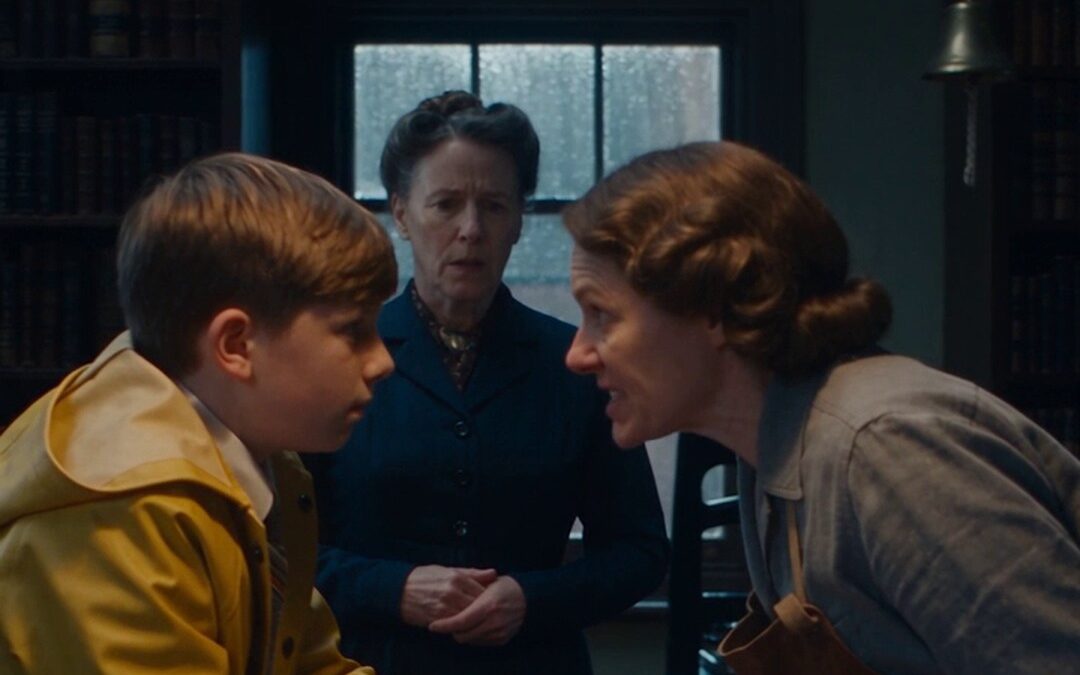
The studio occupied the back room of a narrow shop on Calder Street, where the windows rattled whenever a bus passed and the air always smelled of linen, wheat paste, and old paper. A brass bell hung above the front door. It had not rung in several seconds, but its last trembling note still seemed to hover over the worktable.
Mara Venn kept one hand on the blue book.
Noah kept both hands on the cover.
He was nine, perhaps ten, small for his age, with a narrow face and hair that needed cutting. His yellow raincoat hung open over a school sweater. One cuff had been mended with white thread. He was trying not to cry, but his lower lip moved once before he pressed it still.
Mara noticed that too.
She noticed everything around a damaged book. A torn hinge. A careless thumbprint. A wet corner. The direction of a crease. Damage always told the truth about the hand that made it.
The pencil marks on the cover were not random. Three squares. A slanting line. A second square partly erased by paste. Noah had drawn them with the stiff concentration of someone copying a shape from memory.
Across the table, Mrs. Bell said, “Noah, let go.”
The boy did not.
Her voice softened when she spoke to him, but her eyes remained fixed on Mara. Mrs. Bell was Noah’s foster mother, though she preferred “guardian,” as if a more formal word could give the arrangement stronger walls. She had brought him into the shop because the library was closed for repairs and because, in her words, “He needed somewhere quiet.”
Mara had been repairing a nineteenth-century atlas when she saw Noah beside the blue book.
The blue book had been on the highest shelf.
No one was supposed to know it was there.
“Where did you get that?” Mara asked.
Noah looked at the cover.
“The stool.”
“What were you doing on the stool?”
“Looking.”
“At what?”
He glanced toward the back wall, where a row of tools hung in exact order: bone folders, awls, brushes, knives, rulers, clamps. The room had been arranged by Mara’s hands for so many years that even dust seemed to settle according to her rules.
“I saw the knot,” he said.
Mara’s fingers tightened against the leather.
The red thread was still around his wrist.
It was not a bracelet. It had been tied in a sailor’s stopper knot, except for one loop pulled through the center, making a small uneven diamond. Elias had invented the variation when they were apprentices. He used it to mark books waiting for a second inspection. If the knot stayed intact, the work was not finished.
Most people would have seen a piece of red string.
Mara had seen Elias.
She had not seen that knot in twelve years.
“Who tied it?” she asked.
Noah’s gaze dropped. “My dad.”
Mrs. Bell closed her eyes briefly.
Mara looked at her.
“You knew?”
“I knew he had it,” Mrs. Bell said. “I didn’t know what it meant.”
“You could have told me.”
“I didn’t know it meant anything to you.”
The sentence landed badly. Mara heard the small cruelty in it, though Mrs. Bell had not meant any. To the world, Elias Ward was a name on a brass plaque in the town archive, a man who had gone missing while mapping old footpaths along the northern ridge. To Mara, he was the person who could identify a book by the sound of its spine opening.
The blue book lay between them.
Its leather was darkened at the corners and soft from handling. Along the fore edge, tiny pale scratches crossed the blue dye. The title, stamped in fading gold, read: FIELD NOTES FROM THE NORTH ROAD.
Elias had begun it in the year they planned to leave Calder Street. They were going to travel from town to town, repairing schoolbooks and church ledgers, teaching anyone who wanted to learn. The journal contained measurements, sketches, names of villages, lists of tools.
On the last written page, Elias had drawn a map that ended in a blank margin.
Then he disappeared.
Mara had spent twelve years preserving the book exactly as he left it.
No one touched the cover.
No one opened the clasp.
No one asked what she was waiting for.
Noah’s fingers shifted.
The paste had dried in a cloudy stripe over the title. Some of it had soaked into the leather. The pencil had pressed hard enough to leave shallow grooves.
Mara could repair it.
Of course she could repair it.
She could lift the paste in small layers, soften the adhesive with controlled moisture, brush the leather fibers back into place, and retouch the missing gold. The pencil marks could be reduced without erasing the impressions beneath them. The book might look almost untouched by morning.
But Noah’s hand was still on the cover.
“You wrote the word,” Mara said.
He nodded.
“Why?”
“Because the book didn’t have one.”
“What does that mean?”
“It means it was waiting.”
Mrs. Bell stepped forward. “Noah.”
He flinched at his name, but he did not release the book.
Mara saw the moment he decided not to hide behind the adult beside him. His shoulders rose. His chin lifted, although his eyes remained uncertain.
“My dad said you would know,” he said.
The room changed.
Not dramatically. No one gasped. The bus outside groaned away from the curb. A brush rolled from a tray and stopped against a jar.
Mara heard only one word.
“Your father?”
Noah nodded.
“He said if I ever found a book with a red thread, I should bring it here.”
Mrs. Bell looked at him sharply. “You said your father gave you the thread.”
“He did.”
“When?”
Noah’s thumb rubbed the knot. “Before he left.”
“How long ago?”
He shrugged.
Mara watched the movement. Not evasive. Uncertain. A child measuring time by birthdays, school terms, and winter coats.
“Where is your father now?” Mara asked.
Noah looked at the blue book.
“I don’t know.”
It was not the answer Mara expected, though she had no idea what answer she had expected.
The red thread brightened against his wrist.
She remembered Elias’s hands. Long fingers, broken thumbnail, ink under the first knuckle. He had always tied the thread around a person’s wrist when asking them to remember something important. Once, when Mara was twenty-three, he had tied one around her wrist before leaving for a week in the western villages.
“Don’t untie it,” he had said.
She had laughed. “You think I’m going to forget you?”
“No,” Elias had replied. “I think you’ll decide you’re finished before I am.”
He never came back from that trip.
Mara had untied the thread after three months.
The memory passed through her so quickly that nobody could have seen it. Still, Noah studied her face as if he had been waiting for a change.
“You know him,” he said.
Mara looked at Mrs. Bell.
“Where did you get this boy?”
Mrs. Bell’s expression tightened. “That is not how you ask.”
“Then ask it for me.”
“Noah came to us last spring.”
“From where?”
“Porter House.”
Mara knew the name. A temporary children’s home near the railway yards. She had repaired their donated books for years without meeting the children who used them.
“His father’s name?”
Mrs. Bell hesitated.
“Noah,” she said, “you don’t have to explain anything.”
The boy stared at the cover. “His name is Elias.”
The room seemed to lose its practical light. The lamps still burned above the tables, yellow and steady, but Mara felt as if the windows had gone dark.
“Elias what?” she asked.
Noah swallowed.
“Ward.”
The apprentice at the press made a small sound and immediately looked down.
Mara’s hand left the book.
She moved backward once. The edge of the stool struck her calf. For a moment she thought she might sit, but she refused to let the room see her fall into a chair over a name.
Noah watched her with guarded hope.
“You said your father left,” Mara said.
“He left before I was born.”
Mara’s breathing changed.
Mrs. Bell said, “Noah has been told very little. His mother died when he was small. His father was listed as unknown.”
“Unknown,” Mara repeated.
“We found some things in a storage box.”
“What things?”
“A coat. A notebook. The thread.”
“Where is the notebook?”
Noah’s grip on the book loosened by a fraction.
“I lost it.”
“When?”
“Yesterday.”
“Where?”
“On the bus.”
“What did it look like?”
He frowned. “Brown. It had a broken corner.”
Mara looked toward the blue book.
The pencil squares were not a child’s invention. They were a notation Elias used when marking a route on a map. Three squares meant a building with a basement. The crooked line meant a road that had been closed or erased.
Noah had not drawn a picture.
He had copied a map.
“Why did you put paste on the book?” Mara asked.
His cheeks colored.
“I thought the cover was coming off.”
“Where?”
He pointed to the lower edge.
Mara bent over the worktable. There, beneath the dried paste, was a narrow separation in the leather. It was almost invisible. A seam along the board had opened by less than a millimeter.
Noah had not smeared paste across the book because he was playing.
He had tried to repair it.
The realization did not make the damage disappear. It made the damage more difficult to hate.
“You used book paste?” Mara asked.
“It was in the jar.”
“You put it on the leather.”
“Yes.”
“Why didn’t you ask?”
Noah glanced at Mrs. Bell.
“She said not to bother you.”
Mrs. Bell’s face changed. “I said you were busy.”
“That means not to bother.”
“I did not mean that.”
“It sounded like it.”
Mara almost smiled, but the expression never reached her mouth.
She had heard Elias say the same thing. Not in those words. He believed every instruction had a hidden shape, and children were the only people honest enough to trace it.
A bell rang at the front of the shop.
Everyone turned.
The door opened, and an old man entered carrying a parcel wrapped in brown paper. He stopped when he saw the gathering around the worktable.
“Am I early?” he asked.
“No,” Mara said.
Her voice sounded normal. That frightened her more than if it had broken.
The old man placed the parcel on the counter. “I brought the ledger.”
Mara nodded toward the front room. “Leave it there.”
He looked at the blue book. “Is that Elias’s?”
Mara did not answer.
The old man understood anyway. Everyone in Calder Street knew about the book. They also knew better than to mention it.
He left without another word.
The bell settled.
Mara returned to the worktable.
“Take your hand away,” she said to Noah.
His face emptied.
“I’m sorry.”
“I didn’t say you were in trouble.”
“You said take it away.”
“I need to see the damage.”
Noah slowly lifted his hands.
The cover remained beneath the cloudy stripe, the word WAIT visible through the paste. Mara took a bone folder and angled the book toward the lamp.
The leather had been stained, but the paste had not reached the paper block. The clasp was intact. The spine, though worn, had held.
She examined the pencil marks.
The first square had been drawn on the upper left of the cover. The second sat below it. The third was beside the title. A crooked line connected them, ending at the lower seam.
The final square was beneath the paste.
Noah had tried to repair exactly the place where the mark ended.
“Where did you learn this symbol?” Mara asked.
“From my dad’s notebook.”
“What else was in it?”
“Names.”
“Whose names?”
“I don’t know.”
“Did it have mine?”
He hesitated.
That was answer enough.
Mara felt something cold move through her chest.
“Did he write my name?”
“No.”
“Then how did he tell you to come here?”
Noah looked toward the front window. Rain blurred the street beyond it.
“He said you would recognize the knot.”
“Why?”
“He said you were the only person who knew where the last page belonged.”
Mara stared at him.
Mrs. Bell’s face had gone pale.
“Where is the last page?” she asked.
Noah shook his head.
“He didn’t tell me.”
“What did he tell you?”
“He said the book would tell you.”
Mara almost laughed. It would have been a harsh sound, so she stopped it before it formed.
Elias had always loved leaving riddles where a direct sentence would have done.
But he had not left Noah.
That thought arrived without permission.
Mara closed her eyes.
Twelve years ago, the northern ridge had been searched for six days. Snow covered the trail. Elias’s pack was found beneath a cedar tree, along with a compass, a thermos, and three unfinished book repairs. His body was never recovered.
People said he had fallen into a ravine.
Mara had never accepted the absence of proof, but grief eventually learned to live beside uncertainty. She had kept the journal sealed because opening it felt like agreeing that the story had ended.
Now a boy with Elias’s knot stood on the other side of the table.
Not Elias’s son, perhaps. The name could be coincidence. The thread could have come from anyone. The symbol could be copied from a notebook with no connection to the past Mara had built around it.
But the way Noah held the book was familiar.
Elias never held a fragile thing by its edges.
He held it as if its center mattered most.
Mara drew a breath.
“Where did your father live?” she asked.
Noah shrugged. “Different places.”
“Where did he live last?”
“In a room over a bakery.”
“Which bakery?”
“The one with the green door.”
“There are four.”
“The one that smells like burnt sugar.”
Mara knew it.
The bakery stood at the end of North Lane, near the old tram bridge. Its owner was a woman named Celia Reyes, who had been sixteen when Elias disappeared. Mara remembered seeing Elias speak with her once, the week before he left. He had been carrying a bundle of maps.
“Did your father leave anything else?” Mara asked.
Noah looked at Mrs. Bell.
She nodded.
“Tell her.”
“There was a key.”
“What kind of key?”
“Small. Brass. It has a number.”
“Where is it?”
Noah touched the pocket of his raincoat.
Mara extended her hand.
He did not place the key in it.
“It’s mine,” he said.
The words were quiet but firm.
Mara lowered her hand.
“All right.”
“If I give it to you, you might keep it.”
“I might.”
“You keep things.”
The apprentice at the press looked up.
Mara studied Noah.
The boy had not said it accusingly. He said it as a fact. She kept things: books, tools, letters, broken promises, rooms arranged exactly as they had been when someone left.
“I do,” Mara said.
“Dad said you would.”
“What else did he say?”
“That you don’t give anything back once you decide it belongs to you.”
Mrs. Bell stepped in. “That’s enough.”
Noah’s face tightened. “He told me to ask her.”
“Your father told you a lot of things for a man who wasn’t there.”
The words were sharper than the room could hold.
Noah’s eyes filled.
Mrs. Bell immediately looked ashamed, but the damage had happened. She reached for him.
He moved away from her and knocked against the worktable.
The blue book slid toward the edge.
Mara caught it.
The movement was quick, instinctive. She caught the book with both hands, pressing her palm over the paste-stained cover.
Noah froze.
Mara froze too.
The book had opened.
Not fully. The clasp had sprung loose, and a narrow fan of pages lifted from the back, revealing the inside cover. Between the leather and the pastedown was a thin folded sheet, yellowed at the edges.
Mara saw the handwriting before she saw the words.
Elias.
The letters leaned forward as if trying to get somewhere.
She did not touch the paper.
Noah stepped closer.
“Is that it?”
Mara held the book open with one hand. “No.”
“But it’s a page.”
“It’s part of the cover.”
“Does it say where the last page is?”
Mara did not answer.
The folded sheet had been hidden in the inner board. She had repaired the cover three times since Elias vanished and had never noticed it. The fold was too neat to be accidental.
At the lower corner, Elias had drawn the same three squares.
Mara’s throat tightened.
The mark on the outside had been a copy.
The one inside was original.
She could read only the first line.
If Mara finds this, it means I was too late.
The rest disappeared beneath the fold.
Mrs. Bell moved toward the window. “We should go.”
Noah did not move.
Mara looked at him.
His fear had changed. He was no longer afraid of being punished. He was afraid that the thing he had carried all this way would be taken from him before he understood it.
Mara recognized that fear because she had lived inside it for twelve years.
She folded the cover closed.
Noah’s face fell.
“I need to examine it alone,” she said.
“You said you wouldn’t keep it.”
“I said I might.”
“That means you will.”
Mara set the book on the center of the table. Then she took the key from his coat pocket.
Noah’s hand rose too late.
Mara held the key between her fingers.
It was small and dull, with the number 17 stamped into its round head.
The mark on the blue cover pointed toward the lower seam.
Three squares. A crooked line. Number 17.
She knew the place.
The old municipal archive beneath the courthouse had seventeen iron lockers. Elias had rented one during the year they planned to leave. Mara had forgotten because she had stopped going there after he vanished.
Or perhaps she had chosen to forget.
“Where did you get this?” she asked.
“It was in the notebook.”
“Did your father say what it opened?”
“No.”
“Did he say when I should use it?”
Noah looked at the pencil word on the cover.
“After you saw the knot.”
Mara glanced at the red thread.
Its loop was loose now. The boy had worried it with his thumb until one strand had begun to fray.
“Untie it,” Mara said.
Noah stepped back.
“My father said not to.”
“He also told you to bring it to me.”
“He said not to untie it.”
Mara placed the key beside the book.
“Then leave it.”
The boy looked from the key to the book, making his own decision.
He pulled the thread tight.
Mara watched the knot bite into his skin.
“Does it hurt?” she asked.
“No.”
“Elias always tied them too tight.”
“You knew him.”
“Yes.”
“Was he good?”
The question was so direct that Mara had no shelter from it.
She could have said yes. She could have given Noah the clean answer children were owed.
Instead she said, “He was generous with his time and careless with other people’s waiting.”
Noah considered this.
“Was he good?”
Mara looked at the hidden page inside the book.
“He tried to be.”
That seemed to satisfy him more than praise would have.
The rain thickened against the window.
Mara took a cloth from the drawer and gently covered the blue book. Then she opened the studio door leading to the front shop.
“Celia Reyes is still at the bakery,” she said. “We’ll go there first.”
Mrs. Bell stared at her. “You’re taking him?”
“I’m asking him to come.”
Noah looked at Mara.
She did not reach for him.
That mattered. He noticed.
“I want to see the locker,” he said.
“Then you’ll see it.”
“And the page?”
“When I can read it without tearing it.”
“Will you show me?”
Mara looked at the book.
“Yes.”
Mrs. Bell shook her head. “Mara, this is not your responsibility.”
“No,” Mara said. “It is mine.”
The words surprised her.
For twelve years, she had treated Elias’s unfinished life as an object on a high shelf. She had preserved it, guarded it, and refused to let anyone alter its condition. But preservation was not the same as care. Sometimes it was only a polite name for fear.
Noah put his hand on the blue book again, but this time he did not try to hold it back.
Mara wrapped it in unbleached linen and tied the parcel with ordinary twine. She did not use red thread.
At the front counter, the old man’s ledger waited beneath the lamp. The apprentice stood beside it, watching.
“Should I close?” he asked.
Mara looked through the rain-streaked glass at Calder Street.
The courthouse stood six blocks away. Beyond it, North Lane ran toward the bakery with the green door. Somewhere beneath the courthouse, a metal locker held whatever Elias had placed there before walking into the snow.
Perhaps the locker would be empty.
Perhaps the key would not fit.
Perhaps the page inside the book would contain only another unfinished instruction.
Mara had spent years making peace with questions she could not answer.
She no longer knew whether peace was what she wanted.
“Close at six,” she told the apprentice.
Mrs. Bell gathered Noah’s raincoat around his shoulders.
The boy looked at Mara. “Are you angry?”
Mara held the wrapped book against her chest.
“Yes,” she said.
Noah lowered his eyes.
“At me?”
“No.”
“At my father?”
Mara looked at the red thread around his wrist.
“I don’t know yet.”
They stepped into the front shop. The bell above the door gave one clear note as Mara unlocked it.
Outside, the rain had washed the street clean enough to reveal old chalk marks beneath the gutters. Three squares. A crooked line. The shape was everywhere once you knew how to see it.
At the corner, Noah stopped.
“What if the locker is empty?” he asked.
Mara looked toward the courthouse.
“Then we find out what he wanted us to notice.”
“And if it isn’t?”
Mara’s hand tightened around the book.
“Then we decide what to do with what he left.”
Noah nodded.
They crossed the street together, not touching.
Behind them, the bookbinding shop grew smaller in the rain. Inside, the worktable remained under its yellow lamp. The jar of paste stood open. The bone folder lay beside the cloth Mara had used to cover the blue book.
On the table, beneath the lamp, one loose strand of red thread had caught on the edge of the cover.
Mara had not seen it.
The wind from the closing door lifted it gently, drawing a thin line across the leather toward the place where the hidden page waited.